




Stop Japan from killing whales
Australia's Environment Minister Ian Campbell probably spoke too soon. Days out from the crucial vote, Campbell declared that Japan's push for the International Whaling Commission (IWC) to end its 20-year moratorium on the Southern Ocean Whale Sanctuary was doomed. But voting was doggedly close throughout every session of IWC's meeting in St Kitts and Nevis in the Caribbean. Anxieties soared and tempers flared between anti and pro-whaling states flared as they jockeyed for fence-sitters support.
Critics charged Japan was buying votes. Anti-whaling nations threatened to make their foreign aid conditional. Tuvalu finally sided with Japan, amid charges that Tokyo had promised to fund its infrastructure development. Prime minister Maatia Toafa threw his hands up in disbelief. Togo went to the summit and paid its US$10,000 dues in cash. Tuvalu wasn't alone: Antigua and Barbuda, Dominica, Grenada, St Kitts and Nevis, St Lucia and St Vincent and the Grenadines joined 27 other states in voting to end the moratorium on hunting whales.
Australia's Environment Minister Ian Campbell probably spoke too soon. Days out from the crucial vote, Campbell declared that Japan's push for the International Whaling Commission (IWC) to end its 20-year moratorium on the Southern Ocean Whale Sanctuary was doomed. But voting was doggedly close throughout every session of IWC's meeting in St Kitts and Nevis in the Caribbean. Anxieties soared and tempers flared between anti and pro-whaling states flared as they jockeyed for fence-sitters support.
Critics charged Japan was buying votes. Anti-whaling nations threatened to make their foreign aid conditional. Tuvalu finally sided with Japan, amid charges that Tokyo had promised to fund its infrastructure development. Prime minister Maatia Toafa threw his hands up in disbelief. Togo went to the summit and paid its US$10,000 dues in cash. Tuvalu wasn't alone: Antigua and Barbuda, Dominica, Grenada, St Kitts and Nevis, St Lucia and St Vincent and the Grenadines joined 27 other states in voting to end the moratorium on hunting whales.
 Japanese yen, to curry favour, routinely extends from the tiny South Pacific nations to Africa, from the Caribbean to South America. Japan's record for bribing smaller, weaker nations into prostituting themselves to serve Japanese interests is legend. The smell of Japanese money wafted thickly at the IWC. Since 1998, Japan has poured no less than US$100 million in foreign aid into St Lucia, St Vincent, Antigua, Dominica, Grenada and St Kitts.
In the end the resolution passed 33-32 in favour of the pro-whalers. Japan called it a great victory. The vote does not end the hunting ban, but it does render the IWC dysfunctional, if not redundant. Ironically, the pro-whalers re-affirmed with impudence their commitment to sustainable hunting. Their word can only be as good as the possibility that countries like Togo or Tuvalu will be launching inter-galactic missions within 20 years.
Exploiting a loophole
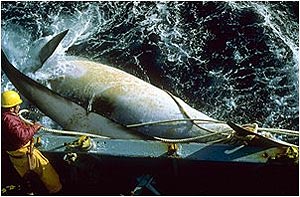
The IWC has been a dead-duck for years. Japan had been exploiting a loophole in the moratorium to hunt and kill minke whales in the Southern Ocean each year for scientific purposes. It s code for commercial hunting; nothing more, nothing less. Now a bigger calamity awaits: beginning 2007 Japanese whalers will be hunting and killing the Australian humpback specie and more minkie whales, without resile.
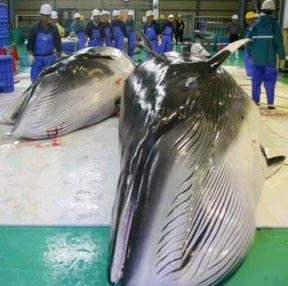 In one breath Japan says whales are hunted for scientific research. In another it says whale killings will benefit some of Japan's small coastal fishing communities. Japanese sadism is so easily justified: the ocean beasts monopolise and deplete fish stocks to the detriment of insatiable Japanese appetite. So whales are dead meat.
Two of the three possible reasons are commercial, but none will justify Japanese cruelty. These killings aren't any better than Australian farmers shooting wild rabbits and kangaroos because they destroy crops. It s no better than Canada, Norway and Iceland, who also hunt whales, or the clubbing to death of seals, including babies. Worse, these civilised nations make a sport of their barbarism, and a tourism focal point.
Japan, Norway and Iceland have killed 2,500 whales in the past 12 months. That's more than in any year since the ban came into effect. The Japan Whaling Association (JWA) says it strongly believes that [whales] should continue to be protected . But the caveat emptor, inevitably: On the other hand, there are species which are abundant enough that marine management is needed, such as the Antarctic and northwestern Pacific minke whales and northwestern Pacific Bryde's whales. This is justification enough for Japan to murder whales.
The JWA employs a curious ploy for further validation of its whale killing. Citing the late Dr EJ Slijper, a world authority on cetaceans ... it seems improbable that an animal which propels itself mainly with its tail should need a more highly developed brain than, for instance, a monkey which uses all its limbs so skillfully.
On a similar note, Dr Margaret Klinowska, a professor of Cambridge University and a member of the Specialist Group of the IUCN Species Survival Commission, said that in most species of cetaceans, the brain is neither very large nor especially complex, adding that whales betray little evidence of behavioral complexity beyond that of a herd of cows or deer.
Outright deception
This makes it perfectly alright for Japan to hunt and kill whales anywhere they find them, in any number they desire, in the name of scientific research of which less than 10% is research, and less than half of that of any practical or intellectual use.
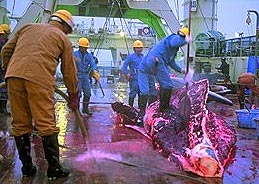 This is outright deception, sanctioned by the Koizumi government. It reveals, indubitably, and in the most hideous way, how sections of Japanese society continue to behave in a modern, civilised world. There s nothing civilised about Japan's whaling operations: it is barbaric. Like the blood of innocent victims of World War II Japanese militarism on its hands, now Japan indelibly wears the blood of whales.
The world has a moral and ethical duty to protect all marine life from callous human predators. Japan has become the chief menace for the sustainability of the world s physical environment. It has plundered tropical jungles and forests everywhere to sustain Japan's building industry. Never mind the consequences for the world's or those nations' ecology, as long as Japan s remains pristine and virgin.
Japan need not bother with bogus research on this either. But if Tokyo wants another research body, here's an idea: set up a research institute for Japanese baloney.
MANJIT BHATIA, an academician and writer, is also research director of AsiaRisk, a political, economic and risk analysis consultancy in Australia. He specialises in international economics and politics, with a focus on the Asia-Pacific.


Are you sure you want to delete this comment?
This action cannot be undone.