




When faith becomes a political show (Part II)
In early May this year, Yu Jie, Li Bo Guang and Wang Yi, the three Christians in mainland China who happen to be human rights activists and members of an independent pen club, excluded the non-Christian Guo Fei Xiong, a fellow activist and writer, from a meeting with President Bush in the White House.
Yu later stated that the meeting was a "wonderful Christian fellowship with Bush", a "brother in Christ", hence it was inappropriate for Guo to join in. Quite understandably, Guo felt slighted and a dispute between the Christian and the non-Christian writers ensued.
In early May this year, Yu Jie, Li Bo Guang and Wang Yi, the three Christians in mainland China who happen to be human rights activists and members of an independent pen club, excluded the non-Christian Guo Fei Xiong, a fellow activist and writer, from a meeting with President Bush in the White House.
Yu later stated that the meeting was a "wonderful Christian fellowship with Bush", a "brother in Christ", hence it was inappropriate for Guo to join in. Quite understandably, Guo felt slighted and a dispute between the Christian and the non-Christian writers ensued.
I certainly cannot speak for other fellow believers, but I personally see the whole thing as a farce. To make amends with his non-Christian comrades, Yu explained that Christians in China and the underground churches, who refuse to join the official churches sanctioned by the Communist government and hence operate clandestinely, had been praying for a good six years for a chance to meet with Bush.
 When the prayer was finally answered, the 'audience' was taken as a 'miracle'. Whether or not this was truly so is not my concern. But it is rather puzzling to know that the persecuted Christians in China should derive their strength from a hope to be received by an American president.
Jesus says in the Bible that whoever wants to be the first must also be willing to serve others. But the US has been growing increasingly arrogant and self-important besides burning bridges rather than making peace since Bush entered the White House with no dram of humility.
The Christian Right may see saving the vulnerable brethren around the globe as their own divine calling, but they may not remember the Old Testament warning that even Israel was to be forsaken in light of its numerous injustices.
Lip service
The incident that involves Yu and the others only highlights the dilemma of the Chinese Christian world. Since the wealth and primacy of the US is (mis)interpreted as symbols of God's blessings, there are always those who feel honoured to be invited to the prayer breakfast at Capitol Hill, although the entire thing reeks of nothing but politics. Needless to say, the number of those who seek fervently to meet with US political leaders and figures is great too.
It is commendable that Chinese intellectuals are earnestly searching for their country's future. Sadly, many of them also hope to get an answer from in the sole superpower. Zhu Xue Qin, a renowned liberalist scholar, once said the Chinese only paid lip service to anti-Americanism.
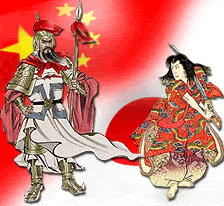 This is because in comparison to Japan, with which China has unfinished historical feuds and enmity, the US cannot be said to have wronged the Chinese. More importantly, as a superpower, the US, so much more than Europe that is made up of a host of small nations, is a model for China in its peaceful ascension as a global power.
I am not here to fan up more "substantive" anti-American sentiments. Rather, it is high time the human rights activists and the independent writers, the Christians included, do some soul- searching as to why, from economics to technology, the phenomenon of de-Asianising and Americanising is ubiquitous in China.
I fully respect the personal faith of US leaders. What makes me feel uneasy is their tendency to turn it into a political means. Even some conservative writers such as Kevin Philips are alarmed by a self-righteous theocracy in the US.
Yu and others have met with Bush. So what? And what is the big deal now that Guo did not make it? But the loser's scorn has indeed betrayed the extent of his dependence on the idea. By quarreling over this trivial matter, they seem to be of the opinion that Christians can only find their examples in American politicians.
Beautiful footsteps
By waging a war of words, Yu and his comrades are sending the time-honoured message that Christians are no different from the non-believers, all too human and prone to politicking and manipulating.
Should this materialistic curse remain, the Christian eyes may continue to be fixed on the American leaders even when the latter have turned their attention to the weak and the needy, contrary to what is said in the Bible that one should see Jesus through the 'least of my brethren'.
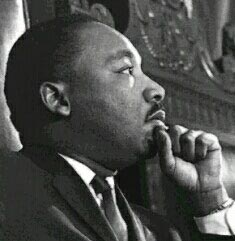 Many individuals have transformed the world one way or another, but what really strikes a chord with others is the changes through non-coercive power. The Civil Rights Movement in the US began with a simple act of defiance on the part of Rosa Parks, with Martin Luther King Jr., another fellow Christian, taking up the leadership role later.
Many Christians and theologians only learn the Sermon on the Mount as head knowledge and academic subjects, but Mahatma Gandhi lived it out, eventually overcoming evil with good and ending colonialism in India.
When the German church succumbed to the xenophobic regime of the Nazis, Dietrich Bonhoeffer stood his ground and resisted, for the sake of the purity, independence and freedom of the faith. He left such beautiful footsteps for others to follow in.
All these legendary freedom fighters have bequeathed us values and notions that are more worthy of our effort to preserve and to promote rather than the city-on-the-hill rhetoric of the Christian Right. As Tony Campolo, an evangelical activist in the US has said, if coercive power is the symbol of justice and righteousness, Jesus would not have come as a baby in a manger, but as a Caesar ready to rule the earth.


