




Politics - where stupidity is no handicap
The adage 'old habits die hard' wisely point to a general truth about the innate nature of Man. Some historians relish the quote when they tell you that 'history repeats itself', with a twinkle in the eye that denotes the silent message, 'I told you so'.
They probably do so to give credence to their profession, while telling us that we should appreciate history more by drawing wisdom from it.
And rightly so. Malaysian voters should be more acknowledgeable about the personal history of our politicians.
The adage 'old habits die hard' wisely point to a general truth about the innate nature of Man. Some historians relish the quote when they tell you that 'history repeats itself', with a twinkle in the eye that denotes the silent message, 'I told you so'.
They probably do so to give credence to their profession, while telling us that we should appreciate history more by drawing wisdom from it.
And rightly so. Malaysian voters should be more acknowledgeable about the personal history of our politicians.
Historians seldom hold the clue or the key in their explanations as to why certain politicians continue to repeat history during their tenure of leadership.
Is it due to the peculiar innate character of political actors that cause repeated scenarios in history or that the electorate is at fault with their choices in the selection of political leaders? Should Malaysian voters set an 'emotional quotient' test for future political candidates to ensure better or wiser choices?
The famous French conqueror Napoleon Bonaparte, though, held the contrary view that "in politics, stupidity is not a handicap".
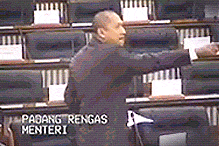 While there are no absolute answers to these complex questions, many Malaysians are fed up with the disgraceful behaviour of some of our elected representatives in Parliament.
As one aggrieved writer put it: "This chap (Minister in the Prime Minister's Department Mohd Nazri Abdul Aziz, photo ) has no respect for the elderly per se . I once saw a video of him in Parliament shouting and yelling at the top of his voice referring to some of the parliamentarians as racists."
Wrong choice?
Has our political culture deteriorated to a level whereby the 'wrong' type of leader is always being chosen? Is the electorate at fault for always making the wrong choice?
Perhaps the legacy of the Chinese philosopher Confucius' teachings can shed some light on this. During his lifetime under imperial rule, he was asked: "What should the ruler do, to make the people believe in the ruler?"
Answered Confucius: "Choose upright men and put them above the crooked, and the people will believe in you; choose crooked men and put them above the upright, and the people will not (believe in you)."
This is confirmed by the Chinese philosophical thought, Ri jiu jian ren xin (the passage of time will unfold the true character of the person).
Another Chinese idiom advises us Jian shan yi gai, ben xing nan yi (It is easier to change the characteristic of a huge mountain than to change the character of a person).
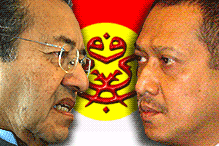 Hence, the recent emotional outburst of Mohd Nazri against former premier Dr Mahathir Mohamad was merely a repeat of history. It was neither new nor surprising. It is said that those who disregard the past are bound to repeat it.
Acting like a hero, Nazri at a recent press conference in Parliament hurled verbal brickbats and rhetorical brass knuckles at Mahathir, challenging him to leave Umno.
"If he remains in the party, he is acting like the opposition. It's better for him to be a jantan and leave the party, become the opposition. Then it's easier for me to attack him. Now if I want to fight him, I will hesitate because he is the ex-PM," Mohd Nazri was quoted as saying.
Previous outburst
What we see today is not merely history, but a repeat of history.
More than a decade ago, in October 1994, newspapers carried front-paged a story headlined Nazri minta maaf (Nazri offers apology), with the sub-heading explaining Tiada niat singgung perasaan Dr M (No intention to hurt Dr M's feelings)
Umno veterans should recall the 1994 episode surrounding Mohd Nazri's own emotional outburst against Mahathir in connection with the resignation of a former Malacca chief minister. Rahim Tamby Chik from all government and party posts.
According to news reports, this came a day after Mahathir linked the resignation to a plot by certain members to oust Rahim for their own political interests.
Interestingly, Mohd Nazri threatened to quit from his post as acting Umno Youth head. The episode triggered an avalanche of criticism against him from senior party leaders who said he was rude and that his remarks were "uncalled for and disrespectful".
One leader accused Nazri of "over-reacting". A veteran publicly chastised him, saying "a politician must be mature and not react to statements the way (Mohd) Nazri did".
Mohd Nazri finally gave in and apologized to Mahathir and even described the latter as having a "big heart" for accepting his apology.
Wise men say that "to apologize is to lay the foundation for a future offence".
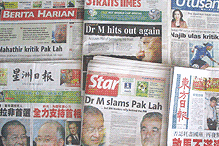 How true it was in Mohd Nazri's case, as he has been condemned for his latest emotional outburst against Mahathir over the latter's criticism of recent government decisions.
An unidentified person wrote in a blog site: "Not only Tun Mahathir is annoyed by Nazri's sudden outburst with the most arrogant tone of irrational criticisms in his heroic encounter with the media at Parliament House, I as one of his friend in Umno, like many others, walked out from the sense with a sense of disappointment and disgrace." ( sic )
Another wrote: "I think those who had accused Tun Mahathir Mohamad of harbouring the support from PAS members are politically and socially immature in their stupid criticisms against a normal courteous behavior, more so to our former prime minister. Being nationalistic as well as a true Malaysian, I feel a prime minister belongs to the people and not members of the party that rules the government. In short Tun Dr Mahathir and Pak Lah do not belong to the Malays or Umno alone, but also to the many patriotic people all over the country." ( sic )
Withdrawal symptoms
Political creatures should learn from Mother Teresa's advice to her followers, "Kind words are short.but their echoes are endless". But the most telling lesson Malaysian voters probably have learnt from the political landscape is of a moral nature.
How a political party treats an important member-cum-leader of its own family, and a former prime minister at that, is crucial. It also raises grave and pertinent questions as to how leaders of other component parties have treated their own family of challengers who have democratically chosen to stand against incumbents during party elections.
 How many good leaders have been marginalised, sacrificed and waylaid in the name of power struggle? Are these weaknesses and characteristics of our political culture worth preserving? Are these political practices and associated values compatible to our ideals of moulding a 'first-class mentality' where leadership by example is merely lip-service?
Instead of addressing major issues and the probing questions raised by Mahathir, certain leaders have preferred to generate a lot more heat than light. The latest political scene is reminiscent of a National Geographical Society documentary showing family-like crocodiles during a drought, fighting each other for greater space inside a shrinking water pool. Smaller or younger crocodiles bite and tear older crocodiles without any sense of respect and gratitude to their own kind.
It is becoming increasingly difficult for ordinary Malaysians to find trustworthiness in our political leadership. Understandably, many withdraw completely from what is happening around them. The type of political leadership has become a sham and a shame to all Malaysians.
Indeed, Plato expounded the truth when he said, "one of the penalties for refusing to participate in politics is that you end up being governed by your inferiors".
There is so much good in the worst of us,
And so much bad in the best of us,
That it ill behooves any of us,
To say anything about the rest of us.
STANLEY KOH is a Buddhist monk and works for a local think-tank.


