
COMMENT | Going back to the Rukun Negara
COMMENT | We are a country with deep fault lines. Issues of race, religion, language, culture and other differences within our society have always existed.
We are constantly trying to manage these conflicts within our society. By and large, we have been successful. The last major sectarian conflict was more than 50 years ago, and fortunately, our foundations have been strong enough to withstand the challenges that have surfaced.
The advent of social media over the past decade or so have enriched our democracy, but it has also brought about new ways for conflicts to come to the fore.
We have been conditioned to believe that laws are a panacea to all our social ills. Any issue or conflict that arises we think must be dealt with by state intervention through the enforcement of laws. But laws exist to deal with those that go beyond the limits of wrongs - the extremes of what we as a society deem "acceptable".
Laws also inherently require the state to step in. We, through our representatives in the legislature, empower the state to take action to deal with those who go beyond the limits.
Laws, therefore, can and have been abused...
COMMENT | We are a country with deep fault lines. Issues of race, religion, language, culture and other differences within our society have always existed.
We are constantly trying to manage these conflicts within our society. By and large, we have been successful. The last major sectarian conflict was more than 50 years ago, and fortunately, our foundations have been strong enough to withstand the challenges that have surfaced.
The advent of social media over the past decade or so have enriched our democracy, but it has also brought about new ways for conflicts to come to the fore.
We have been conditioned to believe that laws are a panacea to all our social ills. Any issue or conflict that arises we think must be dealt with by state intervention through the enforcement of laws. But laws exist to deal with those that go beyond the limits of wrongs - the extremes of what we as a society deem "acceptable".
Laws also inherently require the state to step in. We, through our representatives in the legislature, empower the state to take action to deal with those who go beyond the limits.
Laws, therefore, can and have been abused. We have seen it before with the ISA, and we are still seeing it now with laws such as the Sedition Act and Section 233 of the Communications and Multimedia Act.
How then can we deal with issues arising out of our fault lines without resorting to laws?
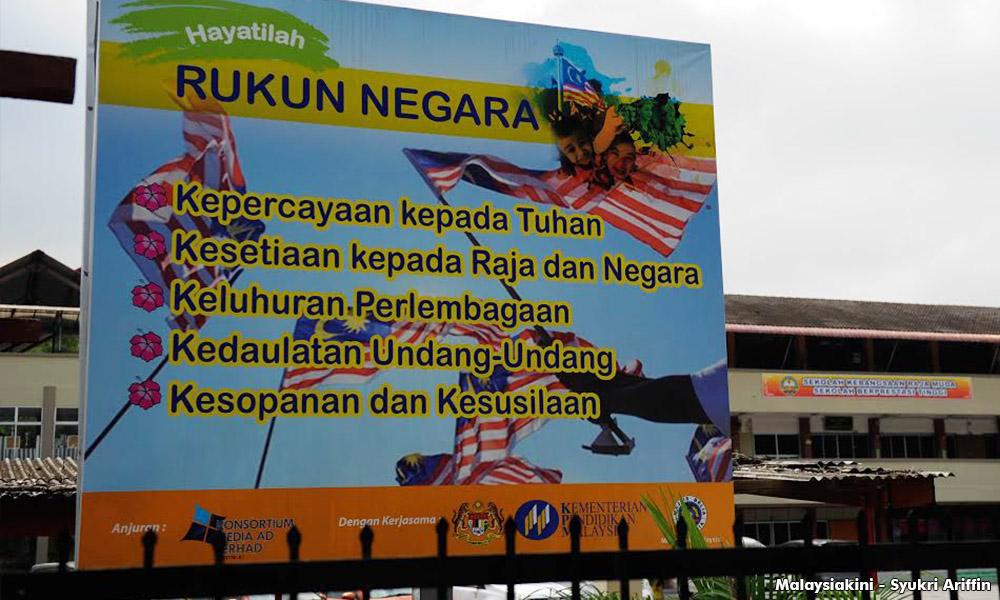
We could go back to the Rukun Negara.
The Rukun Negara provides a set of aspirations and values that we as Malaysians should adhere to. It can give guidance on how we deal with the relationship between individuals in our society, and the relationship between individuals and the State.
The Rukun Negara is not a code of laws. It is precisely because it is not a legal document that makes it a suitable guide in dealing with our issues.
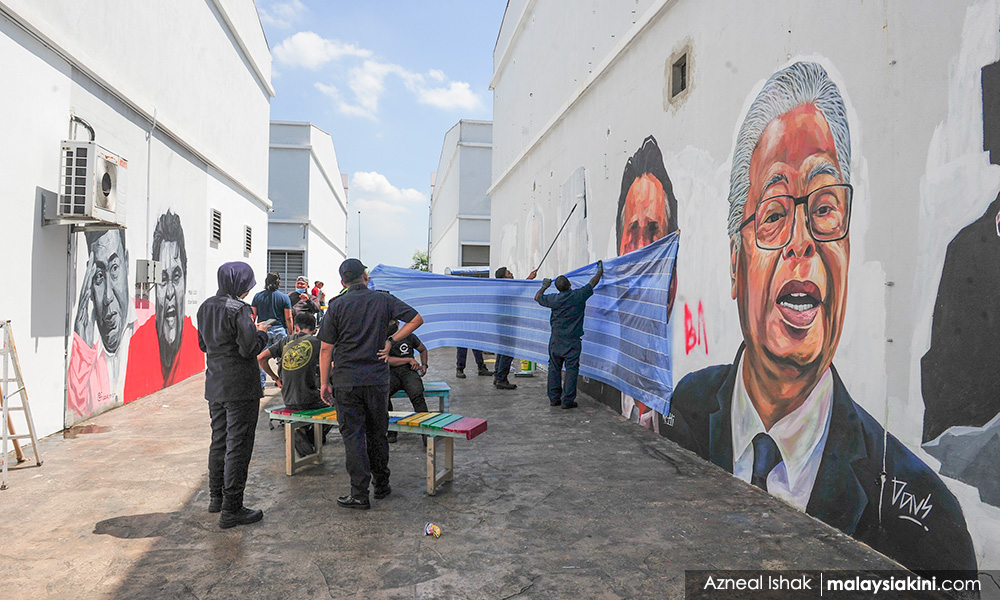
For example, the recent vandalism of the mural in Shah Alam as a prime example of an action that goes against the Rukun Negara values and principles. Rather than dealing with it with the law, if there is even a law applicable, we could instead go back to the Rukun Negara and condemn such action as contrary to our values.
Another example would be the rude heckling and insults hurled at younger members of Parliament in the Dewan Rakyat a few weeks ago. Such conduct, unbecoming of MPs, also goes against the values espoused in the Rukun Negara and should be called out as such.
When discussing the Rukun Negara, many remember Part II of the document - the principles. However, Part I or the preamble is equally if not more important than the second part. Professor Shamsul Amri Baharuddin describes it as the "soul" of the Rukun Negara.
The Rukun Negara is 50 years old. A perusal of the document reveals that the framers were incredibly forward-thinking.
Part I recites the aspirations and ambitions of Malaysians. Amongst others, it talks about creating a just society where prosperity is shared. It also talks about preserving a democratic way of life and creating a progressive society with science and technology. Aspirations which are still relevant today, half a century after its inception.
It is also an indictment of our failure that the Rukun Negara is not more appreciated in our society. Instead of being placed as a statement of our collective national ideology, it remains relegated to the back of school exercise books. Even worse, it is also being hijacked by ethno-nationalists to further their narrow agendas, quite contrary to its inclusive and progressive nature.
We must take ownership of the Rukun Negara. Yes, it may not be perfect, and a case can be made for it to be reinterpreted to fit with our changing society. The principle of "Belief in God" should not mean that those who do not believe in the concept of a god should be excluded from the national identity. Instead, the principle should be given a wider meaning - the belief or adherence to a moral or ethical code.
If we can bring back the Rukun Negara to the national discourse, we would have some guidance to some of the issues that we face.
The Rukun Negara may not be the only answer to all of our social conflicts, but it can be one of them.
SYAHREDZAN JOHAN is a civil liberties lawyer and political secretary to Iskandar Puteri MP Lim Kit Siang.
The views expressed here are those of the author/contributor and do not necessarily represent the views of Malaysiakini.