




N Korean missiles: Did US and mates overreact?
North Korea, billed by US president George W Bush in 2001 as a rogue state, has nuclear weapons. So Washington thinks. Or, at most, US intelligence services think, Pyongyang has nuclear ambitions. Prove of this is in the pudding: eight years after testing its first line of ballistic missiles, the North Korean regime fired seven Taepodong-2 missiles into the Sea of Japan on July 4. These tests had neighbours South Korea and Japan breaking out in cold sweat. After all, the Taepodong-2 has a range of up to 10,000km. That's seven times the range of the earlier Nodong missiles.
So much so, Japan and South Korea raced to Washington to seek counsel from their patron Bush. The wise monkey apparently telephoned his other wise monkey, Australia's Prime Minister John Howard, all the way up from Air Force One, to seek his counsel. The second wise monkey, being the grand old world statesman he thinks he is, thought up the mother of all coups that would bring the rogue state to the pow-wow table. Australia may sell Pyongyang cheap coal if North Korea's enlightened leader, the fruitcake Kim Jong-il who, like his dead father Kim Il-sung, has brutalised and bankrupted his nation over several decades, would give up its nuclear weapons programme.
North Korea, billed by US president George W Bush in 2001 as a rogue state, has nuclear weapons. So Washington thinks. Or, at most, US intelligence services think, Pyongyang has nuclear ambitions. Prove of this is in the pudding: eight years after testing its first line of ballistic missiles, the North Korean regime fired seven Taepodong-2 missiles into the Sea of Japan on July 4. These tests had neighbours South Korea and Japan breaking out in cold sweat. After all, the Taepodong-2 has a range of up to 10,000km. That's seven times the range of the earlier Nodong missiles.
So much so, Japan and South Korea raced to Washington to seek counsel from their patron Bush. The wise monkey apparently telephoned his other wise monkey, Australia's Prime Minister John Howard, all the way up from Air Force One, to seek his counsel. The second wise monkey, being the grand old world statesman he thinks he is, thought up the mother of all coups that would bring the rogue state to the pow-wow table. Australia may sell Pyongyang cheap coal if North Korea's enlightened leader, the fruitcake Kim Jong-il who, like his dead father Kim Il-sung, has brutalised and bankrupted his nation over several decades, would give up its nuclear weapons programme.
 Otherwise, chief wise monkey Bush says unless the United Nation's Security Council, especially its veto members, speak with one voice against the regime's latest provocation sanctions against the regime are inevitable.
Mouths frothing, the Japanese have banned North Korean officials and ships from Japan. Seoul has been mute but privately worried at North Korea's belligerence and seething at Tokyo's hawkish stance against Pyongyang. Australia's foreign minister Alexander Downer, never one to miss a media moment, proudly replicated his Washington masters tune. China felt enormously shamefaced by Pyongyang's moment of craziness. Still, true to form, Beijing called for calm.
By contrast, Russia's gangsta president, Vladimir Putin, didn't even blink. But he had time to kiss a five-year old boy s stomach because he wanted to stroke him like a kitten. Meanwhile, Bush's special envoy Christopher Hill, hurriedly despatched to crisscross the region to seek the frontline states unified voice against North Korea, came away empty handed after talks in Beijing aimed at pressuring China to press Pyongyang's boy king, with the weird hairdo and a booze potbelly, to end his stupidity.
Birthday missiles
As Bush, flanked by his neo-con cheer squad, was blowing out candles on his 60th birthday cake, North Korean chief propagandist, Kim Myong-chol, raised the gamesmanship stakes. He warned Pyongyang would retaliate against any country that backed US-led sanctions against it as a nuclear missile target.
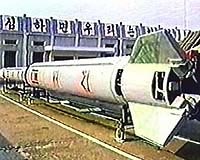 It gets better. Kim added: Now the US is seeking sanctions for us doing nothing in violation of international law. He has a point, but Washington and its allies aren't laughing. Kim Jong-il has offered celebrations to the US and happy birthday to Bush. Somehow, Washington missed the sideshow: Pyongyang likes Bush and America so much that it fired seven missiles beginning July 4 to help Americans celebrate the 1776 War of Independence.
Did the US and its North and South Pacific allies over-react to North Korea's birthday missiles? Ask North Korean apologists and they'll nod. Ask those who'd like to wipe out rogue states like North Korea and Iran, they'll say North Korea, like Iran, is a menace to world peace for conducting illegal nuclear weapons programmes. And like Saddam Hussein's regime and its secret weapons of mass destruction programme, it must be stopped.
Curiously, on July 9, India test-fired a missile capable of reaching Beijing. The US never reacted to this test. Neither did, strangely enough, India's arch enemy, Pakistan. Yet India, like North Korea and Iran, is not a signatory to the nuclear non-proliferation club. Still, Australia is keen to sell India uranium but only cheap coal to North Korea.
Sheer hypocrisy
Somewhere in the west's and Asian reactions to North Korea is a line that smacks of sheer hypocrisy and policy wonkness. India and Pakistan are let off with no more than a sideways glance than a nod: they're not rogue states and they shouldn't therefore be shackled by retaliatory sanctions.
Three years ago, Pyongyang gave Bush a golden opportunity to discuss its nuclear programme, but Bush rejected it outright. Days after the latest North Korean missiles were fired, Bush again dismissed resolving the North Korean issue through direct bilateral negotiations.
Still donning his birthday suit, Bush is hanging out for a strong chorus with Japan, South Korea, China and Russia against Pyongyang. He needn't hold his breath: China and Russia, who have veto power in the UN Security Council, have only wished Bush happy birthday. That was all the good news he got from them. It's all he'll get from the two key North Korea backers.
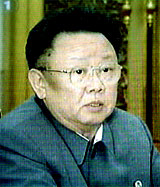 The North Korean missiles on July 4 were nothing more than Pyongyang giving America the finger. The French daily,
Liberation
, thinks so too. No doubt the fruitloop Kim likes to needle Washington, as he also does Seoul and Tokyo. He knows they're gullible poodles whose national security, like Australia's, depend on US military protection.
The North Korean missiles on July 4 were nothing more than Pyongyang giving America the finger. The French daily,
Liberation
, thinks so too. No doubt the fruitloop Kim likes to needle Washington, as he also does Seoul and Tokyo. He knows they're gullible poodles whose national security, like Australia's, depend on US military protection.
The west's and Asian reactions to Pyongyang clearly had elements of overkill. For one thing, it would take a nutter in Beijing or Moscow to provide North Korea with advanced nuclear capability, even if North Korea nakedly admits its nuclear ambitions. Even a dastardly rogue state like Pakistan wouldn't now dare incur American wrath.
Secretly sourced
So far North Korea has been kept in check. Even so, greater vigilance is needed to ensure North Korea does not develop nuclear weapons capability through other third parties, which in all likelihood could be secretly sourced from the breakaway states of the former Soviet Union. Meaning western and allied intelligence services need to have more intelligent minds than they had before and after the 9-11 attacks on America. They're duds if they didn't even know Pyongyang was set to fire missiles this month.
More comical is that the Taepodong-2 missiles also turned out to be duds. Forty-two seconds after take-off, the missiles broke up and junked into the Sea of Japan. Bloomberg's William Pesek got it right: If you re trying to spook Americans with a long-range Taepodong-2 capable of reaching Alaska, it would help if the thing worked. James Na, writing in RealClearPolitics.com, likened North Korea to nothing more than a dangerous but incompetent villain .
But had the Taepodong-2 worked, even slightly better than their embarrassing fizzle, Washington would've moved rapidly and even offer some concessions for direct bilateral talks with Pyongyang. That day might still come. But it wouldn't kill the Americans to pull their heads in, grow some commonsense if nothing else, and start talking to North Korea now rather than later. It would certainly make them look like lesser duds than North Korea's missiles.
MANJIT BHATIA, an academician and writer, is also research director of AsiaRisk, a political, economic and risk analysis consultancy in Australia. He specialises in international economics and politics, with a focus on the Asia-Pacific.


