




Burma: Being brave, breaking ground
"At present, once you become a member of Asean, generally it is a membership for life. There is no procedure or mechanism for dismissing or asking a member country to be suspended or expelled from the organisation".
So Malaysian Foreign Minister Syed Hamid Albar has declared ahead of the Asean Regional Forum next Monday, apparently erasing any possibility that Burma would ever be expelled from Asean.
In essence, this signals to Burma that no matter how abusive, despotic, or evil their government has been and will continue to be, they will always be accepted as part of the Asean brethren.
"At present, once you become a member of Asean, generally it is a membership for life. There is no procedure or mechanism for dismissing or asking a member country to be suspended or expelled from the organisation".
So Malaysian Foreign Minister Syed Hamid Albar has declared ahead of the Asean Regional Forum next Monday, apparently erasing any possibility that Burma would ever be expelled from Asean.
In essence, this signals to Burma that no matter how abusive, despotic, or evil their government has been and will continue to be, they will always be accepted as part of the Asean brethren.
In nearby Aceh, it is said that if an individual is found to be a thief, his whole family is shunned by his village. Clearly Asean does not fear that its honour will be similarly compromised by the unconditional, eternal inclusion of what is internationally recognised as a pariah state.
One could be forgiven for thinking this odd, given how we seem perfectly willing to ostracise countries like Israel, a country whose crimes are really not so different from those of the Burmese junta.
The time has come for Asean to look long and hard for anything that can justify this blind 'loyalty' and unconditional inclusion. Has either Burma or our policy of constructive engagement done anything to vindicate our good faith?
Arrogance, impunity
In the decades since the junta has taken power, there has not been a single indicator that it is at all interested in seriously reforming its human rights practices and tyrannical government. When push comes to shove, it appears the junta could barely care less what the rest of the world thinks of it.
Widespread brutalisation of its people (especially ethnic minorities), total repression of political activism and the hoarding of national resources for a precious few all continue in spite of global protests.
Every now and again, the junta will allow a diplomat such as UN Under-Secretary General Ibrahim Gambari the opportunity to visit individuals like Aung San Suu Kyi. Upon analysis however, this move costs the junta nothing, and does not compromise their position one bit; after all, which part of their discussion could possibly lead to something that might seriously compel the junta to change its ways?
Syed Hamid seems to feel differently. Taking offence at the fact that Gambari was allowed the same access which was denied to him only months earlier, Syed Hamid proclaimed that the double standard was an indication that Myanmar was disrespectful and couldn't care less about Asean or its input.
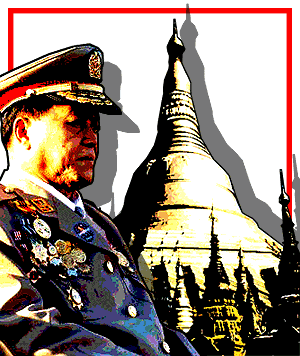 "They don't see it fit for Asean to meet Aung San Suu Kyi. I have gone to Myanmar but they did not allow me to meet Aung San Suu Kyi and other political leaders," he was reported to have said. "That is the way they deal with us."
Even more disheartening is his interpretation of this development - that Asean should keep Burma as a member, but cease efforts to encourage it to mend its ways and pass the buck to the UN.
These reactions seem to miss the point. Regardless of what access it allows which diplomat, Burma has never shown any seriousness about meeting Asean's standards of human rights and good governance.
In reality, for all important means and purposes, it has held the same attitude with the UN and the international community as a whole. How else can we explain their refusal to bend to any international pressure whatsoever?
In light of this, can we really expect the UN to achieve more simply because the junta allowed their diplomat to have a few more conversations than ours?
Lame duck responses
Burma was invited to join Asean under the policy of 'constructive engagement'. Sadly, our engagement has proved anything but. The generals continue to act with impunity, as they always have; nothing Asean has done so far would suggest we are any kind of political force to be reckoned with.
In the decade since Burma has been accepted as a member, Asean's approach to affecting change in Burma has basically been one of 'asking nicely'. When feeling inspired, instead of saying 'Change, please?' we say 'Change, please, Sirs?'
How this is expected to persuade the generals to give up the dizzying power and the sense of invincibility they have been amassing for decades and decades is again, unclear.
The futility of our efforts thus far is not lost on our leaders; most recognise that Burma has been unresponsive to Asean's overtures. When faced with a mountain that apparently cannot be conquered, the truly committed begin climbing anyway.
However, uur foreign minister's stated reaction to the lack of movement on the Burmese issue is: 'Maybe Myanmar will change if we leave them alone'.
Syed Hamid also recently proposed setting up a regional human rights mechanism to address issues arising within Asean. The truth is, however, no number of regional bodies or forums will achieve anything of use without sufficient political will; that same will which Asean has yet to show.
This is what separates a body that is sincere and committed to affecting change from a body that merely enriches hotels and convention centers.
Asean needs to step up to the plate and not only realise, but act on the fact that international principles of sovereignty were not designed to allow states the freedom to mercilessly and unceasingly brutalise its people.
Purely from the perspective of self-interest to Asean members themselves, change in Burma would stop the flow of refugees into neighbouring countries, remove the security threat of a neighboring government inclined towards violence against civilians and most importantly, demonstrate to the world that Southeast Asia does not tolerate reprehensible tyranny in its backyard.
A committed way forward
We can begin to do this by being unafraid to recognise Burma for the pariah state that it is. Continuing to accept and appease a son who continually misbehaves does absolutely no good to either us or the son.
For the sake of both justice and character development, it is our responsibility to take strong measures when wrongs have been committed. Why else would 'kurang ajar' be such a derisive term in our culture?
Constructive engagement is a noble goal, but we must be prepared to face the reality of a failed policy. Let us instead state unequivocally that violent persecution of a people is utterly unacceptable in our region, and that we will have nothing to do with governments who continue to do so shamelessly.
 If there is no procedure to expel a member state from Asean, create one is it really so difficult?
In solidarity with the suffering of the people of Burma, we should also adopt a more open and fair policy towards Burmese refugees. Thailand, like Malaysia, is not a signatory to the 1951 UN convention on refugees, but it has expanded a heartbreakingly impressive amount of energy in caring for the tens of thousands of Burmese refugees that have crossed their borders.
For other countries to follow even a fraction of this example - not blindly but with due care for the internal impact of an influx of refugees - would have an overwhelmingly compassionate effect on the welfare of the abused and persecuted peoples fleeing Burma.
The Burmese issue is an outstanding opportunity to show the world what Asean and Southeast Asians truly believe in. As a people, we should not allow governments to hide behind misunderstood notions of sovereignty and blind acquiescence.
Clearly we owe our brothers and sisters more. Clearly nothing is worth the suffering the people of Burma are forced to endure year after painful year.
NATHANIEL TAN believes things can change. He intends to work for it, and can be reached at just.clarity@gmail.com


