




Rat race to madness
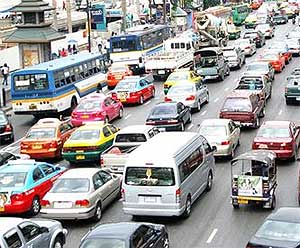
Tuesday, May 30, seemed like another ordinary day in the hustle and bustle of Kuala Lumpur city if not for an unfolding drama involving a 20-year old man having hijacked an express bus when it was caught in the traffic at Jalan Pudu. He assaulted the driver, pushed him aside and took over the wheel. Within minutes the terror ride was over with the bus crashing into a concrete pillar on Lebuh Ampang before that ramming into two other express buses, a taxi, another car and almost running over a pedestrian. When cornered by a mob who tried to capture him, the hijacker suddenly lifted his hands and started reciting prayers loudly.
There were no actors, actresses or movie directors at the scene. It was a real-life drama and the hijacker was a mere statistic of the 21 percent of Malaysians having mental disorders. Are we paying a high price in the pursuit of economic growth at the expense of other 'intangible wealth' which we are ignorant of or have chosen to ignore?
Tuesday, May 30, seemed like another ordinary day in the hustle and bustle of Kuala Lumpur city if not for an unfolding drama involving a 20-year old man having hijacked an express bus when it was caught in the traffic at Jalan Pudu. He assaulted the driver, pushed him aside and took over the wheel. Within minutes the terror ride was over with the bus crashing into a concrete pillar on Lebuh Ampang before that ramming into two other express buses, a taxi, another car and almost running over a pedestrian. When cornered by a mob who tried to capture him, the hijacker suddenly lifted his hands and started reciting prayers loudly.
There were no actors, actresses or movie directors at the scene. It was a real-life drama and the hijacker was a mere statistic of the 21 percent of Malaysians having mental disorders. Are we paying a high price in the pursuit of economic growth at the expense of other 'intangible wealth' which we are ignorant of or have chosen to ignore?
Tony Buzan, famous author for Mind-Maps in his book entitled The Power of Spiritual Intelligence posed the following questions. 'Are we becoming more and more like members of affluent societies, growing tired of the shallowness of their materialistic lives? Are we searching for a new set of values by which we live; values which emphasise a new sense of collective belonging to and responsibility for a world that is in an increasingly fragile state?'
 'Not everything that can be counted ... counts, and not everything that counts ... can be counted' said Albert Einstein. What is the best measurement in evaluating the things that can be counted but are of no value and some things that cannot be counted but are of real value? Should our quality lifestyle be merely measured in terms of 'ringgit-worth' (economic value) or be rather value-based?
Malaysian city life is becoming unbearable from rising noise and air pollution to traffic congestion. Highways and expressways that cut across residential areas are built at close proximity to residential houses, without any caring consideration by the government of the noise and dust pollution affecting the quality of life for Malaysians. Only the wealthy and super rich can own houses in quiet and peaceful environments tucked away from the hustle and bustle of the highways.
What cost?
To make matters worse, local councils lack enforcement against noisy hawker stalls operating under bridges or close to residential homes. Rampant criminal activities involving kidnap cum robberies prevailing in residential areas also aggravate mindsets concerning public safety. Recently, a minister had the cheek to insensitively propose that entertainment outlets be opened in residential areas.
No wonder our mentally disturbed population is growing.
For the sake of earning the tourist ringgit, some of our government leaders are willing to sacrifice our mental health at the expense of other concerns. Money has become the barometer of our government and creating more wealth has become an incestuous relationship between the federal and state governments, even right down to the local councils.
What cost are we paying for the development policies of our government? Let us illustrate some examples by counting our physical achievements. Our nation's productivity report in 2005 registered a productivity growth of 3 percent to RM26,255 from RM25,459 in 2004. So has our population of teenage drug addicts to almost 1,000 age ranging from 13 to 19 in 2005. The number of registered drug addicts increased to some 295,989 as of May this year. Last year, the National Anti-Drug Agency admitted that an average of 60 drug addicts were detected nationwide daily. The government spent roughly RM40 million a year on rehabilitation centers while drug addicts themselves spent about RM328 million a year on drugs.
Despite our government self-acclaimed success in economic development, the destruction of forests, air and river pollution, loss of flora and fauna species and mismanagement of natural resources are 'mentally disturbing' to any ordinary Malaysian.
Grow by all means but count the cost. The entire essence of our government is the hope to make more money, then make more money, then make lots of money with lots of money! We take great pride that our country's 40 richest businessmen (or 0.00015 percent of 26 million Malaysians) are worth a collective US$26 billion (RM95.4 billion), acclaimed to be mostly self-made, having built fortunes in diverse sectors. On the contrary, our nation over the past recent years also faced more than 30,000 reported commercial crimes involving hundreds of millions of ringgit. This exclude car thefts and other cyber-crimes in pursuit of ill-gotten wealth.
Still a rat
The trouble with our times is that the future would not what it used to be. Philosopher and reformer Amos Bronson Alcott once said, 'A government for protecting businesses only, is but a carcass, and soon falls by its own corruption and decay'. Some may think that money is the most egalitarian force in our society because it confers power on whoever holds it. It maybe true, we have so many cases illustrating the fact that we have mastered the art of passing the 'ringgit' from hand to hand until it finally disappears.
We are indeed at a crossroads, between sanity and insanity. We have sound economic strategies driving our productivity growth but equally unsound minds living in our midst. The trouble with being in the rat race is that even if you win, you are still a rat.
 Theodore Roosevelt provided this clue that '... to educate a person in mind and not in morals is to educate a menace to society'. It is said that 'Man can fail many times, but he is not a failure until he begins to blame somebody else'. Judging by this saying, our government has failed miserably in governance and in providing sound leadership qualities.
This political leadership has failed in practice, failed in being a caring and sharing government in providing the necessary environmental prerequisites for Malaysians to live an emotionally balances lifestyle. Our Malaysian lifestyle, our emotional quotient is out of balance, evidenced by the growing incidence of violent crimes, suicides, drug addiction, domestic violence, and marriage divorces.
According to the Public Health Institute (Disease Burden Department), our country has 108,324 people suffering from depression. Clinical psychologist Mahadir Mohamad disclosed that a survey from 1995 to 2000 found that depression topped the list of mental ills. The breakdown included 24,647 people having diagnosed with psychosis, 21,441 with alcohol-related mental disorders and 27,522 drug-related.
A colossal sum of RM15.3 billion was spent by the government in 2004 to manage police activities and to upkeep of our prisons. Persons seeking psychiatric help steadily increased for the past 10 years and it was estimated in 2004 that 20 per cent of 23.5 million Malaysians had mental problems. One in 10 Malaysians has psychological problems.
Armpit stink
In five to 10 years, suicide will be the second biggest cause of deaths in this country, after cardiovascular diseases. The current suicide rate in Malaysia is about 10 to 12 per 100,000 of the population (compared to Singapore's 12 per 100,000 and Thailand's 5 per 100,000).
 The Malaysian Psychiatric Association estimated that 2,500 Malaysian commit suicide every year, mainly due to depression. The reality is this - every suicide directly or indirectly affects 12 family members and friends leading to some 30,000 Malaysians traumatised by suicides annually.
But this is only the tip of the iceberg. Professional psychologists agree that there are many unreported cases and the crux of the problem is that some of us do not even know that we have mental illnesses until we 'snap', trespassing the thin and shared border between sanity and insanity.
The unsettling public might ask, 'what has happened to our humanity?' Are we not becoming more mentally callous and indifferent to daily news reports of gruesome murders and crimes? Do we not rationalise that such tragedies will not happen to us? Many of us would even put up an assurance, never mind even if it is false and pretentious, that we are fully confident of handling our stressful routines and environmental job pressures.
The government may consider our opinions like armpits, and to them, that they probably stink most of the time. On our part, we understand that the ego is our politician's silent partner, and too often with a self-vested interest. But a real leader should face the music even when he does not like the tune.
STANLEY KOH is a Buddhist monk and works for a local think-tank.


