



COMMENT | Budget must put money in the hands of the rakyat
COMMENT | Making forecasts in the middle of an unfolding economic crisis is always difficult, but unfortunately, the pessimistic forecasts we made in June, when we predicted that the economy would contract by 7.1 percent due to the Covid-19 pandemic, are proving right.
The market consensus is now catching up to what we had predicted some months ago. In August, Bank Negara revised down its forecast for gross domestic product (GDP) in 2020 to between -3.5 percent and -5.5 percent. The Asian Development Bank (ADB) revised its estimate down from -4.0 percent to -5.0 percent in September and the International Monetary Fund (IMF) revised its 2020 growth forecast down from -3.8 percent to -6.0 percent in October. Private sector forecasters are also heading toward a range of -6.0 percent to -7.0 percent as the true scale of the economic crisis has unfolded.
We also predicted a second wave of economic costs and we are seeing that now, not just in Malaysia but also around the world in Malaysia’s main export markets. Added to this, the uncertainty of the US election and the political instability here in Malaysia itself is creating a maelstrom of uncertainty within an already terrible economic situation.
Fortunately, some of our policy recommendations have been followed. There has been a 25 basis point cut in the OPR in September to 1.75 percent, but real interest rates still remain high at around 3.0 percent. An extra cash injection of RM10 billion was announced in September, but the full effect of the RM305 billion packages from the Prihatin and Penjana stimulus packages is difficult to gauge...
COMMENT | Making forecasts in the middle of an unfolding economic crisis is always difficult, but unfortunately, the pessimistic forecasts we made in June, when we predicted that the economy would contract by 7.1 percent due to the Covid-19 pandemic, are proving right.
The market consensus is now catching up to what we had predicted some months ago. In August, Bank Negara revised down its forecast for gross domestic product (GDP) in 2020 to between -3.5 percent and -5.5 percent. The Asian Development Bank (ADB) revised its estimate down from -4.0 percent to -5.0 percent in September and the International Monetary Fund (IMF) revised its 2020 growth forecast down from -3.8 percent to -6.0 percent in October. Private sector forecasters are also heading toward a range of -6.0 percent to -7.0 percent as the true scale of the economic crisis has unfolded.
We also predicted a second wave of economic costs and we are seeing that now, not just in Malaysia but also around the world in Malaysia’s main export markets. Added to this, the uncertainty of the US election and the political instability here in Malaysia itself is creating a maelstrom of uncertainty within an already terrible economic situation.
Fortunately, some of our policy recommendations have been followed. There has been a 25 basis point cut in the OPR in September to 1.75 percent, but real interest rates still remain high at around 3.0 percent. An extra cash injection of RM10 billion was announced in September, but the full effect of the RM305 billion packages from the Prihatin and Penjana stimulus packages is difficult to gauge because the Laksana reports show that the non-cash incentives may not be as effective as had been hoped because of low take-up or caution among consumers and businesses.
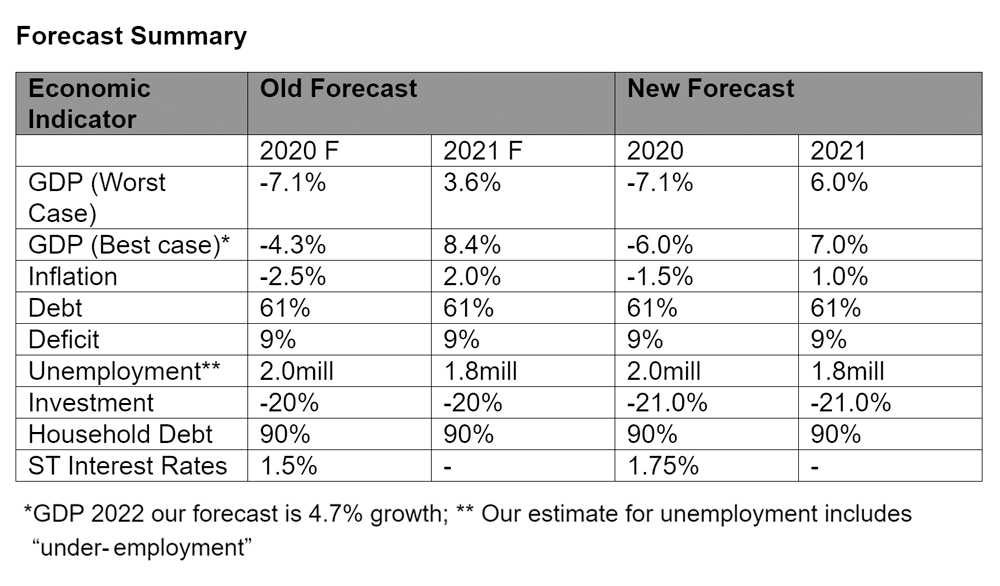
Based on the evolution of events, we maintain our previous forecast from June that the economy will contract by around 7.0 percent by the end of 2020. We have downgraded our best-case forecast to a 6.0 percent contraction based on the current scenario, which is worse than the 4.3 percent contraction we forecast in June.
Consumption hit by lower disposable income
This downgrade in the best-case scenario mainly reflects the deterioration in the Covid-19 situation and the impact of that on the two main components of domestic demand. Consumption has been heavily affected by lower disposable income due to the reduction of workers in productive employment. Investment has suffered from lower spending by firms and we expect overall investment to contract by 21 percent by the end of the year.
The effects of the downturn mean that the previous level of GDP at the end of 2019 will not be reached again until the second half of 2021 and overall GDP will be about 8 percent below where it would have been without Covid-19. In technical terms this is more like an “L-shaped” contraction, with any hope of a “V-shaped” recession all but over.
On a more positive note, we have raised our forecast for economic growth in 2021 from 3.8 percent to 6.0 percent, but this will be weak growth, largely dependent on an improvement in the international economy and a technical “dead-cat” bounce in the domestic economy.
This more optimistic outcome is also dependent on there being no further deterioration in the Covid-19 pandemic and a stable outcome of political uncertainties domestically and internationally.
We must also remember the long-term impact on the Malaysian economy from the decline in investment, the impact on human capital development due to the disruption of education and the hollowing-out of many sectors due to the closure of firms that will never re-open. This is likely to cause mass under-employment, disguised by the official unemployment figures. We predict that around two million Malaysians will be unemployed or under-employed this year as a consequence of the Covid-19 crisis.
These factors will damage the long-term growth potential of the economy and harm economic competitiveness. We expect that growth in 2022 and successive years will be under 4 percent per year, on average, due to the reduced growth potential caused by the Covid-19 crisis.
In terms of inflation and prices, we expect that the risk of deflation will extend into 2021. Nonetheless, we have revised our forecast for headline inflation for 2020 upward to -1.5 percent and we forecast 1.0 percent inflation in 2021. Given this deflationary environment, we maintain our target of 1.5 percent for the OPR to help stimulate the economy at a time when inflation is not a worry.
Budget recommendations
Against this backdrop, it is clear that the government’s response in Budget 2021 on Friday is crucial if we are to avoid economic contraction into next year and beyond.
We believe that the budget should not focus on a “wish-list” of spending, such as the 6,600 suggestions announced by the Finance Minister earlier this week. This is bad policy and mainly helps vested interests. It is also much too slow and will not trickle-down directly into the marketplace, where it is needed immediately.
Instead, it is clear that we need an immediate and direct cash injection into the wallets of ordinary Malaysians, to be spent quickly and as they choose – on the urgent priorities that are affecting their lives now.
We had previously calculated that an extra RM50 billion is necessary immediately. This is roughly equivalent to RM1,500 for every man, woman and child in Malaysia and is needed urgently to offset the decline in consumption and to offer some much-needed demand for firms struggling with the absence of customers.
This is also the best way for the government to create a “budget for jobs”. It is not the job of the government to create artificial jobs – it is the job of the government to create the environment for real jobs to flourish. Demand-side support for short-term recovery and to protect existing real jobs should be prioritised over job-creation or training schemes. Supply-side reform to promote long-term growth, which we expect to decline due to this crisis, just as it did after the 2008 crisis, will be necessary too – but not in this budget.
Debt stabilisation and monetisation of debt are also options to inject cash into the economy and we would like to see a further easing of monetary policy through the monetisation of debt, perhaps beginning with the PTPTN debt portfolio. This will reduce the burden of debt overall and there may not be a better time for the government to take this bold opportunity.
PAOLO CASADIO, HUI HON CHUNG and GEOFFREY WILLIAMS are economists at HELP University based in Kuala Lumpur.
The views expressed here are those of the authors/contributors and do not necessarily represent the views of Malaysiakini.



Report this comment
Are you sure you want to delete this comment?
This action cannot be undone.