




Mahathir fades, but Mahathirism thrives
The week that started Monday Aug 16, 2006 will probably go down in history as the turning point that marked the final eclipse of Dr Mahathir Mohamad as a political power in this country.
 Malaysians must have been taken by surprise by the sudden turn of events that saw the former autocrat stumble and Umno's top hierarchy swinging unequivocally to the side of Prime Minister Abdullah Ahmad Badawi.
How did it happen? Wasn't Mahathir doing just fine upon his return from London when he merrily stepped up his offensive in tandem with new repressive threats against the media spearheaded by his loyalist Zainuddin Maidin (minister of information) while the rest of Umno remained largely quiet? What happened since then that caused the table to turn against Mahathir so suddenly? To understand how this came about, let us trace the events on that fateful week.
The week that started Monday Aug 16, 2006 will probably go down in history as the turning point that marked the final eclipse of Dr Mahathir Mohamad as a political power in this country.
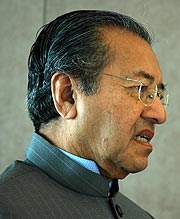 Malaysians must have been taken by surprise by the sudden turn of events that saw the former autocrat stumble and Umno's top hierarchy swinging unequivocally to the side of Prime Minister Abdullah Ahmad Badawi.
How did it happen? Wasn't Mahathir doing just fine upon his return from London when he merrily stepped up his offensive in tandem with new repressive threats against the media spearheaded by his loyalist Zainuddin Maidin (minister of information) while the rest of Umno remained largely quiet? What happened since then that caused the table to turn against Mahathir so suddenly? To understand how this came about, let us trace the events on that fateful week.
On Monday (Aug 7), Abdullah gave his first TV interview to defend himself since Mahathir embarked on his onslaught. That was a lacklustre interview. In particular, Abdullah's denial of nepotism and cronyism involving his son and son-in-law lacked credibility. However, Umno leaders led by deputy premier Najib Abdul Razak gave their polite endorsement to Abdullah's position, as expected.
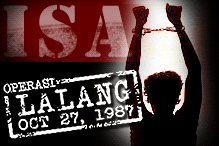
On Wednesday (Aug 9), perhaps encouraged by Abdullah's weak showing, Mahathir revved up his attacks by accusing ministers of corruption and Umno leaders of money politics and threatened to reveal relevant evidences, one at a time. At the same press conference, he also washed his hands off the infamous Operasi Lalang crackdown on dissidents in 1987.
On Friday (Aug 11), Najib broke his lukewarm stance by making his first unequivocal declaration of allegiance to Abdullah. Using unusually colourful expressions, he said in spite of rumours to the contrary, he was giving Abdullah his full and undivided support and promised to be the best deputy possible and to stand by him. He added, just because there is a storm brewing, don't think I will abandon the ship .
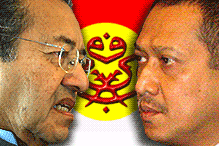 Saturday Aug (12): a chorus of Umno ministers voiced strong support for Abdullah while criticising Mahathir.
Monday (Aug 14): a media blitzkrieg against Mahathir. Newspapers splashed front page headlines carrying frontal attacks against Mahathir by Umno ministers across the spectrum. Mahathir scrambled to deny any attempt to topple Abdullah.
On Tuesday (Aug 15), Najib urged that all parties cease to air the Mahathir issues forthwith, saying there should be a finality to the issues. Significantly, Khairy Jamaluddin, son-in-law of Abdullah and Umno Youth deputy chief, acknowledged Najib's call as a directive, to which he pledged his compliance.
Since then, news on the Mahathir challenge seems to have largely disappeared from the newspapers.
Fatal errors
It is not difficult to see from the abovementioned events that in his tussle with Abdullah, Mahathir made the fatal error of treading on the most sensitive spot of the Umno hierarchy - corruption. His threat to reveal evidence of corruption - one at a time - must have unnerved and angered his former colleagues. After all, who among them could lay claim to a clean slate, right up to the very top? Mahathir's misstep must have been an important contributing factor that tipped the balance.
In fact, Mahathir made more than one blunder in the Aug 9 press conference. He lost the last vestige of his credibility when he shamelessly denied the undeniable - his role in Operasi Lalang. For it has been common knowledge that Mahathir was the mastermind behind that black operation that placed his crown beyond challenge, but crippled democracy, the scars of which are still felt today.
His blatant denial had therefore infuriated the liberals as well as disillusioned the moderates. And so in one stroke, Mahathir alienated the left (the liberals), the central (the moderates) and the right (the Umno juggernaut).
 Another important observation we can make is the pivotal role played by Najib in the entire episode. Note the avalanche of support for Abdullah that followed Najib's crucial declaration of allegiance to the former, and also note how the curtain on the entire episode was lowered a few days later by a directive from Najib.
It should be clear who has been calling the shots. It is also apparent that Najib's power has not been diminished as a result of the eclipse of his mentor, Mahathir, thanks no doubt to Najib's astute judgment in pouncing on the right occasion to make the decisive move.
With Mahathir fading from the radar screen, will Abdullah set sail for his promised land of reforms that had kindled so much hope in the early days of his premiership? Apparently not. In fact, he seems to have all but forgotten his earlier promises. This is evident from the way he used the term 'walk the talk' a few days ago, not to refer to his much avowed reforms but to rolling out the Ninth Malaysia Plan (9MP).
(For one fleeting moment, my spirit was elated when I saw The Star 's headline on Aug 6: 'PM: Time now to walk the talk' , naively thinking that Pak Lah had finally decided to bite the bullet to fulfill his electoral pledges, only to be disappointed seconds later when I found out that Abdullah's so-called walking the talk had nothing to do with reforms.)
Miserable record
Ironically, Abdullah's miserable record as a reformer is mercilessly reflected in the comical swapping of roles between himself and Mahathir recently - Mahathir attacking Abdullah for suppressing media freedom and corrupt practices. These were the very vices of the Mahathir era on which Abdullah built his reform platform that enabled him to romp home with unprecedented electoral victory two and a half years ago.
Granted, Mahathir might have been talking nonsense on the crooked bridge and mv Agusta issues, but his shrewd allegations of nepotism and corruption in relation to Abdullah's son and son-in-law were on the dot.
 As finance minister himself, Abdullah could not escape the taint of conflict of interests and favouritism in the rather one-sided reverse takeover of government linked investment company Avenue Capital Resources Bhd by the relatively small ECM-Libra Bhd which was associated with son-in-law Khairy. Further, there is no denying that ECM-Libra Bhd's earnings had been lifted through Khairy s political influence, as exemplified by its underserved role as co-host of the Malaysian Global Road Show to London and New York led by Abdullah himself in September 2005, when ECM-Libra, as a small domestic outfit, obviously lacked the required international networking to qualify for such a prestigious undertaking.
As for Abdullah's flat denial of his son Kamaluddin's Scomi Group having involvement with government linked projects, evidences fly in Abdullah's face of such involvement as large contracts received from national oil company Petronas, national railway KTM Bhd and national power company TNB, and other multi-million ringgit projects under active pursuit such as the Penang Monorail System and mass fabrication of buses for the state-owned transport company Syarikat Prasarana Negara Bhd. Under such circumstances, Abdullah's ill-advised declaration of non-involvement has only widened his credibility gap.
Raising our gaze from the businesses of Abdullah's close ones to the larger picture of the 9MP, which lately seems to have consumed Abdullah's premiership completely, what expectations can we have of this master plan? Will it salvage Abdullah's premiership from the present doldrums both economically and politically? Or will it be like 9MP's scandal ridden predecessors characterised by the prevalence of corruption, delayed completion, cost escalation and defective structures?
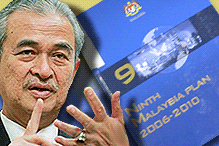 As Abdullah rolled out his long anticipated master plan recently, the initial signals emitted by him were disappointing. On Aug 2, Abdullah announced with big fanfare the approval of the much heralded second bridge and monorail for Penang island. Unfortunately, he also announced in the same breath that the 24km long bridge, estimated to cost RM3 billion, had already been awarded to the politically favoured UEM Group without tenders and without creditable reasons.
Such dubious awarding of probably the single biggest and most glamorous project in 9MP on the opening bang of the master plan is not exactly exhilarating news for investors and the general public who had been watching intently how Abdullah intended to 'walk the talk' on his earlier promise to award all projects under 9MP through open and transparent tenders safe some exceptional cases for reasons of security or exclusive technology.
Close on the heel of the above award, was another announcement of a pre-determined contractor for another prestigious project, this time the monorail for Johor Bahru. A little known company, Jalur Mudra Sdn Bhd, announced on Aug 8 that it was arranging finance as well as finalising the
technical aspects in preparation for the launching of this project. So bang! Another major project gone without tenders within days!
People are beginning to wonder: will it be status quo a la Mahathir for the rest of the 9MP?
Mahathirism thrives
In fact if one looks around for signs of change in governance from the Mahathir era, one cannot fail to observe that nothing seems to have changed.
Take for instance Abdullah's political hot potato at hand - the nutty issue of how to appease the racially-inspired resentment against Singapore-based Parkway Holding Ltd's controlling interests in Malaysian healthcare group Pantai Holdings Bhd. At the core of the controversy are two 15-year concessions in healthcare supplies and services granted by the Malaysian government to Fomena and Medivest. These are lucrative monopolies awarded without tenders to bring long term enrichment to the politically favoured in the name of NEP, in this case granted to Mahathir's son Mokhzani during Mahathir's reign.
 Now that these gold mines have fallen into foreign hands, this issue could naturally be exploited by those bent on reaping political capital, never mind the fact that the potential bumper profits of these monopolies had already been factored in during the transaction conducted on a willing seller to willing buyer basis.
Perhaps it would be more pertinent to ask why such one-sided monopolies were created in the first place. Were these not intended to enrich certain pre-determined individuals at great detriment to the taxpayers? Who were guilty of such fragrantly corrupt acts? But of course, our prime minister will not ask these questions. Instead, another set of politically favoured
individuals will emerge to take over these gold mines.
Another scandalous government monopoly was exposed a few days ago. A RM2 company, Lembah Sari, was quietly granted a lucrative a three-year monopoly worth RM70-100 million a year to provide security labeling to local manufacturers of cigarettes, in effect replacing the last concession held by Kod Efisien. The circumstances surrounding this monopoly are dubious as (a) it was awarded in secrecy without tender, (b) its effectiveness in combating smuggling and
fake products is questionable, and (c) its rewards are far disproportionate to the nominal services provided by the concessionaire - acting as mere middlemen to convey the equipment and ink from the Swiss-owned Sicpa Holdings SA to the manufacturers.
 As such, its existence is seen as comparable to a parasite sucking on the consumers. And as far as this corrupt practice is concerned, the only difference brought by Abdullah's administration is the change of players, not the act.
Guess who is the lucky owner of Lembah Sari? One named Haris Onn Hussein, younger brother of education minister and Umno Youth leader Hishamuddin Hussein. There are good reasons to believe that this is only the tip of an iceberg of massive acquisition of wealth by ruling politicians all over the country.
With such easy supply of enormous funds, is it any wonder why illegal money has flooded to corrupt every Umno party election as well as every state or national election in the country, rendering democracy void of meaning in this country?
And so, Mahathir may have lost the battle for power, but he can certainly find comfort in the thoughts that the system of governance created by him has continued to flourish under the leadership of his successor(s).
KIM QUEK is a retired accountant.


