




Doublespeak of rookie politicians
Politicians would be wise to remember that the spoken word is likened to a memorial tablet of their lips.
It is like an arrow shot from the bow - it cannot be withdrawn. Or, to cite another saying, once toothpaste is out of the tube, it is hard to push it back in.
Some political amateurs may think that the easiest way to popularity is to find fault and pitch one community against another.
But Confucius said: "A superior man puts rightness before courage. An inferior man who has courage but does not know rightness will become a trouble-maker."
Politicians would be wise to remember that the spoken word is likened to a memorial tablet of their lips.
It is like an arrow shot from the bow - it cannot be withdrawn. Or, to cite another saying, once toothpaste is out of the tube, it is hard to push it back in.
Some political amateurs may think that the easiest way to popularity is to find fault and pitch one community against another.
But Confucius said: "A superior man puts rightness before courage. An inferior man who has courage but does not know rightness will become a trouble-maker."
Perhaps it is also worthwhile to note Voltaire's advice that, "To succeed in the world (probably in a political career) it is not enough to be stupid, you must be well-mannered."
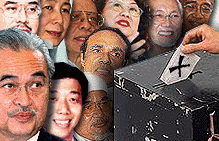 To Confucius, 'rightness' means propriety or conduct and behaviour in accordance to the role played. He meant that "the prince should behave like a prince, the minister like a minister, the fatherfather and the sonson".
Applied in the modern context, it simply means that if you are a political rookie, you should not behave like a de facto prime minister.
Among some aspiring politicians, the desperate quest to reach the top of the ladder darkens their sense of right and wrong.
A Malaysian political commentator confirmed this when he wrote in his weekly column: "It is not easy for politicians to speak the truth because, in their business, truth itself is not necessarily a good defence. So rather than telling the truth, they say what is politically correct."
But there is a new generation of political rookies who are not locally educated, having spent most of their youth abroad. They did not experienced any bonding, friendship or shared beliefs that unite the different racial communities in their growing years.
Widely perceived by others as arrogant and deceitful, some rookies aspire for high leadership positions based on their academic achievements abroad, although they are not ready to play the necessary unifying leadership role in the political arena.
Habitual practice
The recent episode of the message sent by a political rookie at the Umno Youth division meeting in Kedah is a classic example.
Nonetheless, it is not the first time that the Chinese community has been blamed or made a scapegoat. It has previously been unjustly accused as being "disloyal and unpatriotic" and even labeled pendatang (immigrants).
It has almost become an acceptable habitual political culture and mindset of certain quarters to whip up fear of one community against another to gain political mileage or advance a political career. But times have changed.
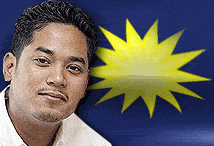 The reaction of the MCA Youth leadership was swift, demanding an explanation of Umno Youth deputy chief Khairy Jamaluddin (
photo
), who is also the prime minister's son-in-law.
The reaction of the MCA Youth leadership was swift, demanding an explanation of Umno Youth deputy chief Khairy Jamaluddin (
photo
), who is also the prime minister's son-in-law.
MCA Youth chief Liow Tiong Lai was quoted as saying that Khairy must be sincere in resolving the controversy he has created.
Whether the rookie's accusations were indeed misinterpreted is debatable. Barely a week ahead of the 49th nationhood celebrations, the Chinese community has again been put in the spotlight - it stands accused of being likely to take advantage of Umno infighting to advance its interests.
Many have criticised the recent episode as childish, amateurish and a display of political immaturity, brushing aside Khairy's justification made that his remarks were made to "uplift the spirit of followers".
Underlying this episode, it is interesting to note that the Chinese character ( hanzi ) denoting guan (official) has a graphic component symbolising two mouths. In the Chinese context, the character included politicians or leaders in government.
During the imperial dynasty civilisation, guan often referred to imperial court guards and officials and local magistrates as having 'two mouths', a sign of authoritarian rule. Many idioms linked to 'two mouths' included kou shi sin fei (saying one thing and meaning another) or kong kou shuo bai hua (double talk or empty promises).
Core difference
No civil society should be built on such a basis that allows any aspiring leader to build his political fortune by playing the racial sentiments of one community against another. There should also be no royal road to political ascension for any political rookie.
Coming of age for a political career is not a chronological matter, it should be a lifetime process. There are always signposts along the way that guide political amateurs - these are really no different from the ones that guide every ordinary Malaysian.
The process of political selection like the process of growing up, is one of accepting, testing and rejecting, of holding fast that is good - the leadership values of integrity, spirituality and self-discipline.
As Abraham Lincoln put it: "Nearly all men can stand adversity, but if you want to test a man's character, give him power."
Eugene McCarthy once described being in politics as like being a football coach: "You have to be smart enough to understand the game and dumb enough to think it is important."
 This probably explains our current political state of affairs. But a larger issue looms ahead as a political observer M Bakri Musa summed up in his recent commentary on the younger generation of Umno leaders.
"There is very little display of civility among Malay leaders, reflecting their lack of class and social finesse. Embarrassing though that might be, it does not concern me," he wrote.
"Far more consequential is that such boorish behaviors set the tone for their followers. Today, these leaders would prefer to remain quiet to the excesses and thuggish behaviour of their boorish supporters."
There is a gist of truth in this, going by historical record which lamentably illustrates that the younger generation of leaders is no better - in fact it is worse. Hence, it is not surprising that the arguments of the Melayu Baru (New Malay) compared to the 'old Malay' (once described by colonialists as "nature's gentlemen") is as controversial as their recent behaviour.
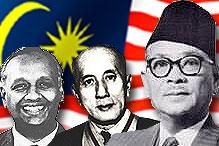 Bakri implicitly argued that the new generation of leaders lacks an ingredient found in the old generation of national leaders like Tunku Abdul Rahman, Tan Cheng Lock and VT Sambanthan whose personal chemistry helped greatly.
They were fond of one another even though they were involved in intense and contentious pre-independence negotiations. Hence, their followers (probably veterans now), seeing the pattern set by them, followed suit.
It is within this context that the spirit of unity within Barisan Nasional will never be the same as in the coalition of the Alliance.
STANLEY KOH is a Buddhist monk and works for a local think-tank.


Are you sure you want to delete this comment?
This action cannot be undone.