




A rational voice drowned out by fanaticisms
When the deadline set by the United Nations Security Council for Iran to halt uranium enrichment and to cooperate with the International Atomic Energy Agency was due, I was attending an international media event, where I met with an Iranian journalist from the Tehran-based Al-Alam News .
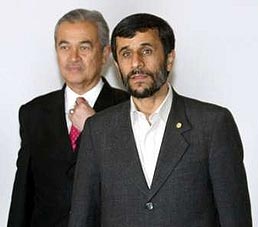
He bears a strong resemblance to Mahmoud Ahmadinejad, the president who has enraged the United States and Israel with his pursuit of nuclear technology, as well as other anti-Jewish remarks. The Al-Alam man was not bemused when I told him that, stressing time and again he was a reformist and did not vote for the 'madman' in June 2005.
"He is the last person that I want to look like." He was clearly quite piqued, and I duly apologised.
When the deadline set by the United Nations Security Council for Iran to halt uranium enrichment and to cooperate with the International Atomic Energy Agency was due, I was attending an international media event, where I met with an Iranian journalist from the Tehran-based Al-Alam News .
He bears a strong resemblance to Mahmoud Ahmadinejad, the president who has enraged the United States and Israel with his pursuit of nuclear technology, as well as other anti-Jewish remarks. The Al-Alam man was not bemused when I told him that, stressing time and again he was a reformist and did not vote for the 'madman' in June 2005.
"He is the last person that I want to look like." He was clearly quite piqued, and I duly apologised.
Mindful of the fact that his country was on the verge of being declared a pariah, he looked somewhat uncomfortable. I tried to assure him of my 'third world solidarity' by inviting him to join me for a drink. He did come, and we began our rather lengthy discussion on the current crisis facing his motherland - over a jug of Tsingtao beer.
 "Iran needs energy. The oil and gas that we have could not last forever, and we have to plan for our future generations. We may not be a rich nation, but our population is growing, in tandem with our level of population. Sooner or later, we will need nuclear reactors to generate electricity. Why is the world trying to pull our leg?"
"You must understand: Iran has a long and proud history. We still want development and progress after the revolution, not only in human rights and democracy, but in science and technology also. If the world stops us from peaceful nuclear technology now, it will, at the behest of Washington, prevent us from conducting stem cell research and developing aerospace technology as well. We would then be independent in name only. Just like Iraq today."
What about his credentials as a reform-minded, liberal, beer-drinking media professional? I could not wait to interrupt.
"Don't be surprised if I tell you I am actually attracted to the notions of democracy and freedom of the press as advanced by the US. This is why I am worried by the fanatical rhetoric often uttered by Ahmadinejad."
(On this point, I was reminded of Francis Nyamnjoh, a celebrated Cameroonian anthropologist, who once asked: "Show me a human being who does not prize freedom?" After all, the longing for freedom is in the blood of the human race, not peculiar to a particular race or nation.)
One unique experience
He then went on with a brief history of post-1945 Iran, beginning with the symbiotic relationship between the Shah family and the White House, which resulted in scores of deaths and disappearances among the dissidents. Given the anti-communist witch-hunt and hysteria at the time, many of his father's friends evaporated from public life overnight.
"We live in the different world now. It is nothing heroic for one to refresh our communist past. It would have been considered more of a bravery to join the Tudeh Party in the 1960s and 1970s for instance, than to write about its contribution to Iranian politics today."
He first thought the 1979 revolution would bring new hopes and transformation. Instead, it wrought havoc on an ancient civilisation on a scale that even the foreign forces could only dream of. Like many Iranians of his age, he became deeply disillusioned with the clerical establishment, and now regrets his act of cheering on Ayatollah Khomeini on the latter's triumphal entry into Tehran.
This unique experience has taught him a good deal about blind faith. Although he still desires freedom and liberal democracy, he is now convinced this cannot be materialised through affiliation with a particular regime, country or leader. He is now willing to sacrifice whatever goodwill he may have in the eye of the US because the dangerous foreign policy of the Bush administration is making it harder for liberals and reformists to operate within Iran.
"An honest and sincere friend is a friend who is brave and free to criticise, not to acquiesce in one's wrongdoing in order to maintain favour with Washington. So I think I am a believer in all the positive values embodied America. But I also think President Bush is as fanatic as Ahmadinejad. They are both working very anxiously to raise the stake so that they can win more support at home. I have no doubt they both want war."
A war will, naturally, rally the faltering and disenchanted masses behind Ahmadinejad. It will also boost the arms industries and powerful beneficiaries of war dividends, whose interests are represented by Donald Rumsfeld and Dick Cheney. And, yes, it will keep the so-called war strategists in their job too.
"When Ahmadinejad said Israel should be wiped off the map, I did not agree with him. But then came the Israeli offensives against Lebanon, and now I have a tough time convincing my countrymen otherwise."
Silver lining
Bahman Nirumand of the Heinrich-Boell Stiftung has recently written in the left-leaning Tageszeitung of Berlin that sanctions will only play into the hands of the hardline Islamists around Ahmadinejad, while I now have reason to believe such drastic measures will also alienate the moderates and the pragmatists who may otherwise be instrumental in producing a positive outcome, which is a more worrying scenario.
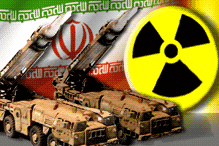 Should the US be bent on imposing stringent sanctions against Iran, it will risk tearing international consensus apart, as Russia and China appear consistently reluctant, and prefer to go the whole hog as far as peaceful solution is concerned. Both Beijing and Moscow have close strategic and economic ties with Tehran, not to mention the importance of oil and gas.
At this stage, it is not even certain if the western powers are willing to pay higher oil prices following sanctions. Being the second largest oil producer, Iran pumps 4 million barrels of crude oil and exports 2.4 million barrels per day. These figures are enough to send chill down the world's spine.
There is still some silver lining in the midst of this thick dark cloud. The foreign policy chief of the European Union Javier Solana has made it clear he will continue to engage in talks with Ali Larijani, Iran's chief nuclear negotiator, while UN Secretary General Kofi Annan has told the French newspaper Le Monde that "a little bit of patience can go a long way, and sanctions are not the end-all solution". German Foreign Minister Frank-Walter Steinmeier, concerned over mounting pressure tactics of the Americans, remains non-committal, although he makes it clear the Iranians should move in the direction set by the world powers.
As a positive sign, the US State Department has granted former Iranian president Mohamad Khatami a visa to attend a conference in Washington. By the time this article comes out, the former Iranian president will have become the most senior Iranian to set foot on American soil since the two countries broke off diplomatic relations in April 1980. Ironically, he will also have made use of the opportunity to meet with Jimmy Carter, during whose presidency the two nations became sworn enemies.
All this, of course, will be treated by the neocons as nothing but appeasement on the part of Secretary of State Condoleezza Rice. But the news so far has kept my new-found Iranian friend happy.
As we parted, the wearisome man gave me a bear hug, and I wished him and his people well. As he disappeared into his hotel room, I walked away with a heavy heart, as no one truly knew if we would wake up to find a vastly different country in Iran.


