



COMMENT | The DAP paradox
COMMENT | DAP’s biggest asset is its biggest liability.
Of all the parties in Malaysia, it can be confidently said that DAP is the only peninsular party that can be guaranteed to win a large number of seats, no matter what happens.
There is no reason to expect support for DAP to reduce significantly in any of its strongholds, no matter what happens politically in the near future.
The same cannot be said for any other major peninsular party. The success of parties like Umno, Bersatu, PAS, and PKR will depend largely on constantly evolving dynamics, alliances, and arrangements.
Almost regardless of what alignments emerge however, as long as DAP does not go into the elections taking the type of stance and positioning traditionally associated with MCA, they should still win big in all their traditional strongholds.
The question is: so what?
DAP’s success in 2018 represented the absolute limit of how far the party can go with its current configuration and branding...
COMMENT | DAP’s biggest asset is its biggest liability.
Of all the parties in Malaysia, it can be confidently said that DAP is the only peninsular party that can be guaranteed to win a large number of seats, no matter what happens.
There is no reason to expect support for DAP to reduce significantly in any of its strongholds, no matter what happens politically in the near future.
The same cannot be said for any other major peninsular party. The success of parties like Umno, Bersatu, PAS, and PKR will depend largely on constantly evolving dynamics, alliances, and arrangements.
Almost regardless of what alignments emerge, however, as long as DAP does not go into the elections taking the type of stance and positioning traditionally associated with MCA, they should still win big in all their traditional strongholds.
The question is: So what?
DAP’s success in 2018 represented the absolute limit of how far the party can go with its current configuration and branding.
The Rocket is seen as the rock-steady symbol of non-Malay political power.
Amongst non-Malay voters in the peninsula, DAP (and whoever they endorse) might command anywhere from 70% to 90% support. Brands like MCA, MIC, and Gerakan on their own likely command a negligible amount of support.
No Malay-based party comes anywhere near this level of support among the Malay electorate. The fragmentation of Malay political power is almost its defining feature at this point - with Umno, PAS, PKR and Bersatu commanding comparable levels of support.
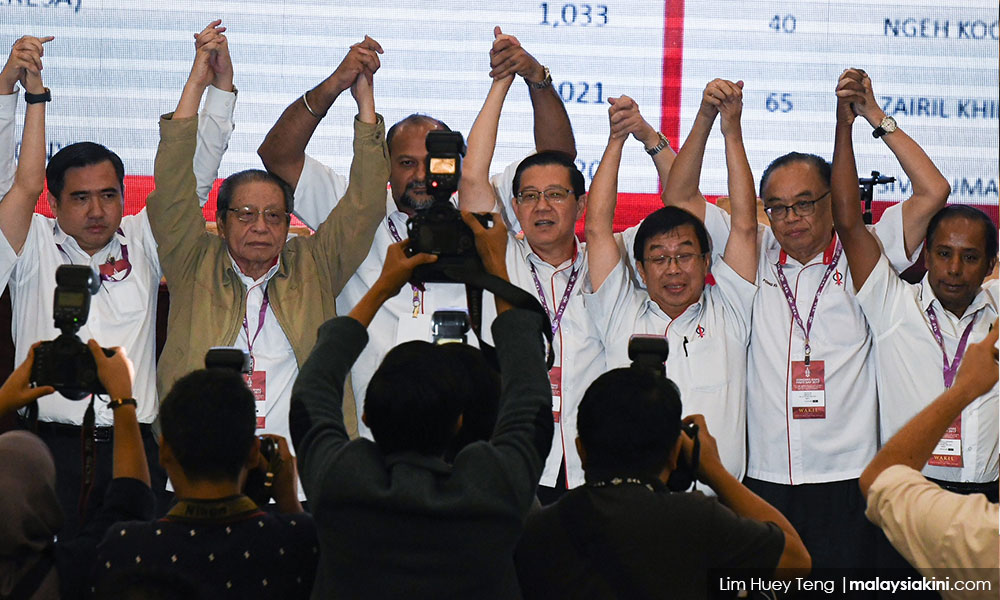
This is why DAP has always been the bogeyman. With over 40 seats in parliament, it represents an unshakeable mountain of non-Malay political power. Compared side by side to the much more fragmented Malay political power, it is always perceived and/or painted as a dire threat to the Malays.
This is also why most Malay-based political parties consistently and without fail paint DAP as the enemy they must fight against. In Malaysia’s version of a tale as old as time, the line is: these strong, threatening, united Chinese are out to get the Malays and take what little you have.
In effect, nearly every initiative DAP has taken to change this perception has failed to do so effectively. It is the one perception DAP cannot shake, no matter how hard they try (and mind you, they are trying very hard indeed).
Hobbits and The Rock(et)
I summarise it as such: if you walk into a (particular kind of) meeting where everyone else is about the size of a hobbit, and you are the size of The Rock, let’s just say it doesn’t matter what words you use to try and reassure everyone else. Those muscles speak louder than anything that can come out of your mouth.
Thus, the DAP paradox is the more seats they win, and the more powerful they become, the more of a liability they are to whoever they support as prime minister.
This factor also limits DAP’s ability to engineer meaningful change in Malaysia or reach any further heights than having its leader become the finance minister, plus a decent chunk of cabinet seats.

This scenario, such as was achieved in 2018, was the most powerful DAP had ever been in its history. But the question remains: So what? Was it really all that powerful or influential?
Due to Malaysia’s immense over-centralisation of power in the person of the prime minister, the PM’s views were the only ones that ultimately mattered, no matter what DAP or anyone else said.
Worst of both worlds
In this situation, DAP had the worst of both worlds. It had enough seats in cabinet and parliament to be painted as a serious threat to Malays while having no real influence on the decisions of the PM at the end of the day.
After 2018, Pakatan Harapan’s ‘presidential council’ was basically a waste of time and space, and a forum in which practically nothing of value was ever decided. This was simply because the council’s views held no real weight, short of threatening to move a vote of no confidence against the PM.
The moment DAP dared to voice a strong opinion on anything, they were beaten down by both sides. They were vilified by their enemies, while their allies politely explained to them why they needed to shut up for the good of everyone. This, of course, led to multiple criticisms (common to most opposition parties that finally became government) that DAP had lost its teeth.
Another major bottleneck that DAP faces is that no matter how successful it is, it will always be shopping for another Malay-led party with a credible candidate for PM to support (these days, they are even considering Umno!).
Victim of their own success
This is an unenviable position - one which puts DAP in the second fiddle position perpetually. While DAP is so fond of castigating and flogging MCA every chance they get, the truth is, politically, they are in a mirror position to MCA - different actors playing essentially the same sidekick role.
If they persist on their current path without innovating, perhaps DAP will end up like MCA was at the height of its power. However, there is every chance that the next step after that is that it will become what MCA is today.
How then, can DAP emerge from the trap of its own success? How can it retain its greatest assets without having them become a liability?
This is the larger question that DAP faces, although at the moment, it seems more concerned with the somewhat related question of its identity.
Splits within the party are becoming more evident as their elections approach. This split is sometimes described as Chinese-speaking versus English-speaking, or those more Chinese-oriented, and those more multiracial in their approach.
Perhaps this is a conflict that can be tackled simultaneously with the question of what DAP’s larger game plan and strategy should be.
Gandalf and the Enterprise
A few detailed ideas came to mind. I shared them with a colleague, who told me I’d be laughed out of the room for suggesting them.
I suppose I had thus better keep those to myself for now, unless anybody asks me for them; in the meantime, I’ll just share some views on the criteria that a long-term, innovative solution should fulfil.
What is probably impossible to achieve is the ‘best of all worlds’ for DAP.
They cannot be non-Malay led, a single unit of immense political strength, and at the true forefront of national decision-making, all at the same time. This combination simply does not work; perhaps a more workable formula (and herein may lie the real secret) is to aim for two out of the above three.
Absent major changes to their approach, I don’t think I could honestly pitch DAP any kind of rebranding exercise that I believed in my heart would change the way the Rocket is vulnerable to accusations of being a threatening Chinese power.
That brand association is simply too strong, too deeply embedded, and too much tied to DAP’s current position.
It pains me to say so because I know so many good people in the party - driven by a true and sincere desire for a better Malaysia and with so much to contribute.
When I talk to my friends about this, I find myself thinking about two nerdy sci-fi and fantasy references. The first is how Gandalf went from Gandalf the Grey to Gandalf the White; the second is how the pilot of Star Trek: The Next Generation decided to differentiate the old and new Enterprises by introducing the gimmick in which the starship separated into the saucer and stardrive sections.
In any case, if DAP is willing to explore some truly radical departures, and explore the concept of how less can sometimes be more, then there may be some innovative options available.
NATHANIEL TAN is a strategic communications consultant. Twitter: @NatAsasi, Clubhouse: @Nathaniel_Tan, Email: nat@engage.my. #BangsaMalaysia #NextGenDemocracy.
The views expressed here are those of the author/contributor and do not necessarily represent the views of Malaysiakini.









Are you sure you want to delete this comment?
This action cannot be undone.