




Rise of China, rise of Chinese M'sians?
Early this year, I happened to be in a group of grassroots MCA members (read: former Team B activists who backed the wrong horse in last year's party election and have since fallen from grace). A lady asked, "How will China's rise as a regional power help us the Chinese in Malaysia?"
Good question. But she was not the only one curious to know the implications of China's new-found prowess for the so-called overseas Chinese. One cannot fail to notice the beaming eye of some Chinese Malaysians when they talk about the phenomenal rise of China nowadays, and some facts and figures will be useful in addressing the issue.
When I first went to study in London, and tried to eke out a living by working in Chinese restaurants, the mainland Chinese that I worked with were largely middle-aged men and women, whose level of the English language was anything but desirable. Many had just survived the disastrous Cultural Revolution that left the country in abject poverty and limbo. At the end of their studies, most of them, quite naturally, chose to remain in the United Kingdom by hook or by crook.
Hong Kong Chinese, who had a head start in the UK and were well established restaurateurs, could not help showing their smug by mocking the mainland accent. Bosses who had a nasty streak often scolded their Mandarin-speaking workers in public, telling them to go back to the "great socialist motherland" if they did not like the hard job in a capitalist society. A Chinese forty-something Chinese woman from Shanghai cried before me when she was told to wash the toilet and she had been a university teacher at a respected college back home.
 Nearly twenty years later, things have changed dramatically. Today, mainland Chinese business people travelling on first or business class is a common scene. When I walked into a cinema in the upmarket Mayfair during my last visit to London, I was served by two young Chinese students in their early twenties. There was strong sense of fulfilment and confidence in their faces, aided by their almost impeccable English. They were giggling when a British man was trying to practise his Mandarin with them.
Early this year, I happened to be in a group of grassroots MCA members (read: former Team B activists who backed the wrong horse in last year's party election and have since fallen from grace). A lady asked, "How will China's rise as a regional power help us the Chinese in Malaysia?"
Good question. But she was not the only one curious to know the implications of China's new-found prowess for the so-called overseas Chinese. One cannot fail to notice the beaming eye of some Chinese Malaysians when they talk about the phenomenal rise of China nowadays, and some facts and figures will be useful in addressing the issue.
When I first went to study in London, and tried to eke out a living by working in Chinese restaurants, the mainland Chinese that I worked with were largely middle-aged men and women, whose level of the English language was anything but desirable. Many had just survived the disastrous Cultural Revolution that left the country in abject poverty and limbo. At the end of their studies, most of them, quite naturally, chose to remain in the United Kingdom by hook or by crook.
Hong Kong Chinese, who had a head start in the UK and were well established restaurateurs, could not help showing their smug by mocking the mainland accent. Bosses who had a nasty streak often scolded their Mandarin-speaking workers in public, telling them to go back to the "great socialist motherland" if they did not like the hard job in a capitalist society. A Chinese forty-something Chinese woman from Shanghai cried before me when she was told to wash the toilet and she had been a university teacher at a respected college back home.
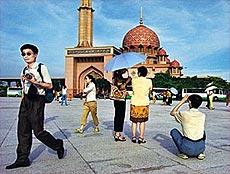 Nearly twenty years later, things have changed dramatically. Today, mainland Chinese business people travelling on first or business class is a common scene. When I walked into a cinema in the upmarket Mayfair during my last visit to London, I was served by two young Chinese students in their early twenties. There was strong sense of fulfilment and confidence in their faces, aided by their almost impeccable English. They were giggling when a British man was trying to practise his Mandarin with them.
Ken Livingstone, the leftist mayor, has made Chinese New Year celebration an official annual event of London, and the once derelict and seedy Chinatown is now being renovated. While it was dominated by Cantonese in the past, Mandarin is now a lingua franca in the "enclave". It may soon be the only one. Needless to say, flights connecting London, Beijing and Shanghai are often full. Unlike our MAS, route rationalisation is never an issue with Air China. When the routes were served by Civil Aviation of China flights two decades ago, travellers knew the acronym CAAC as "China Airlines Always Cancels".
Polishing its image
Worldwide, the economic power of the Chinese is surreal. Walk into any duty free kiosk in major German cities, one will be greeted with a notice that reads ' Wo Men Shuo Han Yu ' (We Speak Han Language). The Time magazine reports that, despite the perennial tension between Beijing and Tokyo, the number of Japanese secondary schools offering Mandarin more than tripled between 1993 and 2005, and it is now the most taught foreign language in Japan, second only to English. The same story is being told and retold in neighbouring countries like South Korea and Vietnam, and can even be heard in as far as the Canada and the United States.
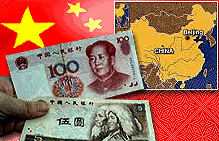 Closer to home, our Ministry of Tourism finally came to its senses and added Chinese to the signboards in several major airports across the country. More and more money changers in Kuala Lumpur now put up a sticker that says '
Renminbi Accepted
', while their counterparts in Bangkok appear more industrious in wooing big-buck Chinese tourists by saying '
Renminbi Welcome
'. The most enthusiastic are the Burmese, the Laotians and the Cambodians living close to the Chinese borders, who are more than happy to trade their weak currencies for the Chinese yuan.
Closer to home, our Ministry of Tourism finally came to its senses and added Chinese to the signboards in several major airports across the country. More and more money changers in Kuala Lumpur now put up a sticker that says '
Renminbi Accepted
', while their counterparts in Bangkok appear more industrious in wooing big-buck Chinese tourists by saying '
Renminbi Welcome
'. The most enthusiastic are the Burmese, the Laotians and the Cambodians living close to the Chinese borders, who are more than happy to trade their weak currencies for the Chinese yuan.
Joseph Nye, when articluating his Soft Power theory, famously wrote that "if you can get others to be attracted to want what you want it costs you much less in carrots and sticks".With the amazing ascendance of China in short span, these words of the Harvard professor, while remaining valid, have to be interpreted anew.
China clearly understands the massive influence of popular culture and media as agents of soft power, having been inspired by the Americans (McDonald's, MTV, CNN, Starbucks etc) and the Japanese (Manga, Hello Kitty, Karaoke, sushi etc., but not Walkman, which was invented by a German ).
After the Tiananmen crackdown in 1989, the issues of human rights and democracy became even more tied to the foreign policies of the US and the European Union. Being confronted with domestic issues at international forums and venues became routine for Chinese officials and diplomats. The situation was made worse by what was seen as "biased and malevolent" international media, represented predominantly by the BBC and CNN, which spread "untrue and distorted information with a view to painting China in a bad light".
Hence the birth of Phoenix, the first Chinese language international satellite broadcaster. Although based in Hong Kong, it is closely linked to the Chinese Communist Party. Its founder-cum-CEO, Liu Chang Le, is a former People's Liberation Army colonel and is known for his cosy relationship with Beijing. At the tenth anniversary celebration in Hong Kong recently, Liu was so carried away by the festive and joyous atmosphere that he could not helping shouting "when Phoenix does well, China will do better" while on stage.
Since its inception, Phoenix has been tasked with polishing the cultural image of mainland China. Beijing understands full well that, though it cannot change the mind of the "stubborn and prejudiced" western bigots, it must at least rally the Chinese worldwide behind it in countering the powerful English media. Judging from Phoenix's popularity today, this strategy has paid off, and Phonenix has been a success story. When the TV broadcaster sent Lv Qiu Lu Wei to cover the Iraq War in 2003, she became the first Chinese correspondent to be at the scene of a major international conflict. No doubt, she did many Chinese around the world proud, and Phoenix is increasingly being taken as a serious global media player.
Phoenix aside, Beijing has expanded the international reach of its media by upgrading the news services offered by Xinhua, its mouthpiece. Much like CNN, the BBC and the Deutsche Welle, Xinhua news are now available in several major languages, including Arabic, French, Russian and Spanish.
Meanwhile Channel 9 of the China Central Television (CCTV), broadcast in English, can be received in many countries, including Malaysia.
A new power-broker
In the early 1990s, I used to go to watch Chinese movies with my British classmates in London. From Judou , about the sorrowful fate of a Chinese woman enslaved by her feudal village life, to Raise the Red Lantern , about the tragic rivalry between mistresses and concubines in a wealthy Chinese family, the leitmotif remained the same: the dark sides of Chinese culture.
Zhang Yimou, the director of both movies, was criticised by my mainland Chinese friends for having a flair for 'washing dirty linen in public".
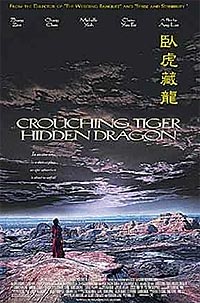 Enter the year 2000, world cinemas were mesmerised by the mystic and legendary characters in Ang Lee's
Crouching Tiger, Hidden Dragon
, and Zhang Ziyi shot to international stardom at a speed that made many Chinese dream-makers envious. As David Gosset, the director of the Shanghai-based Academia Sinica Europaea, has written in his article
A New World with Chinese Characteristics
, Zhang Ziyi, along with Gong Li and Maggie Cheung, has captured the imagination of Eureopean and American movie lovers.
Enter the year 2000, world cinemas were mesmerised by the mystic and legendary characters in Ang Lee's
Crouching Tiger, Hidden Dragon
, and Zhang Ziyi shot to international stardom at a speed that made many Chinese dream-makers envious. As David Gosset, the director of the Shanghai-based Academia Sinica Europaea, has written in his article
A New World with Chinese Characteristics
, Zhang Ziyi, along with Gong Li and Maggie Cheung, has captured the imagination of Eureopean and American movie lovers.
Sensing the changing mood of international audiences and realising the lucrative mainland Chinese market, even Zhang Yimou has begun to produce flamboyant films with grand historical backdrops, such as Hero and The House of Flying Daggers . The latest talk in town now is The Banquet by Feng Xiaogang. Yes, I will be in the queue for a ticket this weekend.
Internationally, China as an emerging power has been quietly but steadily demonstrating its clouts. To allay the fear of the regional countries, the 600th anniversary of the voyages of Admiral Zheng He was celebrated with much fanfare in Malaysia and Singapore, with a subtle message that ancient China, though an empire in its own right, was never an expansionist colonial power.
In 2005, the trade volume between Asean and China amounted to some US$130bn, only US$20bn behind that between Asean and the United States.
According to the statistics released by the China Council for the Promotion of International Trade, China-Malaysia trade volume rose 17 per cent in 2005 to reach US$30bn. The average increase between 2000 and 2005 was a staggering 31 per cent. More Chinese enterprises are on their way to invest in Malaysia, and a bilateral trade value of US$50bn by 2010 is anticipated by both KL and Beijing.
Politically, Beijing successfully exerted influence on Indonesia and Malaysia in blocking the US from patrolling the highly strategic Malacca Straits and keeping the Japanese at bay at the East Asia Summit late last year. It has also managed to pressure the Southeast Asian governments into denying legal status being given to its nemesis the Falungong movement, and minimise the official contacts between Taipei and the regional capitals.
From Africa and Latin America, the same scenario is being repeated daily around the globe. It is far cry from the days when China first opened up the door and found to its horror a world that it could barely recognise in 1979.
But will a mighty China be instrumental in improving the fate of Chinese Malaysians? This important issue will be addressed next week.


