




Of good intentions and media monopolies
With his recent acquisition of the Nanyang group of newspapers, Chinese Malaysian media mogul Tiong Hiew King now has effective control of as much as 80% of the press market in terms of readership and circulation.
Tiong is currently the owner of a good number of Chinese dailies, including the best-selling Sin Chew Daily , as well as overseas titles such as Ming Pao and Ya Zhou Zhou Kan (Asia Weekly) in Hong Kong.
 His foray into the Hong Kong market some 10 years ago has borne fruit, so much so that many readers of his newspapers there know what "Datuk" and "Tan Sri" mean in spite of their lack of elementary Malay.
Rebuking the claim by others that such a move will create media monopoly, Liew Chen Chuan, Sin Chew 's managing director, argues in the Star recently that his newspaper not only rejects monopolistic practice, it has even worked towards the ideals of democracy and freedom of expression.
Or is it?
With his recent acquisition of the Nanyang group of newspapers, Chinese Malaysian media mogul Tiong Hiew King now has effective control of as much as 80% of the press market in terms of readership and circulation.
Tiong is currently the owner of a good number of Chinese dailies, including the best-selling Sin Chew Daily , as well as overseas titles such as Ming Pao and Ya Zhou Zhou Kan (Asia Weekly) in Hong Kong.
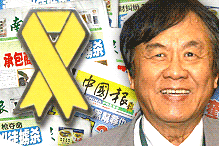 His foray into the Hong Kong market some 10 years ago has borne fruit, so much so that many readers of his newspapers there know what "Datuk" and "Tan Sri" mean in spite of their lack of elementary Malay.
Rebuking the claim by others that such a move will create media monopoly, Liew Chen Chuan, Sin Chew 's managing director, argues in the Star recently that his newspaper not only rejects monopolistic practice, it has even worked towards the ideals of democracy and freedom of expression.
Or is it?
Liew has clearly failed to answer why some prominent names from the Chinese Malaysian circle of writers and commentators are, more often than not, conspicuously absent in the Sin Chew press: Lee Ban Chen, Yang Bai Yang, Tang Ah Chai, Wong Chin Huat, Chang Teck Peng of Merdekareview and Yong Kai Peng, the editor of the Chinese version of malaysiakini , to name a few.
Their crime? Fervent criticism of Sin Chew and of media monopoly. In recent days, the above-mentioned names only appear in negative contexts.
There have also been a number of occasions when malaysiakini was quoted by Sin Chew without acknowledgment.
Double standards
When a group of students and activists held a peaceful protest outside the main entrance to Sin Chew head office in Section 14, Petaling Jaya, two heavy goods vehicles were whisked in to park outside it, shielding the Sin Chew management from the "ugly" scene.
This was bizarre. Since the day the Taiwanese took to the streets of Taipei to demand the resignation of Chen Shui-bian, the scandal-ridden president, Sin Chew has been praising the courage of the protestors as well as the spirit of democracy of the island state.
Over here, series of articles in Sin Chew have been labelling those who braced the rain to gather outside its head office as "trouble-makers". Why the double standards? Were these students and activists not exercising their democratic right to protest and to voice out their discontent, pretty much as the Taiwanese have been doing?
If one truly believes in and champions the right to peaceful assembly as an embodiment of democracy, one should also allow it to be shared universally. Such rights cannot be revoked when it is exercised against oneself, or it only amounts to nothing but humbug of politically correct jargons.
'Good intentions'
Some in Sin Chew have also defended their boss' "commercial decision" by urging the public to give the "good intentions" of Tiong the benefit of the doubt. Tiong and his apologists have said the deal was done to rescue the ailing Nanyang, to avoid cut-throat competition among the Chinese dailies, and to preserve the energy of the Chinese community. They have also said a Chinese media conglomerate is necessary to counter "western hegemony."
I would, honestly, have been more than willing to believe in all the good intentions of Tiong if not for the tragic lessons in human history.
After all, many did believe Adolf Hitler, Emperor Hirohito, Josef Stalin and Mao Zedong were great men and leaders imbued with noble ideas and good intentions. But they all shared one other common characteristic: ambition, which led to series of human catastrophes in "modern" time.
As a Christian, I am also mindful of the painful fact that many in Britain and the United States of the 1700s and 1800s who colonised the indigenous and kept slaves happened to be regular church-goers and sincere worshippers, as evidenced by the split in the Baptist Church in America, a major contributory factor being the differences over the legitimacy of slavery. Down through the centuries, the lure of temptation almost always drowned out whatever good intentions there were in individuals.
How, seriously, shall I believe mere good intentions are enough to ensure the nurturing and flourishing of democracy and freedom of speech?
Tiong is also referred to as the Chinese answer to Rupert Murdoch, but Murdoch's records are anything but exemplary when it comes to safeguarding media independence and freedom of speech.
Murdoch's relationship with Margaret Thatcher was so cozy that it enabled him to acquire the Times of London in 1981 and the Sky satellite network in 1990. The Thatcher government practically overlooked potential regulatory restrictions on these two deals.
Murdoch's disdain for the unions was well known (and the Sin Chew management in the 1980s had a knack for tackling the unionists among them also). He bought the Wapping site in London in 1986 at a cheap price, and moved the printing plant there. Infuriated and refusing to accept flexible working and no-strike demands, existing workers went on strike. New workers were recruited on terms and conditions that were much more favourable to Murdoch, and the strike died off after one year.
In 1994, alarmed at the growing influence of Andrew Neil, then editor of the Sunday Times , Murdoch sacked the latter. Neil had been extremely critical of authoritarians worldwide, including Dr Mahathir Mohamad, and Murdoch is least willing to get on the raw nerve of any of them.
In 1998, HarperCollins, one of Murdoch's publishing houses, dropped a book deal with Chris Patten, the last governor of Hong Kong. There was no love lost between Beijing and Patten, and Murdoch wanted to ensure his business ambitions in the Chinese market remained unaffected.
Clear indications
Also in the 1990s, the Times slashed its Monday edition to just 10p in order to compete with the best-selling Daily Telegraph , sold at 30p, for leadership among the centre-right readers. Such cut-throat competition, although hardly amounting to predatory pricing, raised the eyebrow of other titles and media watchers nonetheless.
The Office of Fair Trading (OFT) under the British Ministry of Trade and Industry finally found itself compelled to intervene and ruled that the Times must seek the clearance of the OFT before it would be allowed to cut its prices again. The OFT also made clear its intention to keep the British press market diverse and competitive in a healthy way.
A year ago, Axel Springer Verlag , one of Germany's biggest media mergers, withdrew its offer to buy a popular TV station under mounting public pressure and following the veto by the Commission to Investigate Media Concentration (KEK). Germany maintains strict controls on media concentration all thanks to the powerful Hugenberg publishing house in the 1920s and 1930s, which helped the Nazis to power.
Hence, the best way to prevent vicious competition is through building and improving institutions that can check and balance media conglomerates of any kind, not acquisition. The OFT in Britain and the KEK in Germany are fine examples. Granted, the records of the Malaysian government in this regard are notorious and appalling, but this does not exempt us from the obligation to seek to address and redress the deficiencies.
The examples above have clearly indicated that good intentions can only be realised with public institutions to check and balance, as one must not forget the famous saying that the road to hell is paved with good intentions too.


