




Chest-thumping unnerves non-Malays
"Malay rights cannot be challenged, otherwise the Malays will run amok and the May 13 (1969) riots will happen all over again."
"The non-Malays are challenging us, it is time to raise our voices and defend the race and Islam.''
"We are willing to risk lives and bathe in blood to defend our race and religion. Don't play with fire. If they mess with our rights, we will mess with theirs.''
These words uttered over five days at the Umno general assembly from Nov 17 have shaken public confidence in the party of not only non-Muslims but also from many among moderate Muslims.
"Malay rights cannot be challenged, otherwise the Malays will run amok and the May 13 (1969) riots will happen all over again."
"The non-Malays are challenging us, it is time to raise our voices and defend the race and Islam.''
"We are willing to risk lives and bathe in blood to defend our race and religion. Don't play with fire. If they mess with our rights, we will mess with theirs.''
These words uttered over five days at the Umno general assembly from Nov 17 have shaken public confidence in the party of not only non-Muslims but also from many among moderate Muslims.
Over a week, ethnic distrust was in the air and the racial divide widened dramatically in this constitutionally pluralistic country. Once proud of their country's tolerance, many non-Malay Malaysians are trying to figure out whether the time has come to pack their bags.
The fear and insecurity was all the more because these chauvinist utterances came not the from 'lunatic fringe' but from Umno leaders.
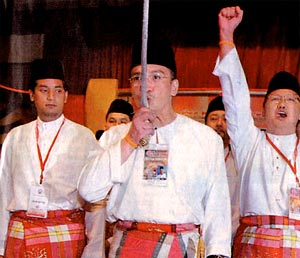 Umno meetings are widely watched by political analysts, foreign investors and diplomats because opinions expressed often translate into government policies later.
Instead of debating the faltering economy or worrying about rising religious intolerance, some Umno leaders, brandished the keris (traditional Malay dagger), thumped their chests and attacked minority Chinese and Indians for "demanding" equality and an end to the affirmative action policy that favours bumiputeras.
The floor comprising some 3,000 grassroots leaders cheered the speakers.
Umno president and premier Abdullah Ahmad Badawi, typically described as patient and mild mannered, shouted Hidup Melayu, Hidup Melayu (Long Live Malays, Long Live Malays) at the end of the meeting.
Fear and uncertainty
For some non-Muslims such public displays confirm that Islamisation and Malay ethno-centric nationalism are on the rise with Abdullah seen as either unwilling or unable to check such extremism.
 "There is now suddenly a sense of fear and uncertainty. What do these words really signify? Is this the end of Bangsa Malaysia? Malaysians feel excluded and threatened," said veteran DAP leader Lim Kit Siang.
After the shock came the balm as Umno leaders, led by Abdullah, rushed to assure the people that the speeches did not signal a hardening of government policies towards non-Malays.
They blamed the spike in public anger on the live telecast of the offensive speeches which, they said, was unfortunate.
Others viewed the live telecast as having unexpectedly given Malaysians a ringside view of "raw, unvarnished Malay anger''.
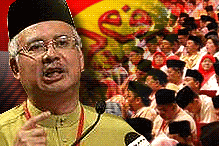 "The speeches are the work of a few disgruntled individuals not that of Umno or the government. We must not give great weight to the speeches," said deputy Umno president and deputy premier Najib Abdul Razak told
Bernama
, also assuring that the nation belongs to all races.
"The speeches are the work of a few disgruntled individuals not that of Umno or the government. We must not give great weight to the speeches," said deputy Umno president and deputy premier Najib Abdul Razak told
Bernama
, also assuring that the nation belongs to all races.
But the damage has been done and the fear and hurt runs deep despite those assurances.
"I got the message...it simply means we non-Muslims cannot question the special status of Islam and Malays. If we do, it will be met with violence," said accountant Mark Ong, echoing the sentiments of many others.
Political scientists warned that the speeches signal deep-seated grievances of the Malays, who form 60 percent of the population of 27 million. Chinese and Indians make up 26 percent and 8 percent respectively.
 Resentment is rising largely because the government's affirmative action policy has benefitted 'Umnoputras' (Malays in Umno or who are close to its politicians).
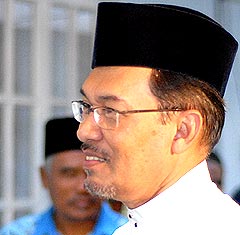
Led by opposition icon and former deputy premier Anwar Ibrahim - who was labelled as a traitor by the Umno delegates - more Malaysians also want affirmative action either ended or extended to all poor Malaysians.
After taking over in 2003 from long-serving premier Dr Mahathir Mohamad, Abdullah allowed reasonably open debate even on contentious issues like Islam and National Economic Policy.
A debate on apostasy and on the boundaries between Syariah law and secular rights has sharpened religious differences and heightened suspicion among the various races.
The debates were dominated on the one hand by non-Muslim fear of creeping Islam and on the other hand by Muslim fear that secularism and pluralism would dislodge Islam from its pedestal as the official faith.
Races drifting apart
The tensions have been worsened by a shrinking economy which has fallen from a high of 9 percent in recent years to under 5 percent this year and is projected to be lower next year. Foreign investment, a mainstay of the economy, has dropped 17 percent to just US$ 3.7 billion this year.
Abdullah is easing Malay fears over his Islam Hadhari which stresses moderation and technological and economic competitiveness.
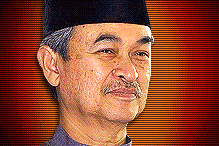 On the economic front he has changed direction from infrastructure growth to giving priority to agriculture, biotechnology and tourism as new growth areas.
But on both fronts - Islam and the economy - his directions are contested not just from within the party but also by Mahathir, who has vowed to force him down.
But Umno is dragging its feet preferring the old ways - sabre rattling, racism and continuance of lopsided policies that kill competitiveness and breed contempt for law.
With the races drifting apart, political analysts say, the Umno general assembly may well be the turning point for the country.
"We were moderate and praised for our tolerance and economic achievements. Now all that has gone (behind) a cloud," said lawmaker S Kulasegaran.
Over the Internet, the discussion is less polite and the anger palpable.
"Is it time to pack our bags again?" asked letter writer Ay Yuen on malaysiakini , where the sudden plunge in race relations is endlessly debated.
"Where do we go from here?" asked another writer, displaying the dilemma that has gripped non-Muslims in Malaysia. - IPS


Are you sure you want to delete this comment?
This action cannot be undone.