




Give Malaysians the IPCMC
As long as the Independent Police Complaints and Misconduct Commission (IPCMC) is not established, even implementing the remaining 124 recommendations of the Royal Commission to Enhance the Operation and Management of the Royal Malaysian Police will be seen as an unmitigated failure to reform the Malaysian police into a clean, efficient and trustworthy force.
 The Royal Malaysian Police (PDRM) plays an integral part in the lives and well-being of 26 million ordinary Malaysians. This is reflected in PDRM's vision statement of 'PDRM as the lead enforcement agency in upholding the rule of law, maintenance of peace, public order and national security'.
There have been high public expectations that PDRM can put behind the abuses and actions of a few black sheep that have severely tarnished PDRM's image and finally come to grips with its primary duty of combating crime to make the streets of Malaysia safe.
As long as the Independent Police Complaints and Misconduct Commission (IPCMC) is not established, even implementing the remaining 124 recommendations of the Royal Commission to Enhance the Operation and Management of the Royal Malaysian Police will be seen as an unmitigated failure to reform the Malaysian police into a clean, efficient and trustworthy force.
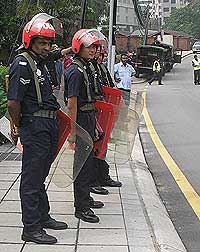 The Royal Malaysian Police (PDRM) plays an integral part in the lives and well-being of 26 million ordinary Malaysians. This is reflected in PDRM's vision statement of 'PDRM as the lead enforcement agency in upholding the rule of law, maintenance of peace, public order and national security'.
There have been high public expectations that PDRM can put behind the abuses and actions of a few black sheep that have severely tarnished PDRM's image and finally come to grips with its primary duty of combating crime to make the streets of Malaysia safe.
Public perception of PDRM is still remote from its motto of ' Mesra, Cepat dan Betul ' (friendly, efficient and correct). The time has come for accomplishing performance, integrity and accountability to return the ownership of PDRM to ordinary Malaysians. Such objectives can be largely achieved through the adoption of the 125 recommendations made by the royal commission.
When the royal commission first published its 607-page report on May 16, 2005 with 125 recommendations to reform the police, hopes were high that Malaysians can have a first-world police force that is clean, efficient and trustworthy in maintaining public safety.
Three challenges
Setting up the IPCMC was a crucial step to eliminate corruption and human rights abuses within the police. In particular to overcome the three major challenges:
The high incidence of crime and widespread public apprehension regarding safety.
Public perception of widespread corruption within the police force.
Extensive and consistent abuse of human rights and non-compliance with prescribed laws.
As the royal commission states eloquently in its mission statement:
"To transform the Royal Malaysian Police into a world class, 21st century organisation that is efficient, clean and trustworthy, dedicated to serving the people and nation with integrity and respect for human rights. This is the goal, but first the present reality: the problem of endemic corruption and abuse of power are identified as the double-headed hydra which is the enemy that has to be fought as tenaciously as the Royal Malaysian Police fought the Communist insurgents to protect our peace and stability."
The report even provided a time-frame when the recommendations have to be carried out and implemented. The first deadline for its recommendations was in June 2005 whereas the final one was by May 2010.
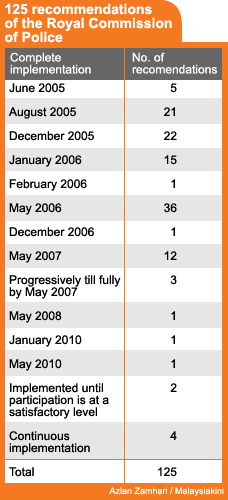 By November 2006, 100 recommendations should have been implemented. The government claims to have done one better by implementing 101 of the recommendations so far. Only 24 recommendations remains, ostensibly due to resistance from the police. However the string of police abuses of power and human rights, corruption and rise in crime index by 12.6% in the first nine months of the year undermines public confidence that there has been any effective implementation of the 101 recommendations.
Adding to these suspicion are the police's strenuous opposition and even threats to 24 of the recommendations, particularly the IPCMC. To avoid any dilatory tactics by the government, the royal commission even drafted a 104-clause IPCMC and set May 2006 as the time-frame for its establishment. The IPCMC is already overdue by six months and yet its birth is still uncertain. Certainly the failure to implement the IPCMC is the most apparent and glaring failure that erodes public confidence in the government's commitment to reform the police.
Establishment of the IPCMC is the benchmark of success to determine whether the royal commission's report had been adopted. As long as the IPCMC is not established, even implementing the other 124 recommendations will still be seen as an unmitigated disaster.
Bowing to pressure
In his policy speech at the recent Umno general assembly, Prime Minister Abdullah Ahmad Badawi spoke of fulfilling promises when submitting his report card for his three-year performance as prime minister. Failing to establish the IPCMC is one promise he failed to keep despite announcing it on Jan 24, 2006.
The New Straits Times had reported then: "The prime minister said the IPCMC would be established as soon as the Attorney-General's Chambers fine-tunes the concept. A-G Abdul Gani Patail got his orders this morning to have the proposal ready soon for implementation."
Abdullah's failure to follow up on his promise is disappointing and shows his lack of seriousness in reforming the police. Clearly the government has bowed down to pressure from the police.
 When I met Inspector-General of Musa Hassan, he cited two principal objections to the IPCMC namely the denial of natural justice through lack of recourse for appeal or judicial review on punitive decisions made by the IPCMC and a dilution of the disciplinary powers of the police which they strongly feel should be the sole preserve of the top cops within.
However, when asked if the police would stop opposing to the IPCMC if their concerns are taken into account, Musa remained evasive. Apart from paying lip service, the police is not committed towards a change in mindset to make crime reduction, eradication of corruption and compliance with prescribed laws and human rights as the top three reform priorities in the police service.
For instance, there is an urgent need to establish reasonable grounds before arrest by rejecting the "arrest first, investigate later" syndrome in the police force. The nude squat case, the serial deaths of police detainees under suspicious circumstances, arbitrary arrests under the so-called preventive laws allowing for detention without trial and the recent high profile murder of a Mongolian model which saw elite police personnel being arrested only highlight the importance of the IPCMC.
Malaysia's current ratio of police to the population is far lower than Interpol's requirement of 1:250 or one policeman for every 250 people. The ratio in Malaysia is 1:1,573. Malaysia needs at least 60,000 extra police personnel to conform to Interpol standards. The government would need to spend billions of ringgit but DAP supports such expenditure because it is our inalienable right as citizens to live in a safe society free from the threat of criminals. It is also cost-effective as the nation suffered losses of RM15.2 billion from crime alone in 2004.
However, Malaysia's present figure of 1:1,573 is even lower if calculated on the basis of crime-fighting police personnel. From press reports, there are only 8,000 police personnel in the CID to make our streets safe for 26 million Malaysians or 1:3,250. With crime going out of control in our cities where students are killed for their handphones, slashed with parang for RM2, openly robbing and carting away entire ATM machines, how much can 8,000 policemen do?
Such pessimism and distrust in the performance of the police is borne out by the latest national crime index rising by an alarming 12.6% over the first nine months this year. Minister in the Prime Minister's Department Dr Maximus Ongkili revealed that there were 170,481 cases reported from January to September 2006 as compared to 151,444 for the same period last year.
In other words, the ratio of one policemen for 3,250 Malaysians is too low. The royal commission recommended that an extra 35,000 men be redeployed from other services in PDRM for crime fighting purposes. This will beef up the crime-fighting unit to 43,000 men or 47% of the present police force of 92,000 men.
With 43,000 men fighting crime the ratio would be one policemen for 605 Malaysians, a much more reasonable ratio for the police to effectively fight crime and be closer to Interpol's recommended 1:250. Only by increasing police personnel in crime prevention from 8,000 to 43,000 or 47% of the police force, can the people feel safe that the police are serious in catching criminals.
Malaysians cannot wait for the 60,000 extra policemen which would probably only be achieved by 2020. Malaysians have a right to demand extra protection now and the only way to achieve that is by redeploying personnel from other sections of the police force, especially the Special Branch. Why does special branch need up to 7,000 personnel in the absence of the communist threat? Would not these personnel be better utilised if half of the special branch personnel are transferred to patrol the streets to catch criminals then spy on law-abiding citizens or report on peaceful and orderly meetings.
I wish to commend the Bar Council under Yeo Yang Poh's leadership for conducting a nation-wide signature campaign to promote the immediate establishment of the IPCMC. The Bar Council signature petition has attracted widespread public support and it is sad that the government continues to ignore such calls.
What else can we do if the government still stubbornly resists public calls, including from some Barisan Nasional Mps, for the IPCMC?
Bi-partisan effort
I wish to suggest a bi-partisan effort by both opposition and government MPs in Parliament to sponsor a private member's bill for the IPCMC.
If the government does not want to introduce the IPCMC Bill in Parliament, MPs can do so as a private member's bill. To ensure its success, those government MPs who support the IPCMC should prove their sincerity and commitment by sponsoring it. The time for talk is over, now is the time for action especially to prove that they practice what they preach.
The IPCMC is essential for a civil society. For far too long, ordinary citizens have been subjected to unnecessary fear by the police. There should be freedom from fear for law-abiding citizens when we deal with the police. The time has come to put some fear into errant policemen who abuse their powers. Only the IPCMC can do so.
Let us not then allow this report to gather dust and remain at best a register of the crimes, follies and buried hopes within the police but a platform of action to reform the police force into an effective and law-abiding service that not only complies with prescribed laws and human rights norms but is truly transparent and accountable to the people.
LIM GUAN ENG is DAP's secretary-general. The above is his speech at the Melaka Bar Council Committee's forum on 'Do we want an IPCMC: Yes or No?' on Nov 24.


Are you sure you want to delete this comment?
This action cannot be undone.