




Huff, puff, blow the temple down
THE fear-mongering which permeated the recent Umno general assembly may have been designed to give the impression that Malays are reacting to Islam under threat. Are they really? Or is it the other races and children of lesser Gods who feel under siege but are threatened by the powers that be to put a lid on their mutterings?
Things have certainly changed since Independence, or even since Dec 2002 when a malaysiakini reader Zaidy Zain wrote this letter to the editor. In it Zaidy reminisces: 'During my childhood, I remember the late Tunku [Abdul Rahman], the prime minister, officiating at the opening of a Buddhist temple near Bukit Mertajam. The Tunku was instrumental in getting the temple built. That deed did not diminish the Tunku as a Malay and a Muslim. Instead it built his reputation for humanity.'
THE fear-mongering which permeated the recent Umno general assembly may have been designed to give the impression that Malays are reacting to Islam under threat. Are they really? Or is it the other races and children of lesser Gods who feel under siege but are threatened by the powers that be to put a lid on their mutterings?
Things have certainly changed since Independence, or even since Dec 2002 when a malaysiakini reader Zaidy Zain wrote this letter to the editor. In it Zaidy reminisces: 'During my childhood, I remember the late Tunku [Abdul Rahman], the prime minister, officiating at the opening of a Buddhist temple near Bukit Mertajam. The Tunku was instrumental in getting the temple built. That deed did not diminish the Tunku as a Malay and a Muslim. Instead it built his reputation for humanity.'
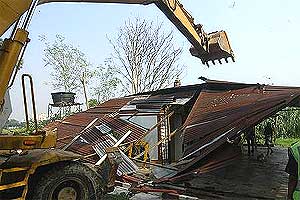
 Among the retrogressive trends since Tunku's era is the spate of temple demolitions, the destruction of a Taoist temple in Bukit Mertajam by the Seberang Perai Municipal Council (MPSP) being the latest.
Malaysiakini reports that a letter by Bukit Mertajam Umno Youth chief Ramlan Ishak addressed to MPSP urged for the temple to be demolished. Another letter signed by Zulkafli Kamaruddin, private secretary to the Penang deputy chief minister said: 'Based on the complaints received from residents, NGOs and political parties, Abdul Rashid [Abdullah] as deputy chief minister supports and endorses the demolition before any unwanted incidents occur.'
Since public complaints are of a public nature and should by right be open to public scrutiny, I and many other concerned citizens would like to know who exactly the complainants are and what exactly they complained about. As well as what 'unwanted incidents' could have been anticipated to erupt in this wonderfully harmonious pluralistic society we live in.
 Among the reasons given by Ramlan was that the temple was located in 'an unsuitable place'. Bravo Umno Youth! You've identified the problem. Now suggest a solution, please.
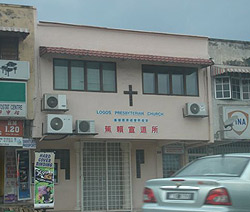
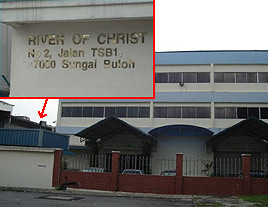
The photos on this page show other prayer halls in equally unsuitable locations. Pray tell us how you as the most pro-active wing of the dominant ruling party propose to resolve this quandary ... in a manner that will promote goodwill and national spirit, that is. After all, the prime minister who is Umno president insists that the BN (which he heads) cares about all Malaysians equally.
 Penang Chief Minister Dr Koh Tsu Koon has unsurprisingly proceeded to take his cue from the Bukit Mertajam Umno Youth chief.
The Sun
, in its article headlined 'Koh: Don't sensationalise temple issue' reported the CM as saying: 'There have been many complaints from the public about the temple's location, which is near the main road, and the council also sent notices.'
Penang Chief Minister Dr Koh Tsu Koon has unsurprisingly proceeded to take his cue from the Bukit Mertajam Umno Youth chief.
The Sun
, in its article headlined 'Koh: Don't sensationalise temple issue' reported the CM as saying: 'There have been many complaints from the public about the temple's location, which is near the main road, and the council also sent notices.'
Is it a sin for a place of worship to be near the main road? Or perhaps Koh has never visited the National Mosque in Kuala Lumpur. Since no Malaysian sees anything remotely untoward about the location of the National Mosque, then conversely it must be the chief minister's logic which is faulty. With such a lack of acuity in his reasoning, it's no surprise then that Koh's leadership is equally rudderless.
 Chong Eng, opposition parliamentarian in whose constituency the demolished temple was sited, says the government should examine its policies on non-Muslim houses of worship. Procedures regarding their regulation should also be finetuned to prevent friction with the affected communities. She advocates sensitivity training and guidelines for enforcement officers carrying out their duties on temple grounds.
Her constructive comments led me to look up the MPSP website for an insight into the council's organisation and operation.
NEP objectives subjective?
Here is the list of MPSP office holders as listed on the council's web page:
Datuk Mohd Aris Ariffin (MPSP municipal president), Fauziah Ariffin (Aris's special asst), Zainol Abidin Md Noh (municipal sec), Siti Aishah Kassim (SUP's special asst), Noraziah Abdul Aziz (director, admin & HR), Mohd Ibrahim Mohd Nor (asst director, HR), Norhayati Sulaiman (asst director, R & D), Latifah Razali (asst director, acquisition & supply), Siti Haslinda Hasan (asst director, training & quality), Maskiah Abdullah (counter officer), Asma Othman (auditor), Lee Moong Nah (director, IT), Hassan Hashim (info systems officer), Abdul Fikri Ridzauudin Abdullah (info systems officer), Mansor Hashim (legal director), Rosnada Abu Hassan (asst director, legal), Munir Affan (asst director, enforcement & security), Mohd Hairay Mohd Yusof (finance director), Shahrulnizad Abdul Razak (finance asst director), Ummi Kalthum Shuib (finance asst director), Dr Romli Awang (health & urban services director), Fadzilah Hasan (director, licensing), Mohd Faidzal Hassan (asst director, licensing), Kamaruddin Che Lah (engineering director), Khirul Annuar Shamsudin (asst engineering director), Baderul Amin Abd Hamid (asst engineering director), Rosnani Mahmud (asst engineering director), Mohd Syukri Said (asst engineering director), Mohd Sobri Che Hassan (asst engineering director), Muhamad Kamaruddin (asst engineering director), Md Pilus Md Noor (building director), Abdul Rahman Harun (asst building director), Ahmad Fuad Hashim (town planning director), Norliza Abdullah (asst town planning director), Mohd Ridzal Abdul (asst town planning director), Kamariah Ramli (asst town planning director), Azian Ahmad (asst town planning director), Dahalan Fazil (asst town planning director), Rozali Mohamud (valuation director), Mat Nasir Hassan (asst valuation director), Ahmad Syahrir Jaafar (asst valuation director), Wan Junaidy Yahaya (community director).
Reviewing the MPSP organisation chart above, which department or personnel should one appropriately approach so that temples and gurdwaras and churches can be legitimately built?
Since MCA has engaged the first gear in its drive to 'Explain to Chinese Grassroots', the association's legal minds might also want to shed some light on application processes vis-a-vis temples during their roadshow. This is for the benefit of temple committees who find themselves entangled in red tape when dealing with bureaucracy.
The almost 100% Malay-Muslim line-up of the MPSP top tier a racial make-up representative of many other elements in the civil service presents a language barrier especially to laymen not conversant in Bahasa Malaysia. How can the average vernacular-speaking applicant obtain help in filling up complicated government forms which stumps even those of us fluent in BM?
Has the NEP and its incarnations the NDP and NVP (and whatever else comes next) accomplished its stated aim of eradicating the identification of economic function with race? In other words, has the Never Ending Policy successfully abolished the old stereotype of Malays as paddy farmers, Chinese as petty traders and Indians as rubber tappers? Or has it on the contrary evolved a new dimension leading to the identification of Malays as government officers and police; Chinese as pirated DVD vendors and loansharks?
National issues
Forward-thinking Malaysians have already passed that infantile stage of communal politics so keenly purveyed by the BN. Therefore it is agreed that we should not view the unfortunate fracas in Bukit Mertajam as having racial overtones.
 On the other hand, fair-minded folks across the board would consider it as involving national issues of failed government policies, corruption, accountability, contempt of the law, and subversion of the intent of the Federal constitution.
It's been rightly asked why 'Rumah besar tak berani, rumah tokong tak peduli'. Temple devotees cannot fail but to compare their plight with the Klang municipal councillors who built 'palaces' similarly lacking in planning approval but against which the government has taken no action nor demolished.
If you search the archives of PAS party newspaper Harakah , you will see photographs of more palatial mansions in other states. Or you probably know of ones in your neighbourhood or down your street where the towering monstrosities don't match their blueprints (if they've got approved building plans to begin with).
These ostentatious eyesores raise issues of improper land alienation, investigation of corruption and why the ACA is a toothless tiger, as well as other laws, regulations and requirements flagrantly flouted by the bigwigs sitting in their big houses.
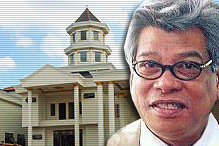 And is there oversight on political appointees, those Little Napoleons who run councils like their private fiefdoms? Zakaria's son and daughter-in-law were appointed to the Klang Municipal Council; Zainuri Zakaria was sworn in last week despite the controversy surrounding his family. Are we fostering dynasties of feudal warlords? But when we have leadership by example from the very top, it is evidently monkey see monkey do.
Furthermore, we're still waiting for Koh to clarify on the DAP's statement that MPSP president Mohd Aris was in a conflict of interest when he ordered the demolition. Unless Koh can satisfactorily get to the root of this matter, Penangites will persist in their belief that he's an ineffectual Kapitan who can't steer his battered sampan away from the rock looming ahead.
And lastly, will Gerakan, the party purportedly leading Penang, put on its granny glasses and read our Malaysian constitution which says: 'Every religious group has the right to manage its own religious affairs, to establish and maintain institutions for religious and charitable purposes, and to acquire and own property and hold and administer it in accordance with law.'
The destruction of the Bukit Mertajam temple has impacted a whole community, leading Penangites to wonder whether the state government really does have our interests at heart and if the current lot in office are fit to govern.
The three monkeys
The Umno general assembly also witnessed Senator Tajul Urus Mohd Zain querying the existence of '241 illegal temples, tokong and churches' in Perak. Now this is a conundrum I've yet to figure out. When there are thousands of 'illegal' places of worship dotting the country, does the problem point to something 'wrong' with the Hindu, Taoist, Buddhist, Christian and other religions?
Why is it that followers of these faiths constantly breech the law by putting up or sustaining illegal structures? Do they possess defiant and criminal tendencies? I've never heard of an illegal mosque in Malaysia.
If it is some congenital malaise afflicting these worshippers of other faiths, then the government should do something urgently to address this illness. Or are the component parties in the ruling coalition (claiming to champion their respective races) like the fabled trio of simians who see not, hear not and speak not? After all, ever-suffering non-Muslims have complained long enough and loud enough.
The Malaysian Consultative Council of Buddhism, Christianity, Hinduism and Sikhism had since early days made known the obstacles, difficulty and long wait inherent in obtaining permission to build their houses of worship, if only to have the approval arbitrarily revoked.
 The Hindu Rights Action Force has appealed to the United Nations and UN secretary-general Kofi Annan to help put a halt to the rampant destruction of Hindu temples and shrines in the Klang Valley.
This is because Malaysian higher authorities are blind, deaf and mute to their cries, while at the same time allowing the local authorities to maintain the demolition derby and issue more eviction notices. Large Hindu temples over 100 years old and [illegally?] erected during colonial times have been demolished. Statues of deities smashed. Other illegal Buddhist-Taoist temples and illegal churches in various states have also been torn down.
Perhaps I've posed too many questions to the Barisan Nasional which has clearly shown that it is incapable of multi-tasking given its own singular obsession with race and religion. All right, just answer one simple one: Do you believe that other Malaysians have no need to pray?


Are you sure you want to delete this comment?
This action cannot be undone.