
COMMENT | Harapan has more than a communication problem
COMMENT | Today, if you type 'Advantix' on Google, you will see a product that kills fleas, ticks, or mosquitos for your pets.
But 25 years ago, Advantix was Kodak’s attempt to get into digital after being warned of digital taking over its core business of film. But Kodak's Advantix was a half-hearted attempt.
It was a digital camera that only allowed you to preview your shots and indicate how many prints you want. It was digital, yet it still used film. Why would anyone buy a digital camera and still pay for film cartridges?
Behind the management mistakes, scale-down challenges, and ecosystem troubles, organisational inertia was also a deep-seated fear of the solution.
Kodak knew the threat of digital before everyone. Their internal market intelligence team said that confluent factors of the low cost of digital equipment, high-quality images, and interoperability of diverse components meant the rise of digital cameras was inevitable.
But Kodak could not stop seeing the solution of completely transitioning to digital as an “enemy, an evil juggernaut that would kill the chemical-based film”.
Psychologists call this 'solution aversion', where you avoid the problem because you dislike the solution. Thus, you find another problem where the solution is less painful and easier to solve.
This is what Pakatan Harapan is going through now. Reducing big and complex problems to a simple “communication problem” as the secret formula for...
COMMENT | Today, if you type 'Advantix' on Google, you will see a product that kills fleas, ticks, or mosquitos for your pets.
But 25 years ago, Advantix was Kodak’s attempt to get into digital after being warned of digital taking over its core business of film. But Kodak's Advantix was a half-hearted attempt.
It was a digital camera that only allowed you to preview your shots and indicate how many prints you want. It was digital, yet it still used film. Why would anyone buy a digital camera and still pay for film cartridges?
Behind the management mistakes, scale-down challenges, and ecosystem troubles, organisational inertia was also a deep-seated fear of the solution.
Kodak knew the threat of digital before everyone. Their internal market intelligence team said that confluent factors of the low cost of digital equipment, high-quality images, and interoperability of diverse components meant the rise of digital cameras was inevitable.
But Kodak could not stop seeing the solution of completely transitioning to digital as an “enemy, an evil juggernaut that would kill the chemical-based film”.
Psychologists call this 'solution aversion', where you avoid the problem because you dislike the solution. Thus, you find another problem where the solution is less painful and easier to solve.
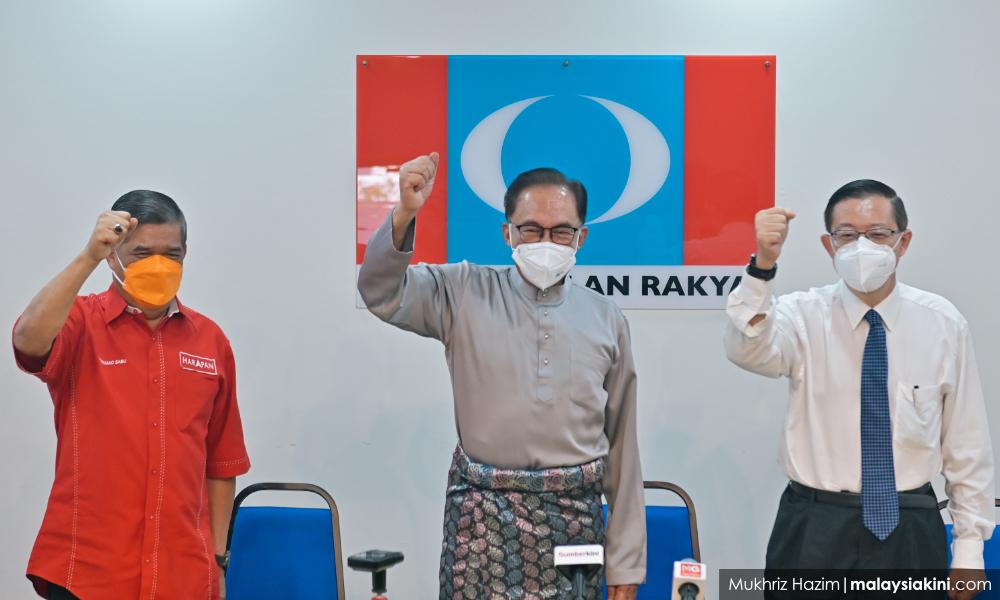
This is what Pakatan Harapan is going through now. Reducing big and complex problems to a simple “communication problem” as the secret formula for success in the 15th general election to avoid making drastic, but necessary, changes.
Calling it a “communication problem” foremost shifts the blame to the voters. The assumption is that if only the voters knew the truth, they would still support Harapan in the upcoming elections.
It assumes voters’ lack of knowledge, and it assumes a correlation between knowledge of truth and voting for Harapan.
Moreover, a “communication problem” is much easier to solve. All it takes is to put out more statements, have more meetings, hire more communications people, and put in more money to the political machine to churn out more posters, colours, and messaging headlines to alter perception.
It is much easier for Harapan to tell themselves that the status quo is fine, and the solution is just to do slightly better in a small area.
Most importantly, however, Harapan wants to avoid three potentially drastic solutions.
Leadership change
First, a change in leadership. In politics, a leader needs to provide three things:
- The ability to set an overall vision and direction
- Act as a glue to the team (for resource sharing, capacity building, conflict resolution)
- Serve as a trustable figure for the public
As it stands, Harapan is in the wilderness; devoid of ideas and relying on the hope that others will do badly enough so that Harapan looks good again.
But this might not happen. Voters have changed; they no longer look for “anti-” parties (negative sense). Instead, they are seeking actual contestation of ideas (positive sense).
Harapan can no longer rely on being “not Umno”, or being “not racist”, “not corrupt” or “not a traitor” to win votes.
While it is important to provide accountability against the current government by criticising their actions, voters are more interested to know what Harapan could provide alternatively, especially after its uninspiring 22-month tenure as government (which was not merely a “communication problem”).
The Harapan leadership is not unlike most regressive political leaderships in Malaysia. They are old in age and old in ways of doing.
Leaders of each party create their respective bottlenecks that prevent new leaders, ideas, or partnerships to flourish.
Even if they are banking on the next political scandal to the magnitude of 1MDB to happen, voters might not pick Harapan as an obvious alternative, which brings me to the second solution.
Coalition overhaul
Two, dismantle the coalition in its current form. At its most basic, a coalition only makes sense if the overall benefit of having the coalition is greater than the sum of its parties individually.
Harapan has lost its strategic, organisational, and chemistry advantage it once had.
Though its parliamentary seats still put it as the largest opposition force, state elections and analysts’ predictions have put Harapan as a potential third or fourth force in the elections after BN, Perikatan Nasional (PN), and potentially a Muda-Warisan-Pejuang tie-up.
Harapan’s collective expertise, candidate quality, and grassroots organisation are not obviously better than the other coalitions.
Harapan exists in name only on a common letterhead; even then, a common letterhead to issue statements does not carry any distinct value anymore.
Moreover, as an organisation, Harapan has functioned disparately in elections. All parties have decided to go their separate ways in the past two state elections.
Resources are spread out, with separate flags, machinery, and campaign messages that render Harapan insignificant as a coalition.
Finally, the chemistry of Harapan parties has long evaporated with mutual resentment and blame.
DAP is resentful because it carries the bulk of the winnings on its own, PKR and Amanah are resentful of DAP’s anti-Malay image, and DAP and PKR are resentful that Amanah still has minimal ability to contribute anything substantially after years of existence. And this leads me to the final solution.
Overhauling parties
Three, overhauling the parties to find their niche. In the fragmented political landscape today, it is increasingly difficult to strive to be a national party that is overarching and dominant.
When politics is no longer a strict winner-takes-all model, a party with only 10 or 20 seats may have significant bargaining power to join a post-election coalition government.
Instead of spreading the party thin by thinking about how to expand to every corner of Malaysia, parties should start looking at which areas it has the highest chance of success, only focusing on those, and ensuring a victory.
This means large but unsuccessful parties might have to consider scaling down and/or taking a hyperlocal approach to elections. From there, your party’s new identity shall emerge.
It almost does not matter what Harapan does for the next year or two, as long as it constantly experiments to seek what works.
The worst thing to do is to assume there is nothing wrong, find a small problem to correct, and do nothing at all.
JAMES CHAI is a political analyst. He also blogs at www.jameschai.com.my and he can be reached at jameschai.mpuk@gmail.com.
The views expressed here are those of the author/contributor and do not necessarily represent the views of Malaysiakini.