




Crime against common sense
Was it just me or did Chinese New Year seem more like damp squib rather than firecracker festivity? The sluggish economy and spiralling prices could have something to do with subdued celebrations of the season.
Times may be bad but still I'll bet the lack of cheer would not have deterred the Chinese Diaspora returning to their hometowns from indulging in a spot of gambling this week. I suppose a friendly card game during family reunions might reasonably be viewed as only a venial sin. At least, money won and lost would have remained within the clan.
Was it just me or did Chinese New Year seem more like damp squib rather than firecracker festivity? The sluggish economy and spiralling prices could have something to do with subdued celebrations of the season.
Times may be bad but still I'll bet the lack of cheer would not have deterred the Chinese Diaspora returning to their hometowns from indulging in a spot of gambling this week. I suppose a friendly card game during family reunions might reasonably be viewed as only a venial sin. At least, money won and lost would have remained within the clan.
While recreational gambling is a form of a get-together pastime, addictive gambling be it a flutter on horses, roulette at the casino, poker sessions, betting on football or playing numbers is not comparatively as harmless. A hardcore gambler depletes his family's monetary resources, lands himself in debt, and in the worst-case scenario, may be driven to suicide by loan sharks.
While it could be true that gambling in Malaysia is a predominantly Chinese preoccupation, it is hardly limited to my race alone. Peer into any numbers betting shop and you'll see the queues graduating in skin colour from fair to dark. Looking at the punters inside clutching helmets and the row of 'kap chai' (low-end motorcycles) parked outside the outlets, you can safely deduce that those hoping to make a lucky strike are not the well-off.
Cents and sensibility
Why do people already strapped for cash waste their hard-earned money on games of chance where the odds are so stacked against them? Engaging in numbers forecasting, especially, defies common sense when it's calculated that the odds of getting the winning combination on a 4-Digit bet is 10,000 to 1.
For the uninitiated, here's an analogy of how it works. Let's say I write four numbers (eg, 2020) on a piece of paper. It can really be anything from 0000 to 9999 and the permutations, you can imagine, are endless. You pay me RM1 to make one prediction on the 4-D. Tell me the numbers I've written and I'll pay you RM3,500 if you are correct on all four digits and in the exact sequence.
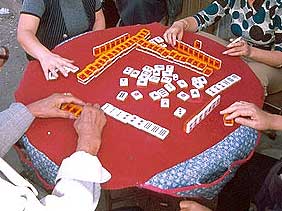 A clairvoyant might be game to try. Those without telepathic powers who don't get it right the first time can try and try again. But you have to give me a RM1 'ang pow' each time you hazard a guess.
Given the amount of the bet (minimum RM1) and the payouts (say RM3,500 for first prize, RM2,000 for second and RM1,000 for third), it actually makes more sense to slot your money daily into a piggy bank. Over time, you would accumulate more than any possible winnings. That's why shrewd bookies sit comfortably in a higher income bracket than their irrational clients.
And it's even more criminal to buy lottery tickets predicting a sequence of seven or more digits. The statistical probability of hitting pay dirt is as astronomical as glimpsing Halley's Comet thrice in a lifetime. For the single person who snags the jackpot, a million others would have been suckered.
Landing a windfall
The ones minting money from these Happy-Happy Joy-Joy habits are the gaming operators. And for all that Malaysia is purportedly an Islamic State, gambling is perfectly legal here. Now where are the overzealous bureaucrats and holier-than-thou enforcement officers championing Islamic tenets in the country's administration just when you need them?
After all, gaming licences are issued by the Umno-led government. Taxes and duties on the industry are collected by this same Umno-led government.
Genting Berhad is the holding company of Resorts World Berhad which operates the casino at Genting Highlands. Genting has a Bursa Malaysia capitalisation of US$4.9 billion. Other companies (public-listed and private limited or PN4) which have gaming interests include Berjaya Sports Toto Berhad, Magnum Corporation Berhad and Pan Malaysian Pools Sdn Bhd (Da Ma Cai), while one of the activities of troubled Olympia Industries Berhad is organising numbers forecast pools.
Among chairmen and directors of companies which have gaming interests are Tuns and Tan Sris titles conferred by the state. And the public figures and luminaries sitting on the boards are not all Chinese.
 Perhaps if PAS ever comes to power, it may ban gambling. At least the Islamist party has the virtue of consistency it says what it means and it means what it says. And PAS doesn't couch its Islamic state intent and execution in ambiguous terms like Hadhari which nobody can quite pin down the meaning of.
But in practical terms of Boleh, our land of video piracy and fake Rolexes, rendering gambling illegal will merely allow the black market catering for it to carve a larger niche for itself.
It seems to me that the Islamisation drive emphasises form over substance, Hadhari homilies notwithstanding. It is moral hypocrisy when outward piety obsesses over women's dress and proper length of headscarf while showing less overt concern over the corruption of the community's moral fibre.
The cardinal sin
Islam forbids gambling. Nor do the other major religions practised in Malaysia encourage it. Despite this apparent concordance in their strictures, I would not advocate increased religiosity as the Band-Aid for this social ill.
Religion is no remedy for the absence of a safety net for the dispossessed, a responsibility of the secular government. The societal fault line that separates the haves from the have-nots does not stem from a lack of religious observance. It derives from the death of hope, not the lack of faith.
Gamblers have all the faith in Lady Luck or the Gods of Fortune but they are clutching at straws in making untenable bets. They are people bereft of hope. I've heard some say that they bet on numbers as a last resort. They cannot conceive of other more viable means or realistic avenues for obtaining that small sum of money to make a positive difference in their lives.
Are there really no genuine opportunities for making a bit of extra cash to raise living standards beyond subsistence level? It may sound like a rhetorical question but we really ought to pause and examine our conscience before calling religion into the picture, or hollering for a greater degree of 'religion' to be infused into national life.
The top 10 percent of the population are the 'all's well' news headliners but who speaks for the bottom 10 percent? Although his tragic end had nothing to do with gambling and everything to do with despair, how should the rest of us as fellow Malaysians feel when a 12-year-old boy living in this country hangs himself because his family cannot afford to pay his school fees?
 This thought-provoking quote comes from Robert Thurman, a renowned Tibetan scholar. Thurman (whose other claim to fame is being dad to Hollywood actress Uma) writes: 'Without karma, there are no consequences, and without a future, no ability to progress'.
Before talking about creating a Kingdom of Heaven on Earth, we should first reflect on whether our temporal authority (which anyone who has voted Barisan Nasional well deserves) has been accountable for its actions, whether it even discerns the consequences of its actions and what sort of future it has shaped for us.
Are we looking at progress or regress in Malaysia? If the latter, then perhaps we should start thinking about how we can expedite the visitation of karma on the administration which has ruled uninterrupted over a docile and compliant electorate for 50 years too long.


