




Putting fear in people
In a theocratic state, God is exalted. In a police state, the said institution is an instrument of power. God-fearing and law-abiding Malaysians, I believe, are as much in awe of the police as they are of the omnipotent deity.
They act like the police are just as omnipresent and omniscient, and as such deserve to be accorded the same dose of fearful respect. I find the first part of this equation somewhat incongruous with reality. After all, one does not see police ubiquitously on the beat except when barrelling down the street as noisy outriders to VVIPs.
So, why assume they patrol everywhere and have ears at every wall? If they did, the national crime rate would be considerably lower.
In a theocratic state, God is exalted. In a police state, the said institution is an instrument of power. God-fearing and law-abiding Malaysians, I believe, are as much in awe of the police as they are of the omnipotent deity.
They act like the police are just as omnipresent and omniscient, and as such deserve to be accorded the same dose of fearful respect. I find the first part of this equation somewhat incongruous with reality. After all, one does not see police ubiquitously on the beat except when barrelling down the street as noisy outriders to VVIPs.
So, why assume they patrol everywhere and have ears at every wall? If they did, the national crime rate would be considerably lower.
Too often, we hear horror stories about victims succumbing to their injuries after a vicious snatch theft. Or we read newspaper reports about high-ranking officials losing cash, jewellery and valuables in the hundreds of thousands of ringgit when their humble abode is burgled or robbed. Or unsolved cases of cargo and consignment heists, or sensational murder cases less than satisfactorily resolved.
 Dispiriting KPI (key performance indicators) aside, one or two departments in the police force might nonetheless be truly as all-knowing as they are credited by the public. The Special Branch, for one, is highly spoken of for their efficiency.
Police rank-and-file too can be demonstrably efficient when they choose. This is seen in their prompt follow-up to several complaints by Umno Youth against perceived miscreants residing outside the charmed circle. In a recent and separate incident, police investigated Keadilan information chief Tian Chua for 'attempted murder'.
Selective prosecution
Chua was alleged to have nearly hit someone when he drove his car through a barrier at Kg Berembang in Ampang Jaya a district famed for the controversial decisions of its bevy of civic-minded municipal councillors. The man behind the barrier, though escaping unhurt, must have been terribly shaken. I'm suspect that most Malaysian road-users, at some time or another, would have yelled at fellow motorists: "What are you trying to do, kill me?"
Now if the police applied a comparable zeal to accident reports, there would be a lot more drivers similarly investigated under Section 307 of the Penal Code and cars being tendered as 'murder weapon' exhibits in court. But from my personal experience, I can only conclude that the police adopt a lackadaisical attitude.
In 2005, my mother lodged a report at the police headquarters in Petaling Jaya. She had been 'really' knocked down by a motorcycle, not 'nearly hit' when crossing the road, necessitating outpatient treatment at a private hospital accident ward.
Our neighbours managed to get the motorcyclist's IC as the mishap happened only a few metres from where we lived. His particulars as well as licence plate number were duly passed to the police.
When I was interviewed by the desk duty officer, she was more interested in suggesting that the motorcyclist was Indonesian. No, he's local, I said, as the Malay heartland address on his IC would imply. I asked what action would be taken. She replied he would be traced and issued a summons for traffic violation, i.e. riding his motorbike the wrong direction down a one-way street. No more than that.
 To date, we've not been contacted by police on any outcome to the report. Since we are not a vindictive family and accept that it was an accident (and not 'attempted murder'), we're willing to let the matter slide.
In making the above comparison, I see no sense of proportion in the police's forceful show against Chua. If anything, I will confidently wager that anyone who has had undesired contact with police would find their experience closer to the unconcern and indifference I encountered.
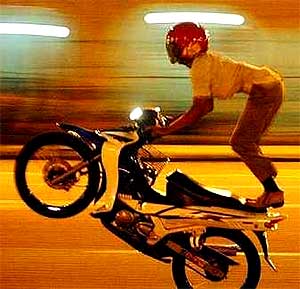
That this country continues to have world-beating road fatality statistics and record numbers of maimed motorcyclists, not to mention legions of Mat Rempit menace (or should we say Putera Umno potential recruits), speaks for itself of police commitment to public safety. The quicksilver action on Chua's driving is a notable exception to the above pattern.
Persecution of activists
One recent dispute I had with an ordinary policeman on an ordinary day in an ordinary part of town elicited the unsurprising reaction from friends. The officer had rapped loudly on the back of the car for me to move on.
I argued it was a No Parking sign, not a No Stopping sign and the road was not marked by double yellow lines. The friends said I should have done as told, driven away and thereby spared myself the ticket. "Why do you want to argue and court trouble?" "Don't you know that you'll never win?" (Like conscience writing in malaysiakini , eh?)
Although I would think my talking back hardly registers a blip on the Geiger counter of getting into the police's crosshairs, for the vast majority of Malaysians, particularly the Chinese, zero contact with police is devoutly prayed for. It stems from the community's over-developed deference to authority.
I concede that under present circumstances one can't 'win' in the way that Bolehlanders understand it. If one could, the opposition would have a stronger representation in state assembly and Parliament, possessing the people's mandate as they do. The 'you can't win' list is too long to enumerate here.

 Granted too, one is more likely to 'lose' when confronting authority. The persecution of Oppositionist Lim Guan Eng and human rights activist Irene Fernandez underscores that inevitability. However, while they may have lost their respective legal battles, they have surely won the war of conscience a meaningful 'victory' that the apathetic, apolitical cliques ('who cares as long as our rice bowl is secure') may scoff at.
What I can't deny though is that conscience is no protective armour when uniformed authority decides to take a swing at you and bestow a black eye. The assault on ex-deputy premier Anwar Ibrahim when in police custody more than reinforces the chilling possibilities for us mere mortals. Who knows if we could be subjected to nude ear-squats? Or unexplained deaths as has happened to unfortunate detainees in police lock-up.
Hence, some Malaysians prefer to disengage while other Malaysians battle for the police watchdog body to be set up. It's short-term expediency vs. taking the daunting and challenging long view. The sorry thing is that the former category totally eclipses the latter.
Our culture of bowed heads and averted eyes has taken too deep a root. I'm not talking about refusal to be in the thick of the action when truncheons, water cannons and tear gas fly, set against a purported Martyr Syndrome. Let's just have a less fearful mindset in our everyday living.
Malaysians wear fear about their necks like a millstone such dread that serves well the country's political overlords. What's the worst that could happen if Malaysians looked this fear square in the eye? Why, they might possibly recognise the ugly school bully all grown up and uniformed in blue. Not the hand of God in human form they are required to pay obeisance to.


