




Why we should mention Iraq
Last Tuesday marked the fourth anniversary of the US-led invasion of Iraq. Thousands of conscientious Americans took to the streets in remembrance of Iraqi casualties, and a good number of churches across America held memorial services, both to repent of their nation's sin and to pray for forgiveness and reconciliation.
A candlelight procession had been organised by the Christian Peace Movement for Iraq four days before in Washington. For all the follies committed by a handful of neo-cons, the country still represents hopes in many ways.
The neo-cons, of course, hate to be reminded of the catastrophic consequences in a land messed up by their "brilliant" strategy that went horribly wrong. They used to dismiss the peaceniks as faint-hearts and wimps, now they grumble that the loony leftists have been rambling on without a purpose. I don't blame them. Who on earth would enjoy being told of the pimples on their face?
Last Tuesday marked the fourth anniversary of the US-led invasion of Iraq. Thousands of conscientious Americans took to the streets in remembrance of Iraqi casualties, and a good number of churches across America held memorial services, both to repent of their nation's sin and to pray for forgiveness and reconciliation.
A candlelight procession had been organised by the Christian Peace Movement for Iraq four days before in Washington. For all the follies committed by a handful of neo-cons, the country still represents hopes in many ways.
The neo-cons, of course, hate to be reminded of the catastrophic consequences in a land messed up by their "brilliant" strategy that went horribly wrong. They used to dismiss the peaceniks as faint-hearts and wimps, now they grumble that the loony leftists have been rambling on without a purpose. I don't blame them. Who on earth would enjoy being told of the pimples on their face?
Four years ago, President George W Bush assured us that "the terrorist threat to America and the world will be diminished the moment that Saddam Hussein is disarmed". It has been nearly four months since Saddam breathed his last, but now the US government is telling us that Iran is the greatest menace to world peace and we are no safer than we were in March 2003. The dictionary may inform us the word 'diminish' means 'decrease', but it signifies something fundamentally different to the neo-cons.
Four years on, the death tolls in Iraq continue to rise, and the sectarian violence between Sunnis and Shiites escalates unabated. At least 1.5 million people are now internally displaced, with millions of others scattered in refugee camps across the Middle East.
 Just yesterday, Ban Ki-Moon, the UN Secretary General, was left shaken at a press conference in Baghdad when a mortal attack took place in close proximity. The latest
poll
commissioned by the
BBC
and other major media agencies clearly indicates extensive pessimism on the part of the Iraqis over the future of the country.
Just yesterday, Ban Ki-Moon, the UN Secretary General, was left shaken at a press conference in Baghdad when a mortal attack took place in close proximity. The latest
poll
commissioned by the
BBC
and other major media agencies clearly indicates extensive pessimism on the part of the Iraqis over the future of the country.
At one's own peril
Perhaps only the Iraqi Kurds are in the mood for celebration: with real autonomy coming their way and, subject to the outcome of future negotiations with their fellow Iraqis, they could be poised to create the first Kurdish state since time immemorial. Their oppressed Kurdish brethren in Turkey, Syria and Iran must be watching the development with a jaundiced eye.
We live in a funny world indeed. Fifteen years ago, many including myself - were so heartened by the End of History. Communism was pronounced dead, and last rites were performed on a host of totalitarian regimes. One could hardly resist the seductive promises of global markets and the lack of an alternative to liberal democracy.
But conservatism arrived in Washington at a gallop, thanks partly to the September 11 attacks. While George Bush Sr announced the beginning of a new world order, flanked by other prominent world leaders at the time, his son could not wait to write invasion into American foreign policy barely ten years later.
As Chuang Tze wisely observed more than two millennia ago, one pursues the limitless knowledge with one's limited life at one's own peril. Too many like Francis Fukuyama were deluded by their blind optimism into playing god, to the extent that war became a necessary vessel to effect change. But at least Fukuyama has made an about-turn on Iraq, while others are too mindful of the serendipitous relationship with the Bush administration to articulate their change of heart in public.
Faced with the havoc in Iraq, many remain obstinate in arguing that the world was still safer in American hands than in those of the rogue powers. Having lived in the West for more than a decade, I fully understand the anxieties of western societies over a world without American power.
US's image shattered
Stephen Hopgood, a lecturer of international relations at the School of Oriental and African Studies, once ignited an animated if heated debate among the class when he asked: "Would the world be better off if international affairs were dominated by a co-leadership of, let's say, China and Russia?"
I am ready to acknowledge the shortcomings and the appalling human rights records in the so-called Third World. But liberal internationalism does not equal American power alone, especially when absolute power corrupts absolutely.
French Prime Minister Dominique De Villepin, in a speech at the Harvard University last week, expressed his heartfelt misgivings in no uncertain terms that the war in Iraq had shattered America's image, and undermined that of the West as a whole. He could not have been more frank. If this message has gone down well with much of the world, it is yet to sink in as far as the policymakers in the White House and Whitehall are concerned.
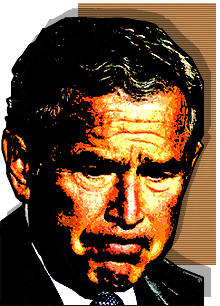 They now seem to be preoccupied with drafting a resolution on a war against Iran, despite Tehran's crucial role in stabilising the state of civil war in Iraq. Should the moment come, the neo-cons would again be euphoric. How would the world look like in 2000 if JFK had gone ahead with bombing Cuba to resolve the missile crisis in 1962, while his successor succumbed to the view of General LeMay and bombed China to halt the latter's nuclear programme two years later?
The neo-cons take delight at the sound of war, which only enriches the coffer of the defence industry. The age of gunboat diplomacy is long gone. As the world community is losing heart with the US, the Bush administration, with less than two years left, should initiate a radical change of course in its foreign policy and abort any attempt to deal with Iran and North Korea with direct American actions. The efforts by the Quartet and the six-party talks may be slow to bear fruit, it is still a far safer bet to change a regime's behaviour than to eliminate the regime itself.
As global affairs are becoming more complicated and state relations more sophisticated, it is incumbent on each and every responsible nation to realise the vital importance of mutual understanding and consensus. Multilateralism, like rational voices, should prevail even in the worst of time. A reason why the world should continue to mention Iraq.


Are you sure you want to delete this comment?
This action cannot be undone.