




The Sultan, Mufti and MP
In the recent fortnight the array of unfolding news had the usual trepidations. One set put my hair on ends.
It's the unlikely linkage between the Regent of Perak Raja Nazrin Shah, his state mufti Harusani Zakaria, and the unlikely Federal Territory Gerakan chairman and member of Parliament for Segambut Dr Tan Kee Kwong.
 The Regent has been one whose sense of civil enlightenment is exemplary. He may be an ivory tower constitutional monarchial head of a state, but his royal feet are on the ground. He knows the score: that in the difficult process of nation building the people in the modern democratic (albeit monarchial) system of government should be guaranteed all of the civil liberties spelt out clearly in the constitution.
What more, the constitution is the primary source of law and authority in the land. There can be no other above it.
Enter the mufti Harussani. It may be a matter of coincidence or is it more of an accident, but this mufti has made many public remarks that are of obvious detriment to the principles of civil liberties and sowing discord to the general population.
In the recent fortnight the array of unfolding news had the usual trepidations. One set put my hair on ends.
It's the unlikely linkage between the Regent of Perak Raja Nazrin Shah, his state mufti Harusani Zakaria, and the unlikely Federal Territory Gerakan chairman and member of Parliament for Segambut Dr Tan Kee Kwong.
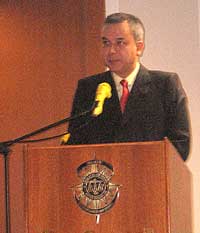 The Regent has been one whose sense of civil enlightenment is exemplary. He may be an ivory tower constitutional monarchial head of a state, but his royal feet are on the ground. He knows the score: that in the difficult process of nation building the people in the modern democratic (albeit monarchial) system of government should be guaranteed all of the civil liberties spelt out clearly in the constitution.
What more, the constitution is the primary source of law and authority in the land. There can be no other above it.
Enter the mufti Harussani. It may be a matter of coincidence or is it more of an accident, but this mufti has made many public remarks that are of obvious detriment to the principles of civil liberties and sowing discord to the general population.
Harussani's actions and deeds are contrary to the spirit of the enlightening teachings and expectations of the Regent and future Sultan of his own state.
To recap, he was against the Kongsiraya celebration, and he was instrumental in sending SMS messages that led to a confrontation between Muslim fundamentalists and Christian groups.
Derhaka
To all intent and purposes Harussani has committed 'derhaka' to the royalty and he certainly has committed 'derhaka' to the spirit of the Malaysian constitution.
I have argued that this social sin is sensitive to the Malay psychology and in the great Malay folklore Hang Tuah had to kill his bosom friend Hang Jebat when the latter committed derhaka to his Sultan.
With all these happenings, it appeared understandable for Dr Tan to state that Harussani should be removed from office.
There was rumour that FT Gerakan passed a resolution to this effect.
 With this development all hell broke loose. Tan was chastened for meddling into the affairs of the Muslim who as a non-Muslim he is deemed having no right to. He was called immediately to retract his words which he did.
He also stated that there has been no resolution passes, and that whatever he has uttered about the Sultan and his mufti were all said in his personal capacity. He had to apologise.
This storm should have stayed in the Malay cultural teacup. But I find it rather distasteful. By his words and deeds Harussani has shown his own anti-constitutional traits, of derhaka to his own Sultan (and therefore to his own culture) and its all part of a day's work.
Probably his sins are all about intra-Malay issues. It does not cross the ethnic border. So for this he is forgiven.
But when the same things are raised into the Malaysian public domain by Tan then they are no longer intra-Malay, they become an extra-Malay issue.
Only losers
Tan has been chastised because he is at the other side of the ethnicity line. The Malay culture may find it easy to forgive and forget if he crossed swords with his fellow brother Malay. But he is less forgiving if non-Malays are inserted into the equation.
What therefore is the moral of the story?
I see the three-person act as the way the country is run, in microcosm of course.
The Sultan is symbolic of the well-meaning secular establishment, trying to make sense of the cruel world and maintain law and order in a fragile and fractious environment.
 The mufti is symbolic of the spoilt-brat bad boy who wants to get his way all the time and every time. Right or wrong does not matter, for to him he is right and always right and others are wrong and always wrong.
And the MP is symbolic of the suffering general population who fights to make sense of the cruel country, and try to maintain a decent and peaceful life also in this fragile and fractious environment.
At the end of the day who is the winner? No one does for all end up as losers.
The Sultan's message and wisdom gets muted. The mufti gets away with the act of hijacking the supremacy of constitutional laws by the religious laws and drags the country a step closer to a steep precipice, and the MP becomes despondent, dispirited and disillusioned.
As if on cue comes the case of the banning of an exhibition ghosts, ghouls, and supernatural beings at a museum near Seremban.
The National Fatwa Council chairman Prof Dr Abdul Shukor Husin felt that spirits and supernatural beings were beyond the comprehension of the human mind as they involved in the invisible world.
Arbitrary religious terms
This apparently raised a conflict of interest among certain quarters and this is not healthy for Muslims. The exhibition was then hitherto banned.
What do we make of this new twist? It is analogous to Harussani's anti-constitutional and irresponsible acts in support of some perceived religious tenets.
Only this time it involves the efforts of the government to encourage creativity and spread of knowledge to the population.
The apparent winner of course the religious establishment for it shows again that it has clout to dictate its arbitrary religious terms.
Harussani and Abdul Shukor are the champions of the slow but sure process Islamisation of the country.
Whether this is good or bad, I am not so sure. But when this involves the commitment and propagation of anti-constitutional acts, and thwarting the creativity and learning process of the population, then I'd say it is very bad.
AB SULAIMAN is an observer of human traits and foibles, especially within the context of religion and culture. As a liberal, he marvels at the way orthodoxy fights to maintain its credibility in a devilishly fast-changing world. In his free time, he loves to read, travel and play golf (although his game could be better).


Report this comment
Are you sure you want to delete this comment?
This action cannot be undone.