


/file/publisher-c1a3f893382d2b2f8a9aa22a654d9c97/2022/03/f35ee1654c90099e35bd8837c795bb51.jpg)

COMMENT | Diplomatic missions should adopt victim-cetric approach
COMMENT | Less than two weeks ago, Malaysia celebrated Labour Day on May 1. In fact, it is the most awaited moment for every worker, regardless of status and background, to be appreciated.
However in Tenaganita, year after year, we see gross violations of workers’ rights in all sectors, particularly among the least recognised group - domestic workers.
We would like to highlight the case of Su, a young Sri Lankan domestic worker who migrated thousands of kilometres from Sri Lanka to Malaysia with a burning hope and a clear set of goals to earn a better life, but whose dream has since turned into her worst nightmare.
Su was not only assured that...
COMMENT | Less than two weeks ago, Malaysia celebrated Labour Day on May 1. In fact, it is the most awaited moment for every worker, regardless of status and background, to be appreciated.
However in Tenaganita, year after year, we see gross violations of workers’ rights in all sectors, particularly among the least recognised group - domestic workers.
We would like to highlight the case of Su, a young Sri Lankan domestic worker who migrated thousands of kilometres from Sri Lanka to Malaysia with a burning hope and a clear set of goals to earn a better life, but whose dream has since turned into her worst nightmare.
Su was not only assured that she would be accorded all basic human rights such as proper accommodation, free medical treatment, and three decent meals daily, she also signed a legitimate and promising employment contract to work as a domestic worker at her employer’s house.
However, as the saying goes - this is all just too good to be true.
No passport, no food, no pay
Apart from the long hours of work - exceeding 18 hours per day - Su was denied all human basic rights in life like the right to rest, health, to practise religion, and her freedom of movement, as the employer withheld her passport.
Just take a second and try to imagine her situation; her every movement was restricted - at most, she was only allowed to go outside the house to throw rubbish and nothing else. In addition, she was not allowed to go to church to practise her religion freely.
With no decent food given, not even once a day, she was further tortured verbally and mentally - resulting in her depression and anxiety.
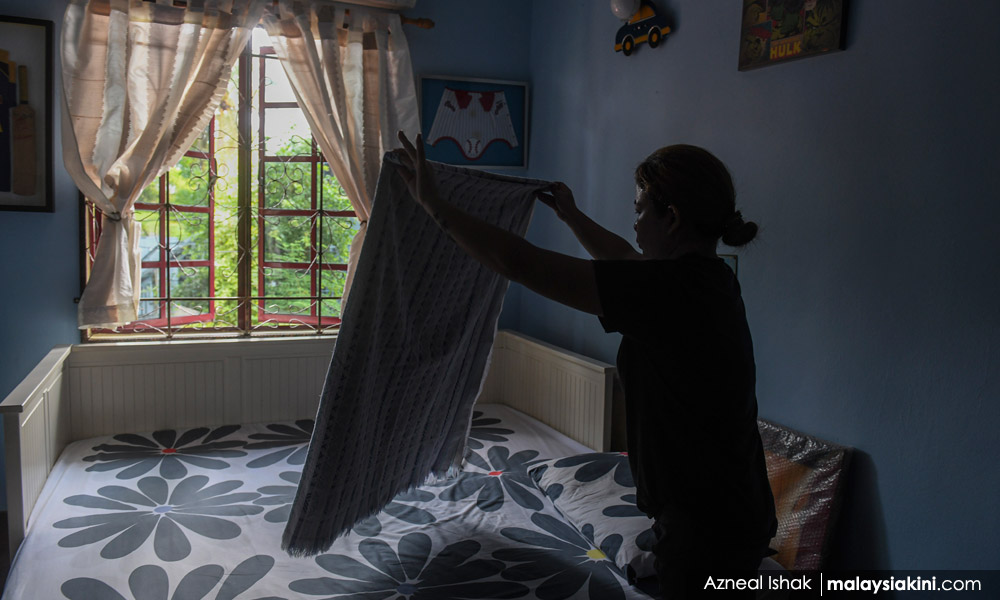
Furthermore, with only a corner in a small prayer room as her bedroom, Su was not even spared any basic amenities such as a bed and proper ventilation while working under her employer.
To add on, her wages were not paid accordingly, including her overtime wages which she obviously deserved.
As such, upon receiving a call from the family, Tenaganita rescued Su from the exploitative situation. After the rescue, Tenaganita sheltered and cared for Su while managing her case against her employer and agent.
After documenting her case and analysing the possible legal intervention, noting the fact that the employer was withholding her passport, Tenaganita reported the case to the Sri Lanka High Commission and subsequently applied for her travel documents. Unfortunately, Tenaganita’s representative encountered a very unpleasant experience.
Blaming the victim
At the Sri Lanka High Commission, Su was treated in an improper and disrespectful manner. She was placed in the same room with the employer by the officer of the high commission and was denied the presence of any of Tenaganita’s representatives despite her request.
Further, the officer of the high commission had the audacity to make judgemental remarks towards Su.
Instead of demanding the employer hand over the passport to Su, the officer of the high commission allowed the employer to keep Su’s passport. This is a direct violation of Section 12(1)(f) of the Passports Act 1966 which reads as follows:
“Passports Act 1966
12. (1) Any person who - (f) without lawful authority, has in his possession any passport or internal travel document issued for the use of some person other than himself shall be guilty of an offence and shall, on conviction, be liable to a fine not exceeding RM10,000 or to imprisonment for a term not exceeding five years or to both.”
Su’s was not an isolated case with a bad and disheartening experience. There have been a few other cases at the Sri Lanka High Commission, which is why Tenaganita is insisting on a dire and urgent change in regard to the role of diplomatic missions of migrant workers’ source/sending countries towards the protection of their nationals who are employed and sometimes exploited in the course of their work in Malaysia.
All diplomatic missions must realise that such matters pertaining to their workers simply cannot be neglected. Therefore, Tenaganita is issuing an urgent wake-up call alerting all diplomatic missions in Malaysia to design a more victim-centred approach, synonymous with the very existence of the embassy and high commission - a safe place for all migrant/foreign workers seeking protection and assistance.
We have been told over and over that as diplomats and representatives of their missions, they are required to play an active role and to be involved, including taking immediate action as these migrants sought redress with little hope left in them.
They should not pick and choose the easier and quicker road, such as shutting these migrants’ voices down, like what happened with our recent atrocious experience with the Sri Lanka High Commission.
At this juncture, it is important to note that Sri Lanka is a signatory to the International Convention on the Protection of the Rights of All Migrant Workers and Members of Their Families on 11 March 1996.
It is important to be reminded that the Convention focuses on upholding and promoting equality of opportunity and treatment of migrant workers and their families, recalling the convention against torture and other cruel treatment.
Appreciate, protect workers
Through the years, Tenaganita has worked together and developed good working relationships with a number of missions such as Indonesia, Philippines, Tanzania, Uganda, Nigeria, India, and Cambodia, concerning the rights of migrant workers from seeking redress, different interventions with Malaysian government agencies, shelter and care, safely repatriating workers, and reintegration upon arrival in the country of origin.
Domestic workers are normal human beings just like everyone else, yet they are continuously exploited by employers and their recruitment agents. This has been the pattern based on our database.
These least-protected groups of workers deserve and are entitled to be protected and equally celebrated. We can neither tolerate nor accept such disrespectful incidents against another exploited woman by her own diplomatic mission representative.
Hence, we are calling all members of diplomatic missions in Malaysia - particularly migrant worker source countries - to respect, protect, and appreciate all workers, including domestic workers and migrants as a whole.
Tenaganita is open and looks forward to collaborating with the relevant diplomatic missions with the common goal of eliminating forced and inhumane labour and the trafficking of persons.
GLORENE A DAS is Tenaganita Women’s Force executive director.
The views expressed here are those of the author/contributor and do not necessarily represent the views of Malaysiakini.
/file/publisher-c1a3f893382d2b2f8a9aa22a654d9c97/2023/05/40dd6e19ba5b0ac59cd2dffb13022e41.png)
/file/publisher-c1a3f893382d2b2f8a9aa22a654d9c97/2023/01/c2e938204f2bdf1794652f70de913d79.jpg)
/file/publisher-c1a3f893382d2b2f8a9aa22a654d9c97/2023/05/5c52dfd564429ede7adf96f4e2f47b57.jpg)
/file/publisher-c1a3f893382d2b2f8a9aa22a654d9c97/2021/05/03bc306b2c395e05daad2659f274fd3b.jpg)
/file/publisher-c1a3f893382d2b2f8a9aa22a654d9c97/2022/04/b6937853e2d259bebe92bcabe3f46cbd.jpg)


Are you sure you want to delete this comment?
This action cannot be undone.