




Russia and its near abroad
There are several historical moments in world affairs that remain stuck in the deepest corner of my mind, and I am still trying to make sense of their significance: the bare-handed Chinese man standing alone before the line of tanks in Tiananmen Square in June 1989, the tragic and shocking death of the Ceacescus, the triumphal entry of Tony Blair into Downing Street (still my first taste of a change of government ever that may never take place in Malaysia!) etc.
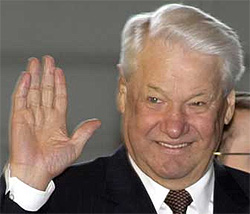
And who in my generation will forget the brave face of Boris Yeltsin on a tank in Moscow, denouncing the military coup in August 1991?
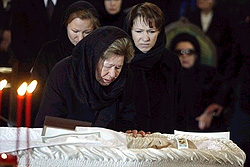
Yeltsin, the man that buried communism in Russia, was finally laid to rest last week. It was rather surreal to witness the mourning faces of the Muscovites, for until merely a few years ago, many Russians still held Yeltsin responsible for the disintegration of the Soviet Union.
There are several historical moments in world affairs that remain stuck in the deepest corner of my mind, and I am still trying to make sense of their significance: the bare-handed Chinese man standing alone before the line of tanks in Tiananmen Square in June 1989, the tragic and shocking death of the Ceacescus, the triumphal entry of Tony Blair into Downing Street (still my first taste of a change of government ever that may never take place in Malaysia!) etc.
And who in my generation will forget the brave face of Boris Yeltsin on a tank in Moscow, denouncing the military coup in August 1991?
Yeltsin, the man that buried communism in Russia, was finally laid to rest last week. It was rather surreal to witness the mourning faces of the Muscovites, for until merely a few years ago, many Russians still held Yeltsin responsible for the disintegration of the Soviet Union.
True, that Mikhail Gorbachev's perestroika and glasnost exposed the cracks in the crumbling communist system, but it was Yeltsin who pronounced the biggest Russian-speaking empire in human history dead. Gorbachev's helpless countenance on his return from the short-lived coup convinced leaders from the capitalist West to the communist China of the inevitable truth that the Soviet president had become irrelevant. The Soviet flag was lowered for the last time on the Kremlin on 31 December 1991.
 But Yeltsin's presidency was fraught with equal turmoil and turbulence, if not greater. It even became erratic towards the end. The shock therapy that Yeltsin applied to put right the ailing economy only impoverished more segments of Russian society. It was also ironic that the very leader who was instrumental in setting the three Baltic Republics free and throwing independence upon the ill-prepared Central Asian states should have resorted to a bloody war to keep Chechnya within the fledgling federation.
Moreover, Yeltsin's political friendships with George Bush Sr, Bill Clinton and John Major only alienated the nationalists and conservatives at home. But these three have-beens on the world stage have proved themselves to be friends in indeed they all paid their last respects in the Christ the Saviour Cathedral in Moscow to the man whose very few fond memories in the hectic world affairs they all share.
Moscow was ignored
Although Yeltsin should be rightly credited with the smooth transition which ushered in the era of Vladmir Putin, he did not make use of his goodwill with the erstwhile republics of the Soviet Union to sort out the difficult history in the region. With Yeltsin's leadership becoming increasingly ineffective towards the end of the 1990s, both Nato and the European Union practically ignored Moscow and began membership talks with eastern European nations and the Baltic republics. Pretty much like China, which remains concerned over the tacit "democratic" alliance between Japan, Australia and Taiwan in the Asia-Pacific region, Putin's Russia too interprets the political changes in its near abroad as 'containment'.

 Russia's failure to deal with its bereavement with the "glorious moments" of the Soviet past, coupled with the eagerness of the former Soviet republics to move out of Russia's sphere of influence, has rendered the diplomatic relations in the region too complicated to be handled. The world should therefore not be surprised at the violent clashes on the streets of Tallinn between the ethnic Russians and the Estonian police. The strong reactions from the Russian Duma, including calls to secede diplomatic ties with Estonia, were indeed bordering on irredentism, but the drastic measures of the post-Soviet Estonian authorities to reverse the policies that were seen as in favour of the Russian minority in the country were partly to blame too.
The struggle of man against power is the struggle of memory against forgetting, so says Milan Kundera. He may be right. But the contentious historical issues between Turkey and Armenia, Britain and its former colonies, Germany and Poland, India and Pakistan, as well as China and Japan, only show that such struggle will almost always arouse more bitterness and resentment.
As far as I see it, the wrath of the Russians has a deeper dimension. The Soviet Union was consigned to history because communism had become a spent force, while capitalism, represented by the US and its western allies, triumphed. The Russians were the clear losers in the decades-long ideological struggle.
 Today, the US is busy fighting another ideological warfare the threat of militant extremism by those who have hijacked Islam - on a different front. Strategically, the US remains firm in ensuring that its military superiority is unsurpassable.
In January this year, US Defense Secretary Robert Gates announced that a US missile defense program in Europe was in the pipeline to counter possible attacks by Iran. Although Gates assured that it would not direct at Russia, only those who are either politically nave or retarded would take the word as it is. Just like no one in East Asia would buy the assurance that the Patriot Missiles deployed by the US in Okinawa, Japan, were not aimed at China, the primary concern being North Korea notwithstanding.
Historical distrust and misgivings
So far, the US has entered bilateral talks with Poland and the Czech Republic about basing pieces of a missile defense system on their soil. Serious technical discussions were also under way about basing an anti-missile radar in the Czech Republic and interceptor missiles in Poland.
It is not to be denied that the two newer members of Nato still harbour deep-seated distrust of Russia, the Poles and the Czechs meanwhile are also hoping a closer military alliance with the Americans would bring them other perks, such as easier travel for them to visit the US and more favourable trade deals in future.
As always, not all Europeans are happy to see a return of arms race which might again make the continent the frontline of another East-West divide. Recent polls indicate that 51% of the Poles are opposed to an anti-missile base in Poland, while 61% of the Czech informants do not welcome a US-built anti-missile rador on their soil.
It is clear to the world that EU and Nato memberships have both improved the international standing of Poland and the Czech Republic. Whether or not the two countries would be willing to act as bridgeheads in the strategic arm twisting between the US and Russia at the expense of the peace and prosperity that they have sacrificed much to secure is another matter.
Meanwhile, what is certain is that historical distrust and misgivings, if not thoroughly dealt with, will only poison further the already tumultuous relations between nations, especially when those outside are awaiting a chance to stoke them to their own advantage.


