




Asean and its fragile identity
On his recent visit to Washington, Singapore's Prime Minister Lee Hsien Loong reiterated his country's support for President George W. Bush's plan to stay the course on Iraq, while urging the US to play a more proactive role in Southeast Asia.
Lee's position came as no surprise to the island state's neighbours. For years, his father Lee Kuan Yew has made it clear that Singapore perceives the presence of the US in Asia Pacific in general and in Southeast Asia in particular as pivotal in maintaining a stable balance of power in light of the potentially hegemonic rivalry between China and Japan.
Despite their breakneck economic growth from the 1980s through the mid 1990s, which helped forge a new sense of Asean solidarity, the devastating financial crisis of 1997/98 has left many Asean countries reeling from its shocking effects even a decade later. What the World Bank once termed 'the Asian Miracle' has become a bubble, exposing the Southeast Asian economies as 'paper tigers' while undermining Japan's economic leadership in the region. China, on the other hand, has emerged as an anchor of stability.
On his recent visit to Washington, Singapore's Prime Minister Lee Hsien Loong reiterated his country's support for President George W. Bush's plan to stay the course on Iraq, while urging the US to play a more proactive role in Southeast Asia.
Lee's position came as no surprise to the island state's neighbours. For years, his father Lee Kuan Yew has made it clear that Singapore perceives the presence of the US in Asia Pacific in general and in Southeast Asia in particular as pivotal in maintaining a stable balance of power in light of the potentially hegemonic rivalry between China and Japan.
Despite their breakneck economic growth from the 1980s through the mid 1990s, which helped forge a new sense of Asean solidarity, the devastating financial crisis of 1997/98 has left many Asean countries reeling from its shocking effects even a decade later. What the World Bank once termed 'the Asian Miracle' has become a bubble, exposing the Southeast Asian economies as 'paper tigers' while undermining Japan's economic leadership in the region. China, on the other hand, has emerged as an anchor of stability.
It has been a lost decade, and Asean's collective identity as a coherent actor now seems fragile. Being a small trading nation, Singapore has every reason to start looking beyond the regional grouping.
 In this context, preferential bilateral trade agreements between Singapore, the US and other major economies are a way out of the quagmire. Even Malaysia, a staunch advocate for a more concrete and effective regional mechanism, has begun its own bilateral trade talks with the US. All this speaks volumes of Asean's lack of economic prowess nowadays.
While Asean was doing its soul-searching, the Sept 11 attacks provided a golden opportunity for China to assume a greater regional role. Bush's insistence that other nations must declare themselves for or against the 'war on global terrorism' only laid bare the hegemonic nature of US foreign policy, forcing the less powerful Southeast Asian states to accommodate the White House's preferences or risk retribution.
As the Bush administration was quick to alienate the Muslim populations in the region, Beijing lost no time in capitalising on the growing mistrust and anxieties of the Southeast Asian nations towards the US to advance its own agenda. To the Chinese leadership, a cordial and trusting relationship with the region is key to preempting any containment plan by the US.
Pragmatism prevails
China's charm offensives have coincided with a dramatic drop in favourable opinions of the US since the infamous Iraq War and its messy, catastrophic aftermath. Such contrasts have also prompted many US apologists in Southeast Asia to adopt a pro-Beijing stance to make themselves more 'acceptable' to the public and to regain their lost credibility.
A confident, assertive and economically prosperous China not only has implications for the US - whose presence in Southeast Asia is still popularly seen as buttressing the region's stability - it has also begun to challenge Japan's imperfect leadership. Seen in this light, the Sino-Japanese diplomatic tussle in the last two years has no doubt been a grave concern for the Singapore leadership as it does not want to be forced to choose between the two East Asian rivals.
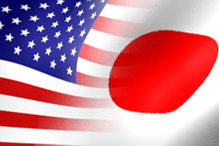 However, one must not overestimate China and Japan. Since the end of the Second World War, Japan has had no independent foreign policy, and Tokyo's strategic dependence on Washington has only constrained its own potential for regional leadership, while reinforcing the unilateral and at times hegemonic position of its American patron.
Although China's enormous and attractive markets, aided by its economic clout, are more than welcome, the Southeast Asian countries traditionally have deep-seated concerns over the country's long-term agenda, fearing some sort of a Chinese version of the Monroe Doctrine for the region. After all, the most populous nation on earth is generally seen as a 'non-status quo power' unhappy with the power alignment in East and Southeast Asia.
Moreover, contrary to what many western scholars have erroneously argued, I personally do not share the view that the sizeable and economically potent Chinese populations from the Philippines to Indonesia would serve as a springboard for China's influence in the region. With the exception of Singapore and, to a lesser extent, Thailand, Southeast Asian politicians of Chinese descent do not hold real powers in government and are often not privy to high-level foreign policymaking. In other words, they are politically emasculated, a fact that the Beijing leadership duly recognises in private.
As for those countries where the Chinese are in a dominant position, pragmatism prevails. Singapore is well known for its cautious navigation between the major powers while devoid of Chinese diaspora sentiments, while Thaksin Shinawatra, the former Thai prime minister of Hakka Chinese origin, forged closer ties with Beijing purely for economic considerations. Geo-strategically, Bangkok remained firmly under Washington's parameters throughout Thaksin's era.
A gentle reminder
Quite clearly, the only country that has the capacity to influence the position of the major powers vying for guardianship in Southeast Asia is still the US, especially in the area of security. The sole superpower's possession of logistical, military and technological resources to pursue its foreign policy goals and interests in ways that other countries cannot is a given fact.
When the disastrous tsunami struck in December 2004, Japan, Australia and Singapore initiated one of the biggest humanitarian and relief operation using their military assets under the aegis of the US.
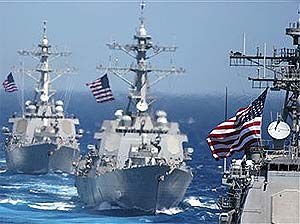 The Singapore leadership, governing with a siege mentality, knows full well that it is hard for China to achieve parity with the US when it comes to such impressive crisis response and management. It was certainly not a coincidence when Jakarta began its bilateral security negotiations with Washington in 2006, a move that could cast the feasibility of an Asean-wide security institution in serious doubt.
In addition, to respond to long-term 'competition' from China, the Quadrennial Defense Review of the Defense Department of February 2006 has set out plans to increase naval deployments and diversify the network of bases in the Pacific that would elevate considerably US surveillance and long-range strike capabilities
In short, the US will continue to figure large in any strategic and security arrangements concerning Southeast Asia for the foreseeable future. Lee's statement could therefore be seen as merely a gentle reminder for China and Japan to sort out their differences and further enhance their necessary capabilities.


Are you sure you want to delete this comment?
This action cannot be undone.