




Letting Umno leak away
Do the Barisan Nasional (BN) component parties, their leaders and members believe in their heart of hearts that their best interests are served under an Umno-led government?
Celebrations of at least two momentous dates provide us with the opportunity to re-examine Umno and ethnic politics in the country we love so much - May 13th, and Umno's anniversary.
The clearest lesson taught by Dr Kua Kia Soong's ground-breaking analysis of the 1969 riots as well as countless examples of violent ethnic conflict in Africa and elsewhere is simple: that ethnic tensions are almost invariably a function of politics, not the other way around.
Do the Barisan Nasional (BN) component parties, their leaders and members believe in their heart of hearts that their best interests are served under an Umno-led government?
Celebrations of at least two momentous dates provide us with the opportunity to re-examine Umno and ethnic politics in the country we love so much - May 13th, and Umno's anniversary.
The clearest lesson taught by Dr Kua Kia Soong's ground-breaking analysis of the 1969 riots as well as countless examples of violent ethnic conflict in Africa and elsewhere is simple: that ethnic tensions are almost invariably a function of politics, not the other way around.
May 13 has been used ad nauseam to suggest that only the BN mould of politics is viable for Malaysia - where ethnic groups are so divided that they must forever be separated politically.
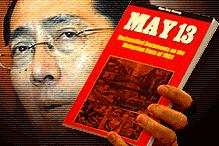 Kua's findings clearly provide context and proof that it wasn't inherent 'racial hatreds' that sparked off the riots, but Umno's quest for political dominance at any cost - completely debunking the myth that primordial ethnic divisions necessitate a body politic divided along those same lines.
'Political dominance at any cost' perfectly encapsulates the mindset that has reigned supreme in Umno from May 13, 1969, to Ijok 2007.
From 1969 onwards, Umno has used the riots to justify supremacist Malay overlordship instead of just and equitable Malay-led governance.
It is crucially pivotal to realise that this 'Malay overlordship' has almost nothing to do with the Malays, and everything to do with Umno.
Our first-past-the-post (and ridiculously corrupt) electoral system allows almost no recognition whatsoever to the massive numbers of voters - both Malay and non-Malay - who have rejected Umno's bankrupt brand of politics wholesale.
Since massive numbers of people, both within BN and without, clearly and passionately object to the awful excesses of Umno, a closer look at what keeps Umno in power needs to be taken.
Umno bigotry
The 'core' of BN is said to be the concept of 'power-sharing'.
What the Malaysian public is becoming increasingly aware of, however, is that sharing the occasional parliamentary or state assembly seat is not the same as sharing power.
One of the opposition's most well received charges is that the non-Umno BN component parties have been reduced to nothing but office boys or budak suruhan . Voting patterns damningly and thoroughly confirmed this perception both in Ijok, and to a different extent, in Machap.
Even the most capable and well-meaning of component party representatives are made to shut up and suck it up in the face of blatant bigotry, intolerance and gangsterism.
With perfect irony, Umno's anniversary celebrations 'coincided' with some of the best examples of this behaviour.
Umno clearly has no respect for other ethnic groups: not content with being racist at home, a politician chosen to be a minister no less, Jamaluddin Jarjis, went all the way to California to make derogatory and demeaning statements about Indian Malaysians.
Umno clearly has no respect for other religions: even a simple, civilised dialogue between religious group is cancelled (whether it was merely 'postponed' remains to be seen).
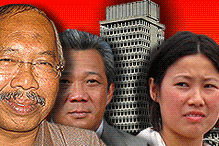 Umno clearly has no respect for women: just when you thought MPs Mohd Said Yusof and Bung Mokhtar Radin couldn't possibly be any more bigoted, they resorted to insulting remarks about menstruation in a feeble and humiliating attempt to deflect attention from how corruption is causing leakages in more than one way throughout the 'hallowed' halls of government.
Umno clearly has no respect for peace or the most noble Malay precepts of sopan-santun and budi bahasa : everyone saw the pictures of Umno Youth deputy chief Khairy Jamaluddin trying to find the best balance between an ape and a hooligan in Ijok, while his underlings beat 16 stitches into opposition supporters' heads.
All these very recent events are in keeping with the 'finest' traditions of Umno - dating back from the manipulations of Harun Idris and Abdul Razak Hussein in 1969, through to keris-waving by both Najib Abdul Razak in 1987 and Hishammuddin Hussein in 2006 as well as statements from Khairy in Jeram about Chinese vultures waiting to take advantage of Malay weakness and so on.
Content as cowards?
The simple question is: where are the rest of the BN MPs in these debacles? The even simpler answer is: silent.
It is probably inaccurate to conclude from this that BN MPs are universally inept, cowardly or clueless. We would be served better by analysing the systemic constraints under which they operate.
 The better representatives go into politics to make a difference in people's lives. A significant portion of them believe that they simply can't make this difference as members of the opposition, so they join the establishment - an establishment that has frightened generation after generation into believing that they must cower before big brother Umno and never offend them at any cost.
In their heart of hearts, however, many of these better politicians and representatives yearn day and night for an end to the Umno regime.
While the ever-resilient DAP and PAS were harder pressed to provide a centrist, Malay-led alternative to seriously challenge that regime, new forces have come into play that have completely transformed the possibilities in Malaysian politics.
The question then becomes: why prop up and be led by supremacist, uncouth bigotry, when you can help lead a bravely multi-ethnic movement committed to equal justice and development for all?
To the opposition hard-core, this question tends to inspire a need to hit one's head against the wall in frustration. Taking a step back however, reveals that some of the clearest obstacles involve incumbency and credibility.
While the opposition has traditionally had difficulty focusing on marketing itself as credible alternatives to the government, especially in the last few decades of the previous millennium, the ever-growing stable of high profile, highly educated and extremely accomplished individuals and technocrats in the opposition are fast communicating to Malaysia that they are more than capable of being entrusted with the reins of government.
All that remains then is breaking the mental barriers of incumbency.
The incumbents themselves and current BN leadership cannot really be trusted to lead this sea change - no matter how much their original aspirations as politicians may push them to; their vested interests in the establishment run far too deep.
It falls then, as it always does, to the party grassroots and the voters.
Secret pleas
Many voters understandably have a sentimental connection to MCA, MIC, Gerakan or their particular elected representatives from those parties, and may not be terribly keen to vote them out of power - however much this comes into conflict with how much they despise Umno.
 Voters with these inclinations should perhaps experiment with a longer view of politics: one where their favourite politicians can be propelled into the golden age of Malaysian politics - a place they'd much rather be than in the hell-hole of Umno dominated politics which they now inhabit.
That same longer view of politics will reveal the fact that our leaders will always consist of the likes of Mohd Said and Bung Mokhtar unless Umno is dethroned. Most of us do not vote in either Jasin or Kinabatangan, but surely there must be some way to register our protest, and if those from within BN are too trapped to do so, it falls to us to break their shackles.
It is vitally important to remember that voting opposition only truly eliminates the bigots and the hate-mongerers. All other BN politicians will find themselves welcomed wholeheartedly into a Malaysia reborn when the old regime falls.
I trust that any truly well-meaning component party member or politician will not seriously try to defend an Umno dominated system over one led by proponents of progress without any stain of discrimination - it would very simply be attempting to defend the indefensible (of course, all attempts to do so are welcomed in the spirit of public discourse).
They may however, again, argue the question of incumbency - the fading myth of BN/Umno 'invulnerability'.
 This, once again, is where the responsibility falls to the voters. When your better-meaning BN representatives tell you that only the BN formula can win, what they are really secretly pleading with you to do is to vote for the opposition until Umno can finally and forever be dislodged, and they can take their rightful place in a reformed political structure that more accurately represents both their passions and beliefs as well as your own.
Those outside of Umno who do not wish for this in private are probably making too much money from the system.
Voters have the only power that really matters, and they know it. BN propaganda over the years has tried time and time again to fool those voters into believing that one vote doesn't really count, and that they're the only winning horse to bet on.
As the new millenium takes hold and new media breaks the BN stranglehold, voters now see that the only part of a horse that should be associated with BN is its rear end.
One simple X in the right box is all it takes to give Malaysia new life. Not a million, not a thousand - just one. That X belongs to you, and to no one else.
NATHANIEL TAN works for Parti Keadilan Rakyat, and he reckons that if you are ready for change, then Malaysia is ready for change.


