




Oh! The peaceful Japan
There was an exhilarating discussion on the differences between the war memories of Germany and Japan last Wednesday, which I thoroughly enjoyed. The group was small, yet everyone was keenly engaged in sharing their thoughts and even offering counter-arguments.
During a brief moment of debate on the legitimacy of the Tokyo Trial, I went a step further by stating that the Trial that sentenced the 14 Class A war criminals to death had been a farce from the beginning. The Japanese people, being also victims of war, were denied the right to put the perpetrators including the powerful Emperor Hirohito on trial, and the whole procedure was dictated by one vengeful man General Douglas McArthur who was bent on seeking revenge on the Pearl Harbour attack and the loss of the Philippines.
There was an exhilarating discussion on the differences between the war memories of Germany and Japan last Wednesday, which I thoroughly enjoyed. The group was small, yet everyone was keenly engaged in sharing their thoughts and even offering counter-arguments.
During a brief moment of debate on the legitimacy of the Tokyo Trial, I went a step further by stating that the Trial that sentenced the 14 Class A war criminals to death had been a farce from the beginning. The Japanese people, being also victims of war, were denied the right to put the perpetrators including the powerful Emperor Hirohito on trial, and the whole procedure was dictated by one vengeful man General Douglas McArthur who was bent on seeking revenge on the Pearl Harbour attack and the loss of the Philippines.
The 731 Unit Germ Warfare research - a horrendous crime - was not included in the process because the Americans believed the vitally important knowledge of the Japanese doctors trumped justice, and many of them were taken to the United States for further research
As I wrote in this column before, the successive Japanese governments since 1945 have failed to face up to their nation's darkest past due to various factors, internal as well as external. The failure of the Tokyo Trial, for one, has no doubt clouded the perception of the modern-day Japanese in this respect.
Peace heritage
There is now a clear international consensus that Germany has accomplished far more than Japan in facing up to its war legacy. The Germans seem to believe a forthright attitude in dealing with the Nazi era is an essential vessel for moral recovery, and hence often find themselves in cauldron of debate on how the darkest chapter of German history can be best remembered. Unfortunately, such cultural resource is not available to the Japanese, who tend to think dwelling on the past does not command respect. Many of the rightwing politicians in Japan prefer to offer the world something different that, to their mind, will be more promising and fruitful: peace.
Unlike many Chinese around the world who are constantly on a lookout to demean the entire Japanese nation solely on account of the revisionist view of the extreme rightwing forces, I am more than willing to acknowledge the peace heritage so jealously guarded by the Japanese over the last few decades. The only issue that continues to bother me is how to lift them out of the victimhood mentality as a result of the catastrophic atomic bombings and encourage them to examine in greater depth the horrible crimes committed by the Japanese Imperial Army in the 1930s and 1940s.
This "future-oriented" atonement premised on world peace has served Japan well so far. It is now a well-respected country at least in the eye of the western world, as indicated by the first Global Peace Index released this week, which puts Japan on the 5th place as being the most peaceful nation. (Iraq, first invaded by the US and then caught in sectarian violence, is at the bottommost, a reason why the neo-cons and war apologists have gone silent.)
 But now there are clear signs that Japan's post-1945 peace heritage is at risk. The rise of China as an economic and political power may have been overrated, it has caused real and tremendous fear among the Japanese populace nonetheless. Meanwhile, a belligerent North Korea emboldened by its newly-found nuclear prowess and backed by the Chinese leadership has been unhelpful. It is easy to understand why Tokyo and Washington both do not trust Beijing fully. After all, Pyongyang's nuclear warheads should they be developed would more likely be pointed east rather than west.
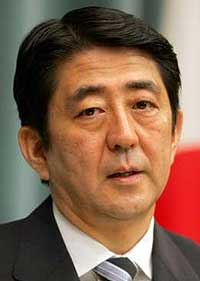
The anxieties of the Japanese play into the hand of the rightwing forces, whose call for constitutional amendments is getting louder by the day. Just a few weeks ago, Prime Minister Shinzo Abe announced the plan to form a panel of experts to look into the possibilities of reinterpreting the Pacifist Constitution, which was imposed by none other than McArther in 1946.
'Britain of the East'
This is strange, as the body that is granted the right to interpret the Pacifist Constitution is Japan's Supreme Court, not an extra-constitutional body made up of nationalistic scholars and politicians. But Abe is in many ways much shrewder and smarter than his predecessors. He knows full well that any military action that is not strictly for the defence of Japan could potentially be in violation of Article 9 of the constitution.
Given that the passage of a host of emergency and security-related laws in the last few years, the reaffirmation of the US-Japan strategic arrangements, and Tokyo's recent agreement to develop a ballistic missile defence (BMD) system with the help from Washington, paving the way for Japanese bases to intercept ballistic missiles targeting the US, necessary changes have to be made to the Pacifist Constitution, and Article 9 in particular, in order to facilitate these new developments. According to Martin Seiff, a United Press International senior news analyst, a two-tiered system of BMD has been mooted by the two countries, and US Defense Secretary Robert Gates has stated publicly that Japan should demonstrate greater commitment to use the system "in defence of the US."
Abe, meanwhile, has promised his people that Japan will become a normal but "beautiful" and "peaceful", ready to shoulder more security burdens worldwide. To achieve that end, he is willing to enter into a pact with the US as a junior partner, a "Britain of the East", which has won praises from neo-cons like Charles Krauthammer, who has even suggested that the US should not only unfurl its nuclear umbrella for the "most reliable partner after Britain", but allow it to develop nuclear weapons also. Of course, the same Krauthammer regretted the fact that Article 9 had prevented Japan from sending troops to invade Iraq back in 2003.
Article 9 has long served as a bulwark against any attempt by irresponsible Japanese politicians at remilitarisation. Should Abe be so deluded as to conclude amendments could be made while the country's wishy-washy attitude towards war legacy, such as the comfort women issue, remains, he could just end up making Japan a beautiful but less peaceful nation.


Are you sure you want to delete this comment?
This action cannot be undone.