




G8: Not one big happy family
The G8 Summit held in Heiligendamm, Germany, this week is significant for various reasons. Chaired by German Chancellor Angela Merkel, it is the first hosted by a female head of government in so many years since the heyday of the Thatcher-Reagan, and will be the last for Tony Blair, the outgoing British prime minister (and the Blairites at home must be keeping their fingers crossed that there would be no sequel to the Yo, Blair last year!), etc..
Most of all, it has been overshadowed by the increasingly acrimonious relations between the United States and Russia. President Vladimir Putin's warning last Sunday that any attempt by the US to deploy a missile defense system in Poland and the Czech Republic would turn Europe into a powder keg, as the Russian leader was convinced that it was his country rather than Iran that was on the back of President George W Bush's mind.
The G8 Summit held in Heiligendamm, Germany, this week is significant for various reasons. Chaired by German Chancellor Angela Merkel, it is the first hosted by a female head of government in so many years since the heyday of the Thatcher-Reagan, and will be the last for Tony Blair, the outgoing British prime minister (and the Blairites at home must be keeping their fingers crossed that there would be no sequel to the Yo, Blair last year!), etc..
Most of all, it has been overshadowed by the increasingly acrimonious relations between the United States and Russia. President Vladimir Putin's warning last Sunday that any attempt by the US to deploy a missile defense system in Poland and the Czech Republic would turn Europe into a powder keg, as the Russian leader was convinced that it was his country rather than Iran that was on the back of President George W Bush's mind.
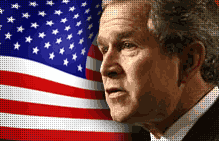 Prior to this, Bush had criticised Russia on a range of issues, and not least so on democracy, human rights and Moscow's "backtracking" on reforms. Meanwhile, the rhetoric employed during a
hearing
last month by the US Congress' House Committee on International Affairs could not help but be reminiscent of the dark days of the Cold War. It was called "Russia: Rebuilding the Iron Curtain."
Prior to this, Bush had criticised Russia on a range of issues, and not least so on democracy, human rights and Moscow's "backtracking" on reforms. Meanwhile, the rhetoric employed during a
hearing
last month by the US Congress' House Committee on International Affairs could not help but be reminiscent of the dark days of the Cold War. It was called "Russia: Rebuilding the Iron Curtain."
Quite clearly, no amount of reforms would satisfy the US president if these efforts were deemed not beneficial to Washington. With confrontational language abounding, it beggars belief that the world should be surprised at the "sudden" deterioration of US-Russian relations.
Nearly 16 years after the collapse of communism in Europe and the disintegration of the former Soviet Union, many Russians again find themselves under siege just when the country is trying to assert itself as a sovereign power. The sharp rise in oil prices since Putin's ascension to presidency seven years ago has boosted a nation that had spent almost a decade in pain searching for a pillar of cloud and fire.
Sense of betrayal
Mikhail Gorbachev, who single-handedly consigned Soviet rule to history and has long been held as a dear friend of the Western world, credited with putting Russia on the road to democracy and capitalism, has also been compelled to speak against "American imperialism" in an interview with the BBC. One could detect a strong sense of betrayal in his tone.
That is only understandable. In his relatively short leadership, Gorbachev strove to secure a peaceful environment both within and without the then Soviet Union in which Moscow could rebuild its ailing economy and halt the rot of the country, only to see the Union collapse before his very eyes. Following weeks of escalating tension between Russia and America, Gorby, as he was once fondly and popularly known, must have been wondering if all his legacy has been a delusion.
As far as Germany is concerned, Bush had hoped the election of Merkel as a right-of-centre chancellor in late 2005 would enable the US to consolidate its trans-Atlantic leadership over Europe in the post-Soviet era. However, Germany's geostrategic position in the Continent has predestined that the most populous country in the European Union cannot simply go along with whatever hegemonic agenda that the US president has in mind.
It is true that Merkel has been more vocal of Russia, drawing a clear line between her and Gerhard Schroeder, her predecessor, yet the fact that Berlin is dependent on reliable energy supply from Moscow has stopped her from being seen as outright anti-Putin. Moreover, Merkel's strange bedfellows, the Social Democrats in her coalition government, have been persistently refusing to be drawn into any conflict between the US and Russia, seeing both powers as vitally important to Germany.
It is also interesting to note that Merkel, having lived through the communist era in the former East Germany, can be firm in ensuring that Europe focuses on economic revitalisation and political empowerment, instead of sleepwalking into another Cold War.
China's open criticism
One country is watching the US-Russia episode closely with keen interest. Before the G8 Summit in Gleneagles in Scotland two years ago, there had been calls from the international community for China to join the most powerful club in tandem with its growing economic might. To the dismay of many enthusiasts, Beijing opted to resist the vainglory by playing down the possibilities, while reiterating its preoccupation with economic development at home.
Mindful of the reality that the US cannot establish its global dominance without taking Europe and Japan on board, the Chinese leaders have moved from cautious self-restraints to open criticism in regard to Bush's insistence on the deployments of missile defense system in Central Europe and Japan. Both Moscow and Beijing now see it as detrimental to their mutual benefits in their respective "spheres of influence".
The Chinese leadership, seeking to please the Americans at all times for economic reasons, has now been forced to acknowledge that the planned global anti-defense system is a step too far, calling it "targeting at Russia and China", according to its official mouthpiece the People's Daily.
With the benefit of hindsight, it is perhaps safe to conclude that Beijing was right to turn down the calls for China to join the G8 as a full-fledged member. Now that Russia has been subject to stringent demands and incessant suspicions despite its imperfect democratic credentials, and the Chinese leaders must dread thinking what ridicule they would have to endure from their American and European counterparts given China's plethora of human rights violations and lack of any democratic pretension.


Are you sure you want to delete this comment?
This action cannot be undone.