


/file/publisher-c1a3f893382d2b2f8a9aa22a654d9c97/2023/10/4d093b298d05537c70ec9435b6c28b77.jpg)

COMMENT | Anwar and his govt's greatest challenge
COMMENT | How can Prime Minister Anwar Ibrahim and the coalition government take the nation forward depends on whether they are able to correctly analyse the deep roots of the current diseases that are affecting the nation’s society, economy, and politics.
From this, honest analysis can then produce the policy initiatives and medication that can help cure Malaysia of the multiple illnesses that we see today and which will continue to recur until a fatal attack devastates the country.
The first step in trauma treatment is to identify how and why the trauma - physical and psychological - has come about. Medical science identifies three major types of trauma - acute, chronic, and complex.
Trauma can stem not only from acts of violence but also as an outcome of bullying, intimidation, oppression and subjugation.
COMMENT | How can Prime Minister Anwar Ibrahim and the coalition government take the nation forward depends on whether they are able to correctly analyse the deep roots of the current diseases that are affecting the nation’s society, economy, and politics.
From this, honest analysis can then produce the policy initiatives and medication that can help cure Malaysia of the multiple illnesses that we see today and which will continue to recur until a fatal attack devastates the country.
The first step in trauma treatment is to identify how and why the trauma - physical and psychological - has come about. Medical science identifies three major types of trauma - acute, chronic, and complex.
Trauma can stem not only from acts of violence but also as an outcome of bullying, intimidation, oppression and subjugation.
Psychological trauma is a more difficult condition to diagnose and can be a response or an outcome of a stressful event. Individuals, groups as well as entire communities can experience trauma.
Trauma can result in a wide range of physical and emotional symptoms and responses. With diagnosis and appropriate remedy, individuals, groups, or communities can address the root cause of the trauma or find constructive ways to manage the symptoms.
Traumatic experiences are not necessarily one-off episodes. They can recur repeatedly or manifest themselves in different or related events and experiences.
To understand the trauma of non-Malays and non-Muslims, it is necessary to have a historically informed knowledge and assessment of the events and developments leading to, and accounting for the traumatised condition. Only after that can come the treatment and solutions to deal with the trauma.
Emergence of Ketuanan Melayu
Few will dispute that the key causative factor is the emergence of a racially hegemonic ideology soon after independence and which has accelerated in intensity.
We are not talking about a recently inflicted trauma but one of a long duration of several decades and which has taken on a permanent condition.
The main responsible parties in the shaping and concretion of the institutionalised racist ideology have been Umno and PAS, with supporting roles provided by the MCA, MIC, and other non-Malay parties that have governed the country.

Together, they have been responsible for the racially driven politics which has been manipulated and exploited to entrench the single-party dominance that the country has had until recently.
In particular, six decades of electoral boundary changes and gerrymandering with the electorate vote of non-Malays severely disadvantaged - by as much as a factor of four non-Malay votes being worth that of a single Malay - has ensured unfair election outcomes.
According to one study conducted by Harvard University and the University of Sydney in 2017 on electoral integrity, Malaysia ranked 142 out of 158 countries and was far behind our Asean neighbours of Singapore, Indonesia, and the Philippines.
The research involved assigning a PEI (Global Perceptions of Electoral Integrity) score that measures electoral laws, electoral procedures, district boundaries, voter registration, party registration, media coverage, campaign finance, the voting process, and vote count to capture an electoral system’s degree of manipulation.
The fact of the matter is that anyone in the world wanting to understand the extraordinary longevity of BN rule does not have to look hard for evidence of how the Alliance and BN parties manipulated the electoral playing field through numerous underhanded and unethical practices.
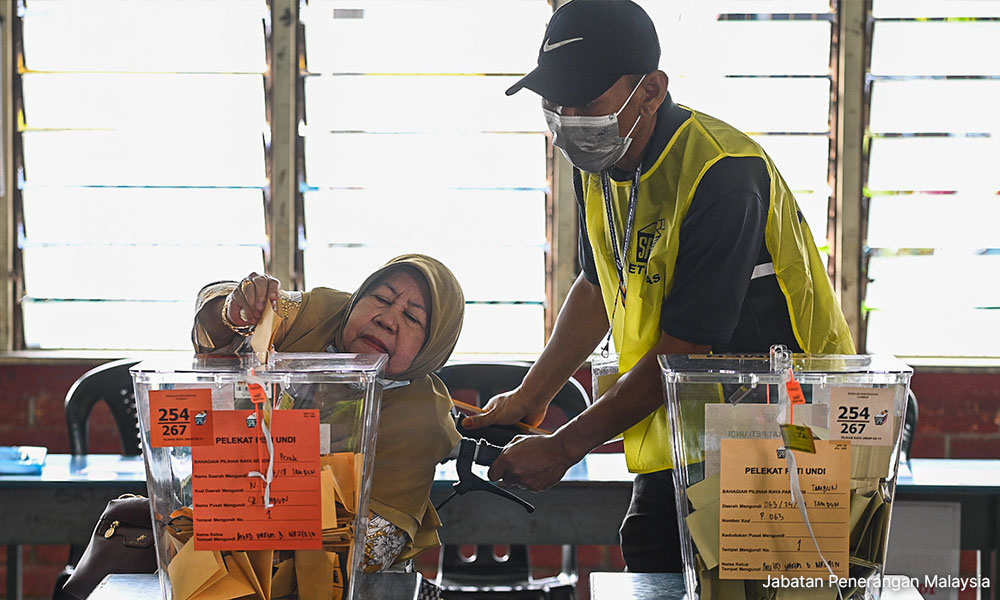
The main losers of Malaysia’s deeply flawed government have been the non-Malays. Within the nation’s political system governed by the past ruling coalitions of Alliance and BN, the key players and influencers have been Umno and PAS.
Today, the latest coalition of Perikatan Nasional finds its Malay-dominated incarnation in Bersatu.
For Umno and its membership of 3.5 million, its founding principles based on Malay nationalism and Malay supremacy have remained unchanged.
The same can be said of PAS. Set up by Islamic clerics who were members of Umno subscribing to its racial principles and ideology, the party represents a key component of the Malay community. But this breakaway harnessing Islam as its main driving force has not been in any moderate or progressive direction.
Meanwhile, the latest Malay party Bersatu’s ideology and mission objectives are equally focused on an updated variation of an institutionalised racist ideology
Civil service’s role in implementing hegemony
Critical in the development of the nation, the civil service has become a less inclusive and more exclusive Malay enclave - some would see it as a tool for Malay interests - with the political grip of Umno and PAS on it reinforced by an initially burgeoning but now dominating Malay presence in all sectors of life in the private sector.
Together, the bureaucracy and two Malay parties, one from the ruling coalition and the other from what appears an outwardly oppositional party but in fact is a supportive ally in the espousal of a Malay-dominant nation where Islam is instrumentalised to capture political power, have successfully redefined the country’s politics and policies to ensure Malay supremacy and hegemony in life and society.
It is a supremacy that is not directed solely at the retention of political power. It is one that can be likened to a hydra with multiple points of growth, outreach and goals, and what may sometimes appear to be opposing leaders with outwardly divergent aims and different strategies.
In reality, it stems from the same genus of “ketuanan Melayu”. In effect, we have a mass psychosis which has reached into every corner of Malay society and which is aimed at dominance in every aspect of society.
There has been perhaps only one Malay leader with a multiracial vision for the development of the country. This rare exception is the nation's founding father, Tunku Abdul Rahman, who was forced to resign as prime minister after the May 13, 1969 riots.
The aftermath of the episode saw more extreme Malay forces backed by Tunku’s deputy, Tun Abdul Razak, and Dr Mahathir Mohamad demonise and reject Tunku’s moderate racial politics to usher in an era of pro-Malay policies.
Since the departure of Tunku, Malay supremacy and hegemony have increasingly become the raison d'etre and common driving motivation for all Malay-based political parties and their leaders.
Today, Umno, Bersatu, Pejuang, and PAS are all in agreement on some form of “ketuanan Melayu”, although this may be couched in slightly different or less precise and explicit terms in their respective party constitution and agenda.
The question now is whether Anwar is like Tunku Abdul Rahman, Nik Aziz, or a version of Mahathir in his analysis and treatment of the nation’s condition.
Some think that he may perhaps be a clone of Hadi as he brings Islam into the forefront of policy making.
Meanwhile, and ever since May 13, for many non-Malays, the only escape from the trauma of institutionalised racism in Malaysia is to migrate.
LIM TECK GHEE is a former senior official with the United Nations and World Bank.
The views expressed here are those of the author/contributor and do not necessarily represent the views of Malaysiakini.
/file/1307/72729657d9543207c8f3e776f19d8112.jpeg)
/file/publisher-c1a3f893382d2b2f8a9aa22a654d9c97/2023/09/20f4298c9ee45e1255dff905e431cb4e.jpg)
/file/publisher-c1a3f893382d2b2f8a9aa22a654d9c97/2023/10/9dcb228001e31fe809621eb4fb78f6ff.jpg)
/file/publisher-c1a3f893382d2b2f8a9aa22a654d9c97/2020/10/c5ce36274e24fa5afeab2500b0df3adb.jpg)
/file/publisher-c1a3f893382d2b2f8a9aa22a654d9c97/2023/11/c0a1aa42aee4a123084ca664fb779c01.jpg)
/file/publisher-c1a3f893382d2b2f8a9aa22a654d9c97/2023/10/5e40085281c7b057e1a772b0380d6382.jpg)


Report this comment
Are you sure you want to delete this comment?
This action cannot be undone.