




Between the bus and LRT (Pt 1)
When it comes to discussing public transportation issues, some of my neighbours in Subang Jaya are probably quite happy.
After all, the LRT extension to Subang Jaya has been proposed and accepted. The funding has been obtained, and plans are being developed by SPNB. Even the residents of Subang Jaya have gotten involved, proposing a plan and delivering it to SPNB.
The LRT is coming, and the residents of Subang Jaya and Bandar Sunway and UEP Subang Jaya are eagerly awaiting it.
When it comes to discussing public transportation issues, some of my neighbours in Subang Jaya are probably quite happy.
After all, the LRT extension to Subang Jaya has been proposed and accepted. The funding has been obtained, and plans are being developed by SPNB. Even the residents of Subang Jaya have gotten involved, proposing a plan and delivering it to SPNB.
The LRT is coming, and the residents of Subang Jaya and Bandar Sunway and UEP Subang Jaya are eagerly awaiting it.
And to make a sweet thing even sweeter, the Selangor government is announcing a plan to build an LRT line around the Klang Valley, including a connection from KL-Klang.
While I am excited by the prospects of better public transportation, I'm not the type who accepts the idea that the arrival of the LRT extension or more LRT lines will solve most of the public transportation problems in Subang Jaya or the Klang Valley.
This skepticism seems to be getting some of my neighbours a little bit concerned. After all, they have been lobbying hard to get the LRT extension to Subang Jaya, and such an attitude might damage those chances.
Ten years of waiting for a LRT extension has left the townships of Subang Jaya, Bandar Sunway, and USJ with nothing but hopes.
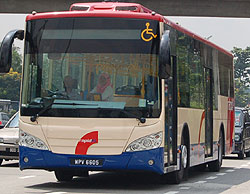
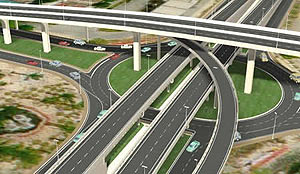 Public transit services in these areas have been poor. The bus services offered by various companies such as Triton, Uptown Ace, Metrobus and lately RapidKL, spend most of their time servicing the main roads. For years, the services have not been consistent or reliable.
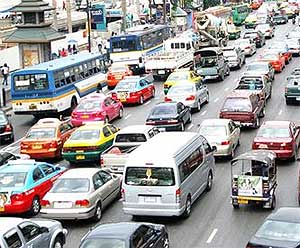
As a result, car traffic has increased and increased to the breaking point. New flyover projects are being proposed to disperse (but not reduce) traffic throughout the Klang Valley. Yet cheap, effective and quick improvements to public transportation services are usually ignored.
So when the government starts talking about LRT extensions - to Subang Jaya and USJ, with a short hop to Bandar Sunway and from KL to Klang and an outer LRT line - well, who are we to complain?
But public transportation projects should not be given out as 'gifts' from the government. Rather, it is an investment in the infrastructure of a community.
And like all good investments, investment in public transportation and public transit should be regular and consistent, and above all, responsible.
Careful planning
Good public transit service is never going to be cheap. And why should it? Investing in public transit is a challenging, costly investment that must be done right because it will shape the character of a city for many years.
This is why careful planning must be done when creating a public transit network. The government must invest the right amount of money, to create the right public transit service, in the right area. This service must meet the needs of passengers in the near future and in the long term as well.
 If too much money is spent on providing transit services to one area, other areas may miss out on the benefits of transit services. They may not get the transit services that they need.
If the Selangor government wants to build an LRT line linking Klang, Puchong, Kajang, Ampang, Ulu Klang and Rawang, communities in the outer Klang Valley, that is their prerogative.
Unfortunately, the communities in the inner Klang Valley, the ones that need the LRT lines the most, will be neglected.
Urban areas should have the first priority for the construction of LRT lines. If the government wants to spend money, it should be spent in the Federal Territory of Kuala Lumpur, then Selangor.
Bus and LRT
The foundation of public transportation services is the humble bus. It has the flexibility, capacity, and frequency to meet the needs of most passengers, as well as the needs of the public transit operator. Buses run on existing roads, which means that they can be introduced quickly to meet the needs of the public. They also cost less because less investment is required.
But there are two main disadvantages to bus service. The first is that unless changes like bus-lanes are made, bus services will get stuck in the same traffic as everyone else. The second is that Malaysian bus services (being privatised) operate on a competition-based model, rather than a service-based model.
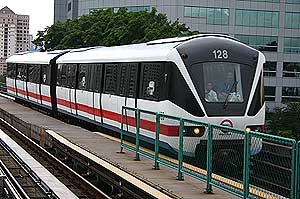
 This is one reason why many people in Malaysia find that Light Rail Transit or Light Rapid Transit is a popular transit option. Malaysia's LRT lines are grade separated. This means that the LRT is either above or below ground level. The advantage of grade separated LRT is that it can move far more people than buses, and because it is grade separated, traffic congestion is not an issue. However, LRT requires a heavy financial investment. Elevated or underground construction is costly and time consuming.
LRT also lacks the flexibility offered by buses. Bus routes can come to you, but you have to go to the LRT.
For high-density and urban areas, investment in LRT is the most sensible thing to do, because more people need to be moved around. For suburban areas and low density areas, investment in cheaper modes of transit with more flexibility, would be the better choice.
A typical bus carries 75 passengers. During peak hours, a bus might arrive every 10 minutes, although this is not typical. However, we can see that a route operating 75-passenger buses in mixed traffic at a frequency of five-minutes per bus (12 buses per hour) can carry a maximum of 900 passengers per direction.
In contrast, an LRT system like the Kelana Jaya LRT or Seri Petaling LRT will carry far more passengers and move them about faster and with more comfort. The Kelana Jaya LRT train carries 260 passengers. At the typical frequency of two minutes between trains (30 trains per hour), the Kelana Jaya LRT line can carry a maximum of 7,800 passengers per hour per direction. If this service frequency is increased to 90 seconds between trains (40 trains per hour), the Kelana Jaya LRT line can carry a maximum of 10,000 passengers per hour per direction.
The service gap
We can see that there is a huge gap between the number of passengers who can be moved by buses and LRT. For 10 years nothing has been done to fill this service gap.
 People have assumed that the only way to build better, safer, faster public transit is to build LRT. Effectively, we have started to believe that LRT is the only option worth waiting for.
While we have waited and waited, use of public transportation has dropped sharply, from 30% down to 16%, while roads have become more and more congested.
Ironic, isn't it? Billions of ringgit have been invested in LRT lines, but transit use has dropped by nearly half.
Even more ironicit was the introduction of the better organized and more reliable RapidKL bus services that has encouraged more and more people to start using public transit again.
Between the bus and LRT (Pt 2)
Between the bus and LRT (Pt 3)
MOAZ YUSUF AHMAD is a regular user of public transport who is deeply concerned that government plans to encourage people to use public transport will ultimately fail because of poor planning and a lack of support from the public.


