




Reservations about Rushdie
What you are now reading, Reservations about Rushdie , is the essay's third draft. After some deliberation, I decided to chuck the first two versions which I had titled Apostasy: Revisiting Salman Rushdie . This final rewrite is an 11th-hour effort exploring instead the subtext in my earlier copy.
Version #1 looked at the reasons why I believe Rushdie's vintage writings remain relevant to us and our times. His subject matters communal tensions and inter-faith conflict in for example Midnight's Children and what he terms the 'goblins of sectarianism' bedevil us still. Against the negativity, Rushdie weaves themes of rapprochement, reconciliation and mutual acceptance.
In this initial version, I said PAS protests too much. Okay, so Rushdie's got the knighthood. Well, he IS a good writer. He crafts literature. But I had also to confront the 'Rushdie Dilemma' and attempt to gauge readers' response. After all hell broke loose, the celebrated author was tasked: 'Surely you anticipated the firestorm that would erupt!'
What you are now reading, Reservations about Rushdie , is the essay's third draft. After some deliberation, I decided to chuck the first two versions which I had titled Apostasy: Revisiting Salman Rushdie . This final rewrite is an 11th-hour effort exploring instead the subtext in my earlier copy.
Version #1 looked at the reasons why I believe Rushdie's vintage writings remain relevant to us and our times. His subject matters communal tensions and inter-faith conflict in for example Midnight's Children and what he terms the 'goblins of sectarianism' bedevil us still. Against the negativity, Rushdie weaves themes of rapprochement, reconciliation and mutual acceptance.
In this initial version, I said PAS protests too much. Okay, so Rushdie's got the knighthood. Well, he IS a good writer. He crafts literature. But I had also to confront the 'Rushdie Dilemma' and attempt to gauge readers' response. After all hell broke loose, the celebrated author was tasked: 'Surely you anticipated the firestorm that would erupt!'
But as Rushdie tried to explain, if he had told the publishers (in 1988) that his book would rock the world, he'd have been accused of being an egomaniac. Personally, I do not expect to be threatened with violence was I to publish my essay as I had originally written it. My topic is Rushdie, not Islam or Prophet Muhammad. However, I did expect to alienate a segment of the readership.
 'Mind the Muslim sensitivities' feels like debased currency because it's been so often used and abused as political coin. Frankly, I'm weary of this exhortation seeing that give-and-take usually connotes the non-Muslims giving, whether out of complaisance or grudgingly, and the tolerance not being a reciprocal process. But when this due respect is given in freewill by both sides, then we've would taken that small, sincere step forward.
Rushdie is undoubtedly an award-winning writer. Nonetheless whatever I comment about the merit of his work would have to be tempered by the fact that a number of people are insulted by The Satanic Verses . The rage against Rushdie is not something I can identify with. I do however understand Muslims are pained that he disparaged their faith and the Prophet.
Discussion on Rushdie while ignoring The Satanic Verses fails to register empathy for this hurt which could be lingering still in malaysiakini's Muslim audience, and this remiss on my part is a discourtesy. So out the window went the first draft.
Malaysian writers, in tackling religion-tinged issues are not being deliberately provocative, certainly not when the Sedition Act and other repressive laws hang over our heads. Saying what needs to be said, the aim is constructive. Within this context, to borrow from Rushdie's apology, "Let us attempt to believe in each other's good faith."
Lost in translation
The second writing of Apostasy: Revisiting Salman Rushdie was re-angled to discuss the nature of disinformation. The curious case of Mrs Abdullah Badawi II is an illustration of Orwell's 'memory hole'.
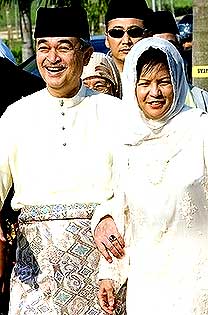 She is Jeanne Abdullah nee Jeanne Danker formerly "just a rumour". Between the prime minister becoming first a widower and then remarrying, there lies an enigmatic blank and an eloquent silence. Hence to Malaysians, the news of his marriage when it was 'officially' released came suddenly and out of the blue.
Wedding bells peeling signalled to the punkahwallahs they had the green light to go ahead and publicly fete the 'First Lady'. Thus Malaysians are treated to the comical sight of these assiduous sycophants tripping over themselves in their eagerness to fan the First Newlyweds. And we are to forget the 'only rumour' evasions before.
[A quick digression: I've taken a shine to 'punkah' its imagery and the quaintly appropriate ring to the word. Before India had electricity, fans ('punkah') in rich homes were worked manually by a boy ('wallah') sitting in the closet who tugged at various cables to turn the blades. In local idiom, to fan implies sycophancy.]
Similarly with the Rushdie fallout, there's a big blank sandwiched between the blasphemy charge and the subsequent violence associated with The Satanic Verses' publication, translation and distribution. Muslim countries banned it. It remains banned in Malaysia. When access to the heart of the matter is effectively blocked, reality is alternatively constructed from hearsay or on (PAS) say so or from reliance on other mediating sources.
I'm sure most people have played the Whispering Game at parties. Imagine 20 people sitting in a circle. The originator of a message whispers a sentence in the ear of the person sitting beside him. The second person passes on what he heard to the third person and so it goes around. By the time the message returns to sender, it would have been garbled and its meaning lost or distorted.
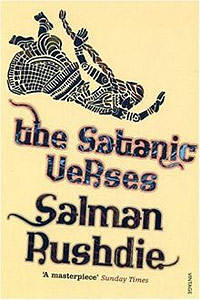
The Satanic Verses has been irretrievably lost in the clamour of angry voices raised against it. Malaysia is the Mother of Whispering Games. It's the surreal land where rumours are held to be reliable and pronouncements from official sources greeted with scepticism. In this sort of exaggerated milieu, I can easily imagine anyone who admits to ever having read Rushdie would be accused of Islamophobia.
What he really wrote
Such an information gap as exists in turn promotes a perception gap. The perception of the PAS demonstrators is clearly not aligned with the perception of the jury which bestowed the Whitbread Prize on The Satanic Verses . Where the latter sees literature, the former sees filth. Here again, I see the necessity to repeat that I do accept Rushdie has pained Muslim readers. I'm making a point about how people see things differently, not making excuses for the book.
Rushdie claims the book he wrote is not the same piece of work labelled an anti-Islam tract by those hostile to him. From a genuine apprehension that my essay Apostasy: Revisiting Salman Rushdie could be misinterpreted, I decided to scrap the second version too. And to avoid the inference, 'Oh see, aren't the Muslims an intolerant bunch, with an avidity for silencing, criminalising and punishing'. Reiterating misleading religious stereotypes is not my intent at all, and unproductive.
 Whereas my real objection is to authoritarian control over what is deemed suitable for Malaysians to read, and permissible to think, speak and do. Lack of clarity occasioned by memory holes promotes misconceptions. Censorship such as ours serves only tyrants.
I do not wish to be misconstrued either as encouraging the unimpeded circulation of The Satanic Verses. Rushdie may be the most banned author in Malaysia, but a variety of other titles by international and local writers are banned too. I find it bitingly ironic that Karen Armstrong had been invited to give a talk here and her lecture attended by the Foreign Minister and the former premier when Malaysians are not allowed to read her. We're free to read pap though.
It would seem that the privilege of writing in this country resides in composing paeans to First Ladies. Such a sugar-coated privilege is bad for our health. On the other hand, Rushdie has arguably paid the world's highest imaginable price for honestly writing what he believes. Writing with honesty then is daunting when so many pitfalls lie in wait. Missing too is the good faith to leaven the reading.
I took the final stab at my Rushdie essay in order to share this thought. Unbelief is another sin which Rushdie adds to his crime of blasphemy. He argues against the notion that an individual should belong to Islam purely by virtue of birth, and choosing to leave it a capital offence. I agree. I'm all for equal rights, and for Malays to have the right of freedom of religion or freedom from religion. I'm so very sad for Lina Joy.
Contact Helen Ang at: z.sunday@yahoo.com


Are you sure you want to delete this comment?
This action cannot be undone.