




Between the bus and LRT (Part 3)
A quick recap: The first part of this article discussed why many people feel that LRT is the only real public transportation choice in KL.even though there are other options that can cost less and be implemented faster. The second part of this article discussed the gap that exists between bus services and LRT services, and presented Bus Rapid Transit as the first of two alternatives that can be better and cheaper than bus or LRT. The third part of the article will discuss the second of the two alternatives.
Who are the streets for, exactly?
A quick recap: The first part of this article discussed why many people feel that LRT is the only real public transportation choice in KL.even though there are other options that can cost less and be implemented faster. The second part of this article discussed the gap that exists between bus services and LRT services, and presented Bus Rapid Transit as the first of two alternatives that can be better and cheaper than bus or LRT. The third part of the article will discuss the second of the two alternatives.
Who are the streets for, exactly?
For some time we have been fed the idea that streets are only for cars, and we have gotten used to this concept. Our streets have been upgraded so that cars can drive as fast as possible without stopping. Any possible source of interference with the movement of cars has been eliminated. Roundabouts and signaled intersections have been replaced with flyovers. Entrances to the main roads and exits from the main roads have been closed or blocked. We have pushed public transit and pedestrians as far away from the streets as possible, and built elevated LRT projects, all to keep the cars moving.
It is a sort of apartheid, where the streets belong to cars, not people, and public transit is a service for poor people, who are effectively second class citizens.
 Public transit buses, for example, must fight their way through the same traffic as everyone else. Buses dare not interfere with the flow of traffic. If they wish to stop and pick up or drop off passengers, they must pull into the bus bays or lay-by areas that have been built. Never mind the fact that many of these bus bays or lay-by areas have become parking or standing areas for cars. Never mind the fact that the amount of space is actually too small for the bus to enter and exit comfortably or safely.
And woe be to any pedestrian who wishes to walk along (or heaven forbid, across) a main road. They must be taught, quickly, that cars rule the road and pedestrians are at the bottom of the pecking order.
It doesn't help that we are reinforcing this attitude by spending a lot of money on the construction of LRT projects. By doing this, we end up building a few magnificent LRT lines that can whisk people across the city in comfort, but when the passenger leaves the LRT station, they are on their own.
I would much rather see the government spend less money on the construction of public transportation using great technology, and instead spend more money on building a complete rapid transit network and improving the public transportation experience for all users, from door to door. If the "first mile" and the "last mile" (meaning, the trip to and from the bus stop or train station) of travel is not made easy or comfortable, that will be one more excuse for people to avoid using public transit.
Putting rapid-transit at ground level, on our streets, will reinforce the idea that streets are foremost for the people, not for cars. Using lower-cost forms of rapid transit such as BRT allows this to happen. It brings rapid transit to more people because more lines can be built. It also allows more money to be spent on improving the public transportation experience.
BRT is a good form of rapid transit that would be suitable in some areas of the Klang Valley, especially along relatively straight, wide roads such as Jalan Klang Lama and Jalan Puchong and Persiaran Kewajipan.
Of course, like all forms of rapid transit, it has its advantages and disadvantages.
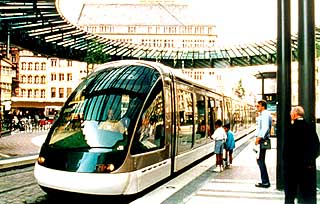 Many BRT advocates claim that BRT is "rapid transit on tyres," suggesting that it is cheaper to construct and operate than a rail service, but offers the frequency, comfort, and style associated with trains. It is argued that BRT service eliminates all the disadvantages associated with buses, and is therefore much more appealing to the "choice" riders, those who choose to use public transit, even though they could use a car.
Others have argued that BRT is not much more than "buses in make-up" (in some cases, very little make up). Basically, the idea is that you can dress a bus up, make the body smoother and more streamlined, call the bus shelters "stations" and do various other things to give the bus service more style, but essentially, all that you have is a bus service that is trying very hard to be a rail service. So why not just build the rail service?
Light rail transit
Of course, rail construction is an expensive capital investment. Light rail service is one option for rail service that has lower investment costs. Light-rail can be best described as any rail-based transportation system that runs primarily at-grade, that is, at ground level, in urbanized areas or between urban areas. Light-rail may travel along streets in mixed traffic (known as a "Category C" Right-of-Way) or in its own restricted lanes (known as a Category B" right of way). It may also travel along a completely separate Right-of-Way (known as "Category A") or even above ground or underground where necessary.
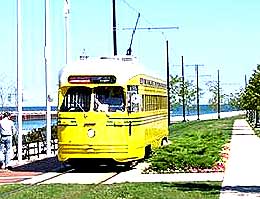
Most of us are familiar with "Light Rail" through the examples of trams (also known as streetcars or trolley cars in North America) that operate in mixed traffic in the denser areas of cities.
Trams/streetcars have an image problem just like buses do. For many years trams/streetcars were seen as being slow and inconvenient. It has been (and still is) argued that trams/streetcars interfere with the flow of traffic. It is said that they lack the flexibility of buses, and the capacity and the speed of metros.
Just as people have attempted to change the image of buses, people have attempted to change the image of trams/streetcars.
The term "Light-Rail Transit" was actually invented as a modern term to describe upgraded tram/streetcar service, just as the more recent term "Bus Rapid Transit" has been used to describe upgraded bus services.
This form of rapid-transit is described as "LRT" in North America but it is not the same as the "LRT" service that we are familiar with in Malaysia. Light-Rail Transit can also be referred to as "rapid tram" or "fast tram" service. I will use the term "rapid tram" to avoid confusion.
It is 'rapid' service
The things that separate "rapid trams" from traditional tram service are effectively the same things that separate bus-rapid transit from regular bus service.
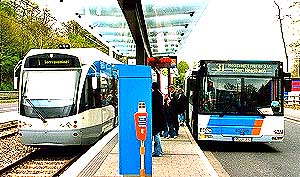
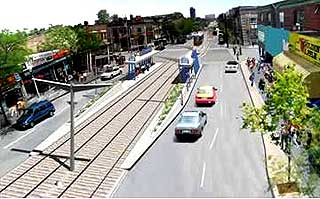 Whatever the technology, the "rapid" service operates faster, with greater distances in between stops. The service is isolated from other traffic (using a "Category B" or "Category A" right of way) to improve reliability. The "rapid" vehicles are longer than the traditional ones, and often articulated to increase passenger capacity. Instead of shelters there are larger "stations" which can accommodate more passengers. Payment is done off-board, before entering the vehicle. Operators do not need to check fares.
Floors may be high or low, but the key feature is that the actual boarding is level. There are no stairs or ramps needed from "platform" to the vehicle. These features make boarding and alighting easier and faster, as well as making the service more accessible.
So if BRT and "rapid trams" both offer these advantages, which one is the best choice?
Advocates on both sides are very vocal and critical in their support of one "rapid" mode over the other.
Advocates of BRT argue that "rapid tram" service has higher construction and operating costs than BRT. They argue that the rail service is very noisy, because of the metal rails and metal wheels. They claim that "rapid trams" are ineffective and inconvenient when compared to BRT because they lack flexibility and are stuck to the rails. They may argue that trams are simply "old-fashioned" and supporters are simply nostalgic "railfans." There are even attempts to highlight rapid trams as being dangerous to other traffic.
Advocates of rapid tram service view it as a better mode of rapid transit than BRT. After all, if BRT is trying very hard to mimic all the advantages of rail, there must be something positive about rail. They advocate the belief that people just like rail service more than buses. They also suggest that rapid trams last longer and have greater capacity for expansion than BRT, since the rapid trams can be easily connected to form longer trains, while buses cannot. There is also the argument that electric or diesel-electric rapid trams emit far less air pollution and carbon dioxide emissions than diesel-powered buses.
The advantage of rail
One advantage that rapid tram service (and indeed, any rail service) holds over BRT is the capacity for future expansion. Rail carriages (and rapid trams) can be connected into multiple-carriage trainsets. Different lengths of trains can offer different capacity to meet passenger demands.
Multiple-carriage (also known as multiple-unit) trainsets can be designed in different ways. Carriages can be connected permanently, or semi-permanently. The 2-carriage LRT and KL monorail lines, 3-carriage electric multiple-unit (EMU) trains of the KTM Komuter, and 4-carriage EMU trains of the Airport Express Line, are all examples of permanent connections. There is also the option of semi-permanent connections. This is currently done in the Ampang-Seri Petaling LRT and the KTM Komuter. The Ampang Seri Petaling LRT connects two or three multiple-units of two carriages each (for a train with a total of 4 or 6 carriages). The KTM Komuter connects two multiple unit trains of 3-carriages each (for a train with a total of 6 carriages).
With a rail system, flexibility of expansion is quite possible.
In contrast, the only way to really improve the capacity of a BRT service (and indeed, any bus service) is to add more buses. Though buses can be articulated, each additional unit becomes smaller and smaller, meaning that capacity is diminished.
 For example, a single unit bus would be 12 meters long. A typical two-unit articulated bus would be 18 meters long (12 + 6), and a three-unit double-articulated bus would be 24 meters long (12 + 6 + 6).
Additional capacity requires additional buses, and additional buses require additional operators, who have to be trained, and paid, and promoted.
The BRT system requires more operators and more vehicles to move the same number of people as a rapid tram system. It is for this reason that the long term operating costs of the rapid tram service will be lower than the BRT service.
Another interesting factor is the age of the vehicles. Most rail vehicles have a useful life of 30 years, while buses have a useful life of about 15 years.
Existing systems
Let us now take a look at the stock of existing rail systems in the Klang Valley to develop a greater understanding of the rapid transit options that we have.
Currently there are 5 different lines representing 4 different types of rail technology and two types of Right-of-Way. In fact, many people who are interested in public transit are quite impressed with the variety of technologies and designs that can be found in the Klang Valley.
The Ampang-Seri Petaling LRT is a 6-carriage "mini-metro" design combining 3 multiple units of two carriages each. It uses a third rail for electric power.
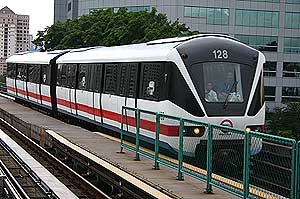
The Kelana Jaya LRT line is a 2-carriage, "Advanced Rapid Transit" design. It is currently operating as a single multiple-unit of two carriages. Future expansion to 4-carriages can be done by coupling two multiple units to create a 4-carriage train, or creating a new, 4-carriage multiple unit train. The "Advanced Rapid Transit" design uses a Linear Induction Magnet system that pulls the train along the tracks. The train uses a third-rail for electric power.
The KL Monorail is a 2-carriage, ALWEG type monorail design. It is currently operating as a single multiple-unit of two carriages. Future expansion to 4 carriages will likely be accomplished by creating a new, 3 or 4-carriage train. The KL Monorail uses two rails for electric power.
The Kelana Jaya LRT and KL Monorail lines are fully grade-separated (above or below ground) for their entire alignment. The Ampang-Seri Petaling LRT line is fully grade-separated (above ground) from Sentul Timur station to Plaza Rakyat station. Other parts of the line operate both grade separated (above ground) and at-grade (at ground level).
The KTM Komuter is a 3-carriage, electric-multiple unit (EMU) train. It currently operates as a single 3 carriage train, but occasionally two EMUs are coupled to create a 6-carriage train. The KTM Komuter operates fully at-grade but separated from all other traffic. It is powered by an overhead wire system.
The Airport Express Line (AEL) is a 4-carriage electric-multiple unit (EMU) train. It currently operates as a single 4-carriage train. The Airport Express Line operates almost fully at-grade but separated from all other traffic. Like the KTM Komuter, the Airport Express Line uses an overhead wire system.
Of the 5 different lines, the KTM Komuter and the Airport Express Line have the most in common. Both use EMU trains with overhead wire power systems. The Komuter train uses narrow gauge tracks, while the AEL uses "standard gauge" tracks.
There are also many wide roads in the Klang Valley, which could be converted to rapid transit uses if the political will existed. The first step would be rather easy: expand the existing network of bus lanes and enforce the use of these lanes.
Simplicity, flexibility and versatility
If one looks at the different types of railway technologies that are found throughout the world, it is interesting to see that electric-powered trains with overhead wire power systems offer the greatest levels of speed and flexibility.
The rapid tram may have the greatest simplicity, flexibility, and versatility of any train system that has been designed for passenger travel.
The rapid tram has simplicity because it is, effectively, an electric train with an overhead wire power system. This type of technology has been around for over 100 years and has been used in everything from single carriage trams to 3 and 6-carriage EMU and metros to 16-carriage Shinkansen (bullet) trains. The technology is widely understood. Costs can be kept low because of competition. Many different rapid tram designs are available that can easily be used on the same right-of way. The 3 different types of EMU that are used by the KTM Komuter, or the 5 different types of trams and rapid trams used in the city of Melbourne, Australia show the versatility of the rapid tram.
This contrasts with the design of a technology like the Advanced Rapid Transit technology used in the Kelana Jaya LRT line. The LIM system is proprietary technology, with very few options when it comes to future expansion. Fewer options generally would mean higher costs.
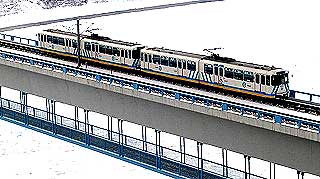 The rapid tram has flexibility in terms of vehicle capacity. It can operate as a single multiple-unit of 2, 3, 4, or 5 carriages. Capacity can be doubled or tripled as necessary. The only thing that is limiting the capacity of a rapid tram (or other EMU) is the size of the station platform and the amount of space available for platform expansion.
To compare, the existing Kelana Jaya line can be built to a maximum of 4-carriage trains. It is currently operating 2-carriage trains and is at capacity during peak hours. Along with the planned extension to Subang Jaya and USJ, the Kelana Jaya line will upgrade to 4-carriage trains, effectively doubling the existing passenger capacity. However, passenger loads will only increase, especially if the recently mooted extension to Shah Alam and Klang is built. This means that at some point, possibly within the next 10-15 years, the Kelana Jaya line will again be at maximum passenger capacity.
At that point, what will happen? Extending the elevated and underground LRT platforms will be very costly and disruptive to the existing service.
The rapid tram has versatility as well. The LRT is limited to operation in the "Category A" Right-of-Way, which means that is has to be completely isolated from other traffic. In contrast, the rapid tram can be operated in all three types of Right-of-Way. It can operate in Category C (mixed traffic) and Category B (restricted right of way). The rapid tram can operate at grade (at ground level) but if necessary, can operate above or below ground as well.
The future of rapid transit
With the high level of versatility, flexible passenger capacity that is similar to existing LRT lines, and a simple, common, lower-cost technology, the rapid tram may be the best option for the future of rapid transit in the Klang Valley.
Imagine a line that could operate elevated inside the city centre of KL and other urban centres such as Petaling Jaya or Cheras, but also operate along a major street as well as underground in some areas.
For example, consider the township of Puchong. Existing plans to extend the Seri Petaling LRT from Seri Petaling to Puchong, would bring LRT service to Puchong, but this service would be indirect. Passengers who use this LRT to get to the city centre would have to travel through the south and southeast of the Federal Territory before reaching the city centre.
Now, consider the possibility of a rapid tram line being built from the city centre to Puchong. This line could be elevated in the city centre of KL. Once the line leaves the city centre, the rapid tram could return to ground level, following a street level alignment. Using Jalan Klang Lama and Jalan Puchong, the rapid tram line could travel all the way to Puchong. At the major intersections, like Jalan Klang Lama/Jalan Kuchai Lama, or Jalan Klang Lama/Jalan Puchong, the rapid tram could be elevated to avoid the traffic congestion that would be present.
Since the line would be able to operate in Category A and B and C right of way, it would be more flexible than an LRT. Costs of construction would be lower. There would be reduced need for concrete pillars, support columns, and guideways. There would be fewer elevated stations, and thus, fewer lifts, escalators, and stairs would be needed.
The Kelana Jaya LRT line, fully grade separated, cost RM150 million per km. The Ampang-Seri Petaling LRT line, with some sections at grade, cost about RM130 million per kilometer to construct. Though the Ampang-Seri Petaling line is slightly shorter in overall length that the Kelana Jaya line (27 compared to 29 km) it has larger platforms and longer trains. This shows that grade separation costs money.
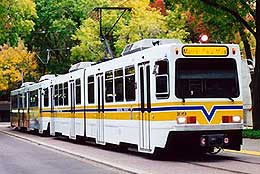 There are stretches along the Kelana Jaya line where it could operate at ground level. Imagine if the Kelana Jaya line had been designed using a rapid tram technology rather than the Advanced Rapid Transit Mark II technology. Perhaps, by operating more of the line at-grade, some money could have been saved, or that line could have been extended. Perhaps if the Kelana Jaya line were built as a rapid tram, it would already be serving the areas of Subang Jaya and USJ.
Similarly, consider the idea of the Outer Ring LRT line recently mooted by the Menteri Besar of Selangor. This line is proposed to cost RM12 billion. However, if the line were designed using rapid tram technology, perhaps RM5 billion could be saved. That extra RM5 billion could be spent on building more rapid transit lines.
Network thinking
Before any future plans are made for the expansion of public transit in the Klang Valley, it is very important to understand two things. First, no matter what the choice of technology, whether it is rail or bus, the goal must be to make transit more "rapid" and more frequent and more reliable. Second, the creation of a complete network is absolutely important.
The best and most effective way to get people out of their cars is to create a vast, complete network of rapid transit lines throughout the Klang Valley, and make the use of public transit easy and comfortable, from door to door.
If rapid tram or BRT lines are used, they will cost less overall per kilometer than elevated LRT construction. Lower costs per kilometer means that more lines can be built for the same amount of money.
If all the money is spent on building LRT lines, the Klang Valley will end up with fewer rapid transit lines. Fewer people will then have easy comfortable access to public transit, and there will be fewer public transit users. If the network is completed, there will be more.
Conclusion
It is wonderful that the government is willing to invest in public transit and LRT construction, it would be better if the government considered the following questions:
Which has a greater value for the Klang ValleyA few more LRT lines or a complete rapid transit network?
If the outer ring LRT line mooted by the Menteri Besar of Selangor is built, then what about the needs of Kuala Lumpur and the inner suburbs, which desperately need rapid transit lines?
If the Kelana Jaya LRT line, already at capacity, is extended to Klang, what will happen when it reaches capacity quicker than planned?
If a KTM Komuter system already exists, with lots of flexibility and room for expansion, why is it necessary to build an LRT extension that will leave no room for future passenger growth?
Finally, who is going to be responsible for overseeing the planning and implementation of public transit service in the Klang Valley. Right now there are too many government departments at the Local, State and Federal Level, as well as government agencies and government-linked companies involved in the decision making.
If we do not ask these questions and deal with these challenges now, it may create significant problems in the future.
 So to my neighbours in Subang Jaya, I only wish to say this. I'm not trying to torpedo the LRT extensions. I fully support some of the LRT lines. I just don't want to look back in 10 years and wonder what the Klang Valley could be like if the rapid transit network had been completed.
I want to see a complete rapid transit network in the Klang Valley, as soon as possible. Even if the government has enough money to build the entire network as LRT service, I would still rather see that other options have been considered.
It is time to be honest and realistic. The perception that the only good transit option is LRT needs to be changed. Our current perceptions about technology do not matter. The government must make the best choice for the long term. This choice must be simple and allow great flexibility and versatility.
Finally, the attitude that streets belong to cars must disappear. The future of rapid transit in the Klang Valley depends on this change.
Between the bus and LRT (Part 1)
Between the bus and LRT (Part 2)
MOAZ YUSUF AHMAD is a regular user of public transport who is deeply concerned that government plans to encourage people to use public transport will ultimately fail because of poor planning and a lack of support from the public.


