




Wishing Blair luck
I can't quite remember if Billy Bragg, the high-profile anti-war artist, sang at the outdoor concert by the River Thames celebrating Labour's landslide victory in the early hours of May 2, 1997. He probably did as he had hated the Tories so much. After a decade, I am not too sure if Bragg and Tony Blair are still on speaking terms.
At 54, Blair is already an ex-prime minister. Margaret Thatcher, one of Blair's predecessors that he is said to admire greatly, was just given the keys to 10 Downing Street around this age.
I often wonder if Blair would have liked to hang on for a little while so that he could break Thatcher's almost 12 years record as prime minister but, alas, events were beyond his control, and his allies-turned-rivals within the (new) Labour Party just wanted him out sooner.
I can't quite remember if Billy Bragg, the high-profile anti-war artist, sang at the outdoor concert by the River Thames celebrating Labour's landslide victory in the early hours of May 2, 1997. He probably did as he had hated the Tories so much. After a decade, I am not too sure if Bragg and Tony Blair are still on speaking terms.
At 54, Blair is already an ex-prime minister. Margaret Thatcher, one of Blair's predecessors that he is said to admire greatly, was just given the keys to 10 Downing Street around this age.
I often wonder if Blair would have liked to hang on for a little while so that he could break Thatcher's almost 12 years record as prime minister but, alas, events were beyond his control, and his allies-turned-rivals within the (new) Labour Party just wanted him out sooner.
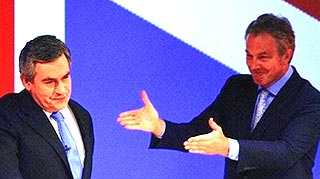 It was interesting that the last guest that Blair received as prime minister was Arnold Schwarchenegger, the Terminator. Or was he trying to send a message that he would be back?
Blair certainly did not leave 'with the crowd wanting more' as he reputedly had wanted. Rather, it was a low-key departure, and his wife Cherie, no friend of the 'predatory' British press, uttered a final barbed comment to the keenly awaiting journalists: 'I don't think we will miss you', before disappearing into the Jaguar that would drive her and her hubby from Downing Street for the last time.
To be fair, the past ten years of the Labour government has not been a total failure. Britain is now a more open and competitive country, and among the most multi-cultural in Europe. No voice of protest was heard when Blair included a gay person and a blind man in his first cabinet.
He also increased considerably the number of women candidates at election, forcing the paternalistic Tories to follow suit. To the chagrin of the traditionalists, the Civil Partnerships Act received the royal assent in 2004, making Britain among the handful of countries that recognise gay marriages.
Smart politician
To soothe the simmering anger of the Scots and the Welsh, Blair granted them devolutions soon after taking office, honestly believing that such a move would benefit his New Labour Project. It did, only at the beginning. Now the Hollywood Parliament in Edinburgh has produced its first Scottish Nationalist government, which wants nothing less than an independent Scotland within the European Union.
In Wales, the nationalist party Plaid Cymru continues to make inroads, and The Economist once reported that English parents - who were disgruntled with more Welsh being in used in schools - had been leaving the province in droves.
Such is the price to pay for being a mature democracy. But Blair had not gone far enough. For years, he shunned calls for a national assembly for England, one of the reasons why a large part of the English electorate was becoming disillusioned with him.
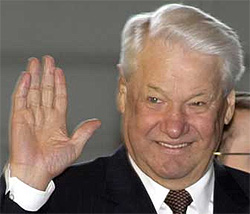 But Blair was a smart politician. He had seen for himself how power was swept from beneath Mikhail Gorbachev's feet with the election of Boris Yeltsin as president of Russia in late 1980s.
That spelt the beginning of the end of the Gorbachev era. Given England's sheer size and politico-economic importance, Blair simply could not afford to have an 'English' leader whose power and authority would almost rival that of his.
But I have underestimated Blair's ego. Having dominated the Westminister Parliament for ten years, Blair could no longer bear with the fact that he would have to go back to where he began - the backbench. He simply did not want to make do with being just one of the ex-prime ministers, spending the rest of his life either as a backbencher or a Labour peer.
Thanks to his friends in the White House, Blair is now an envoy for the Quartet to sort out the mess in the Middle East. His years of loyal service to President George W Bush have clearly paid off. Even Russia has grudgingly extended its endorsement despite the recent tussle between Moscow and London.
Would he make a difference in one of the most contentious and volatile areas in the world today?
Jerusalem arrival
First of all, Blair got the job largely as a reward for his close ties with the Bush administration. But Bush will exit the world stage in less than two years time.
Moreover, that president's credibility is dwindling by the day, to the point that even some of his most trusted allies have begun to ditch him, Richard Lugar the top Republican and former chairman of the Senate Foreign Relations Committee being the latest. Lugar has just said Bush's strategy in Iraq is a failure.
Blair has supported the war on Iraq from Day One, a past that he cannot reverse, although he did try to argue some errors had been made based on 'dis-intelligence'. How is he going to pick up the pieces?
This aside, the Pew Institute's survey , by far the most comprehensive poll on international opinion, has found that the global distrust of the Bush administration is bordering on anti- Americanism. The survey's findings yet again confirm the deep-seated resentment of the Muslim world towards Washington.
 The anxieties do not just stop there. At least four-fifths of the Spanish, French and German populace have expressed no confidence in Bush, and the figure in Britain stands at 70 percent. The neo-cons and the so-called strategists will have a tough time digesting the unpalatable truth.
And that is not all. When Ariel Sharon was still prime minister, he demanded Israel's retention of the major settlement blocs on the West Bank, and Bush conceded. Blair publicly endorsed the agreement. Some regard it as the most egregious British betrayal of the Palestinians since the Balfour Declaration of 1917.
With Blair's arrival in Jerusalem, where he is said to be given an office, the Palestinians will surely recall with bitterness the deceptions in the past.
Some commentators have likened Blair's appointment as 'putting a rat in charge of the cheese'. The onus is now on him to demonstrate his skills as an honest broker. I shall wish him luck.


Are you sure you want to delete this comment?
This action cannot be undone.