




Election jitters in MCA?
I read with interest Sim Kwang Yang's excellent column speculating on the possibility that MCA president Ong Ka Ting will contest in Bukit Bintang, a DAP stronghold in the heart of Kuala Lumpur.
I hope that I'm not jumping the gun by adding some of my thoughts on this issue, with the help of past election results.
Mention Bukit Bintang and most people will think of Sungai Wang, shopping malls, nights spots, Chinese hawkers and good eating places. Mention the parliamentary seat of Bukit Bintang to the casual political observer and the immediate response would that this is a DAP stronghold.
Indeed, these impressions are largely accurate, with some important caveats.
I read with interest Sim Kwang Yang's excellent column speculating on the possibility that MCA president Ong Ka Ting will contest in Bukit Bintang, a DAP stronghold in the heart of Kuala Lumpur.
I hope that I'm not jumping the gun by adding some of my thoughts on this issue, with the help of past election results.
Mention Bukit Bintang and most people will think of Sungai Wang, shopping malls, nights spots, Chinese hawkers and good eating places. Mention the parliamentary seat of Bukit Bintang to the casual political observer and the immediate response would that this is a DAP stronghold.
Indeed, these impressions are largely accurate, with some important caveats.
The Bukit Bintang parliamentary seat is indeed a compact seat covering only 16.4 sq km in the 2004 general election. It is slight smaller than the Lembah Pantai (21.4 sq km) and Seputeh (20.6 sq km) but slightly larger than Cheras (14.4 sq km) and Kepong (11.8 sq km).
It has 21 polling districts or stations, ranging from the Bukit Nanas area (which includes Jalan Perak, Jalan Sultan Ismail and Jalan Ampang) to Imbi Pasar (which includes Jalan Imbi and the infamous Sun Complex) to Medan Pasar (which includes Jalan Pudu) to the Brickfields area.
 These are mostly Chinese, lower middle class areas (with a smattering of Indian voters in Brickfields), which contributes to the general impression this is a seat largely comprising of Chinese hawkers, if you will (hence the dubbing of former DAP stalwart and KL Bandar MP Lee Lam Thye as the 'Godfather of Hawkers').
The ethnic breakdown of this constituency, in the 2004 general election, was 13 percent Malay, 75.8 percent Chinese, 10.5 percent Indian and 0.7 percent 'Others'.
But what is less well known about this constituency numbering approximately 65,000 voters in 2004, is that it is also home to approximately 5,000 postal voters, of which 88% are Malay (or 4,400 out of the 5,000).
These postal voters are mostly policemen 'parked' in the Jalan Sultan polling district and air force personal 'parked' at the Air Force base in the Lapang Terbang polling district (remember the old airport along the Sungai Besi Highway on the way to Jalan Tun Razak?).
These postal voters are significant for two reasons. Firstly, the relatively higher turnout of the postal voters changes the effective ethnic composition of the constituency. The turnout in 2004 was 60.9% including postal votes and only 58% after excluding postal votes. The turnout among postal voters was an astonishing 94.5%!
If we assume that the rate of turnout among the different races is the same among postal and non-postal voters, the Chinese composition of Bukit Bintang decreases from 75.8% to 71.6% and Malay from 13% to 18% - i.e. it becomes less Chinese and more Malay.
Influential factors
More important than how postal voters change the effective ethnic composition of Bukit Bintang is how the postal voters vote. Of the 4,807 postal votes cast in 2004 in Bukit Bintang, 4,465 or 92.9% went to the BN.
In other words, given that postal votes are cast before polling day, the BN started with an advantage of approximately 4,400 votes, a not insignificant advantage, even in a DAP 'stronghold' such as Bukit Bintang.
Postal voters have always been part of the landscape of the Bukit Bintang constituency (though their exact number in elections prior to 1999 are not known to this author) but they have only become important in the past two elections, given that the margins by which this seat was won by the DAP in past elections were too large for these postal votes to matter. This margin has narrowed significantly, as pointed out in Sim's piece.
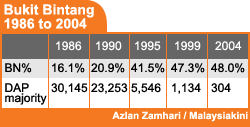
Table 1 shows the percentage of the popular vote won by the BN in Bukit Bintang since the 1986 general election. It has increased from 16.1% in 1986 to 48% in 2004.
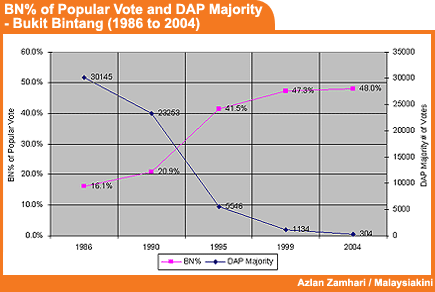
The margin of victory for the DAP in 2004 was a mere 304 votes. One needs to take this figure with a small pinch of salt.
 What most casual observers may not realise is the fact that Bukit Bintang saw a four-corner fight in 2004 and that former DAP MP Wee Choo Keong, contesting under the banner of the Malaysian Democratic Party managed to 'siphon' off 1,107 votes, while independent candidate Billie Lim Peng Soon won another 132 votes.
Assuming that a large proportion of these 1,239 votes would have gone to the DAP if these two candidates did not contest, the margin of victory would have been larger than 304 (perhaps closer to 1,000). Not a large or insurmountable margin by any stretch of the imagination but certain larger than 304.
Perhaps a final characteristic in regards to the Bukit Bintang seat that is of note is its age profile. It has one of the oldest age profiles among parliamentary seats in Malaysia. Almost 40% of its non-postal voters are above the age of 55 (38.1%). Only 12.4% of its non-postal voters are under the age of 35.
For comparison's sake, the corresponding figures for Seputeh are 29.4% above 55 and 20.4% below 35; and for Lembah Pantai 25.8% above 55 and 21.4% below 35. Even PJ Selatan, which has a reputation as a constituency with many retirees, 'only' 30.2% of non-postal voters are above 55 and 19.8% of voters are below 35.
Bukit Bintang, in a sense, is similar to Tanjong, a parliamentary seat in Penang, also another Chinese majority constituency whose residents have slowly moved out of the constituency. (Tanjong probably has the oldest age profile among all seats in Malaysia with 40.6% of non-postal voters over 55 and only 11.8% under 35).
Why is this important? The aging voter profile coupled with the fact that many former residents have moved out of the Bukit Bintang constituency for a variety of reasons (found better housing elsewhere, conversion of many housing areas into apartments or shoplots and so on) probably explains the relatively low voter turnout in this constituency. (The average voter turnout for the 11 parliamentary seats in KL in 2004 was 67.9% compared to 60.9% for Bukit Bintang.)
MCA worried?
If Ka Ting were indeed to contest in this area, the turnout 'battle' as it were, would be an important one in determining the final outcome of this race, especially if the final tally is close.
And given that turnout 'battles', which includes the ability to mobilise and ferry voters who are sympathetic to one's cause from both near and far, are costly affairs involving money, manpower and resources, MCA should have the upper hand in this regard, even considering the relatively well-financed DAP incumbent Fong Kui Lun.
The trend of this narrowing majority coupled with a 'bank' of postal voters and the potential for winning the turnout 'battle' certainly makes this seat a winnable one for any MCA president who is contesting against any DAP leader with a relatively low national profile, as Fong most undoubtedly is.
But if Ka Ting does indeed decide to contest, he would do well to remember that he will be contesting in a Chinese-majority seat at a time when the national sentiment is far from favourable towards the BN and the MCA, as the most recent Merdeka Centre polls have shown.
Does he think that he can buck the trend in national sentiment when the propitious economic conditions in 1995, the 'collusion' between the DAP and PAS in 1999 and the 'Pak Lah' factor in 2004 all failed to dislodge the DAP from this seat?
He would also do well to remember the lesson learned by his brother Ka Chuan, who left his safe state seat of Chenderiang under the parliamentary constituency of Tapah in Perak to contest the parliamentary seat of Batu Gajah with the aim of defeating, then first term DAP MP Fong Po Kuan. With the resources of the MCA state machinery at his disposal, Ka Chuan, former state exco in Perak, was soundly and unexpectedly defeated by almost 8,000 votes.
Of course, Kui Lun would not elicit the same amount of public sympathy as Po Kuan, given the fact that she was expelled from Parliament for six months during her first term, and that Ka Chuan was seen as 'bullying' a woman incumbent opposition MP. And Ka Chuan was not the president of the MCA.
The possible entry of DAP secretary-general, Lim Guan Eng as a possible challenger to Ka Ting makes the potential Bukit Bintang contest even more interesting. Guan Eng would certainly be able to play on sympathy that he was not able to contest in 2004 because of his jail sentence for breaching a provision of the Printing Presses and Publications Act.
He, unlike Kui Lun, does have national appeal and national standing and would certainly decrease the odds of Ka Ting capturing this seat (though it would certainly catapult this contest as one of the ones to watch in the next general election).
It would be a contest which we've not experienced since Lee San Choon, then MCA President, took on the DAP's dare and contested and defeated its advisor and strongman Chen Man Hin in the parliamentary seat of Seremban in 1982 with a majority of 845 votes. Perhaps Ka Ting is hoping to follow in San Choon's footsteps?
 In all likelihood, this speculation would probably remain at that - purely speculation. I don't see forsee the possibility of Ka Ting putting his political career on the line (even with his three-term limit) by hazarding the dangerous waters of Bukit Bintang.
Therefore, the contest between Ka Ting and Guan Eng that many political observers would have hoped for will not happen. Still, speculation spices up the political landscape and give us political analysts something to write and think about.
But the fact that this possibility was even thrown out into the public arena tells me that MCA are very concerned about its electoral chances in the upcoming general election, speculated to be held early next year. Judging from the public sentiment, I would not blame them for feeling this way.
ONG KIAN MING is a PhD candidate in political science at Duke University.


