




KTM Komuter - the way to go (Pt 1)
People who regularly see me at the KTM Subang Jaya station probably wonder why there is often a smile on my face.
To many, the KTM Komuter service just cannot compete with the faster, more frequent, more appealing LRT service. The service is infrequent, slow and often delayed, trains are overcrowded, the location of stations is terrible.
Sadly, they fail to recognise that the Komuter service has a great deal of potential. In fact, with the right improvements, I believe the service will do a lot of good for transportation in the Klang Valley and elsewhere in the future.
People who regularly see me at the KTM Subang Jaya station probably wonder why there is often a smile on my face.
To many, the KTM Komuter service just cannot compete with the faster, more frequent, more appealing LRT service. The service is infrequent, slow and often delayed, trains are overcrowded, the location of stations is terrible.
Sadly, they fail to recognise that the Komuter service has a great deal of potential. In fact, with the right improvements, I believe the service will do a lot of good for transportation in the Klang Valley and elsewhere in the future.
Perhaps the main reason why I am happy is my belief that after 11 years of operation, the Komuter is finally getting the recognition it deserves.
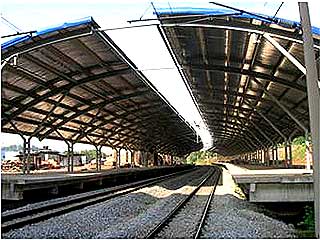 I am truly pleased because the makeover of Komuter stations has finally reached Subang Jaya. The key feature is the higher, broader canopy (first introduced at MidValley) which is airier and cooler. The larger covered area means that the platform is protected from the elements.
Another reason is that KTM Bhd (KTMB) is starting to upgrade facilities. Stations have more food and beverage options, more entrances and exits, more Touch 'n' Go lanes, and cleaner toilets. There are even escalators and lifts at the newer stations. Some of the halts are also being upgraded. The Bank Negara halt is being upgraded to a proper station.
It is interesting to see that changes are finally taking place in the attitude towards public transportation and the rail transit network. Many new properties are starting to consider access to public transit as a possible asset.
A bridge is being built to connect the LRT and KTM stations to the first floor of the Sogo department store in Jalan Tuanku Abdul Rahman. Happily, after a long delay, the bridge connecting the Setia Jaya KTM station to the Leisure Commerce Square development is nearly complete.
It will be a while before people start to understand the advantages of transit-oriented development, but at least they are considering the advantages of being connected to public transit.
Smart thinking
The Komuter service has improved in other ways. The recent extension of operations from Rawang to Rasa is a fine example of how KTMB is doing things right. It found an interesting solution without disrupting service on the Rawang-Seremban line.
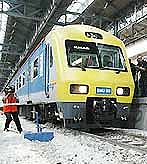 Instead of using electric multiple-unit (EMU) trains, it used a diesel-powered shuttle train. KTMB should take pride in this and use the same solution when lines are extended, including to Tanjung Malim.
The extension from Sentul to Batu Caves and the proposed station at Abdullah Hukum are also examples of smart thinking. These improvements will improve the integration of the rail transit network and have a positive impact on public transportation and development in communities like Pantai, MidValley City, Sentul, Selayang and Gombak. With the relocation of KTMB workshops and training facilities to Batu Gajah, the current site in Sentul will be redeveloped.
A proposed extension of the LRT from Sentul Timur would meet the extended Komuter line at Batu Cantonment (or Sentul North), which would encourage transit-oriented development. Similarly, a Komuter station at Abdullah Hukum will improve public transit access to MidValley city and LRT/Komuter integration in the Klang Valley.
It is time we realise that the LRT lines do not have the capacity to move enough people to meet the needs of the Klang Valley. The Komuter service has a very important role in the regional public transportation network in the Klang Valley, as well as regional public transportation networks in the north and south of Peninsular Malaysia.
The Komuter service needs to aim for high frequency service that can compete with the LRT. This will require new trains and larger trains.
Expansion potential
When it comes to expansion potential, Komuter services are actually quite far ahead of LRT. The stakeholders and those who follow public transit in Malaysia should be aware that the LRT service is about to reach a plateau.
Sure, there are plans to extend the Kelana Jaya LRT line to Subang Jaya and USJ and to extend the Seri Petaling line close to Puchong. Another line is proposed from Kota Damansara to Cheras (Plaza Pheonix). The Selangor Menteri Besar has mooted an 'outer ring' LRT line and an extension of the Kelana Jaya LRT line to Klang.
But the fact is that LRT expansion costs a lot of money and the service does not have the expansion potential of the Komuter service.
Let's weigh the facts. The Komuter operates 3-carriage EMU trains at frequencies between 12-15 minutes. Each train can carry about 450-500 passengers.
The Kelana Jaya LRT line operates 2-carriage trains at frequencies as high as 90 seconds, and as low as 11 minutes. Trains can carry about 250 passengers now and future trains will carry about 530 passengers. The Ampang and Seri Petaling lines operate trains at frequencies as high as 2 minutes and as low as 15 minutes. Current trains carry about 300 passengers.
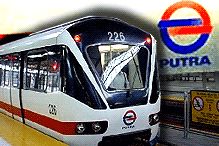 Many do not consider that the Ampang-Seri Petaling line is now operating the longest trains possible. They also do not realise that the Kelana Jaya line is operating at 140 percent of maximum capacity during peak hours.
This means that passengers waiting for four to five trains to pass before they can find space, which is a spare brought in to handle heavier passenger loads. When four-carriage trains are introduced, passenger capacity will double But this will just mean that peak hour passengers will only have to wait for two trains to pass before they can board.
We have to realise that once the Kelana Jaya LRT line converts to four-carriage trains, services in the Klang Valley will come ever closer to a plateau. When this happens, the only effective way to improve will be to construct additional (expensive) LRT lines. This is simply because the LRT trains will have no room for more passengers. Any extensions to existing lines (say, to Subang Jaya or Klang) will simply pack more passengers onto already crowded trains.
The Komuter's inherent advantage over the LRT is that it still has four possible ways to expand operations.
1. Train frequencies can be improved. Current frequency could be reduced to 5 minutes if there are enough trains. Additional improvements, such as automatic train control, could expedite frequency to as high as two minutes.
2. Train capacity can be expanded relatively easily. The coupling of two 3-carriage EMU trains into a 6-carriage train set is already taking place on the Sentul-Pelabuhan Klang line. A 6-carriage EMU train can carry up to 1,000 passengers. If there are enough EMUs, the Komuter could operate each train as a 6-carriage train to double service.
Of course, service expansion does not have to be limited to 3-carriage EMUs. The Express Rail Line operates 4-carriage Siemens Desiro EMU trains. Future Komuter EMUs could be trains with four or five carriages.
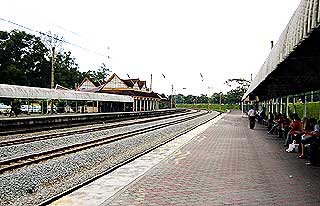 3. There is enough space at most Komuter stations and halts to accommodate 7-8-carriage trains. And unlike the LRT, platform expansion at most Komuter stations and halts would be relatively easy. Imagine 9-carriage or even longer EMU trains in the future.
4. Komuter operations could use different options, if we take the example of the KLIA Express line. Most of the ERL operations are on double-track lines. Bypass tracks have been constructed at all stations, meaning that near the station areas, there are four tracks. ERL is therefore able to operate two different services, the non-stop Express and the limited-stop KLIA Transit.
Most of the rail lines around Komuter stations are 3- or 4-track lines. Most of the lines between stations are 2- or 3-track lines. This leads to the ability to provide different types of train services, which LRT cannot match.
MOAZ YUSUF AHMAD, a regular user of public transport, is deeply concerned that government plans to encourage the use of public transport will ultimately fail because of poor planning and lack of support from the public.


