




KTM Komuter - the way to go (Pt 2)
If KTM Bhd (KTMB) is considering ways to add variety to its KTM Komuter service in the Klang, Valley, four choices come to mind.
A popular option would be a limited-stop line running parallel to the current service. Perhaps this might be called 'Komuter Baru' or 'Komuter Laju', but effectively, the trains would only service the stations, not the halts.
This would speed up travel. For example, the train from KL Sentral to Port Klang would stop only at the Shah Alam, Subang Jaya and Petaling stations.
If KTM Bhd (KTMB) is considering ways to add variety to its KTM Komuter service in the Klang, Valley, four choices come to mind.
A popular option would be a limited-stop line running parallel to the current service. Perhaps this might be called 'Komuter Baru' or 'Komuter Laju', but effectively, the trains would only service the stations, not the halts.
This would speed up travel. For example, the train from KL Sentral to Port Klang would stop only at the Shah Alam, Subang Jaya and Petaling stations.
A second choice is the express-in-out service supplemented by 'local' services. After a certain station, the in-bound train will be full. From this point, the train runs non-stop to the final destination, while a local service picks up passengers closer to the city. The out-bound service operates in a similar way, with passengers travelling 'express' from the city to the suburbs, and then stopping at all stations.
 In Komuter terms, the train from Seremban might be full by the time it reaches Kajang. So, it will run 'express' to KL Sentral. The return trip would operate non-stop from KL Sentral to Kajang, then stop at all stations from Kajang to Seremban.
A third option involves a system of alternative trains and stops. Trains are labeled A and B, while stations are labeled A, B and AB. The A train stops at Stations A and AB; while the B train stops at Stations B and AB. Skipping stops reduces travel time and passenger load in the trains and at stations.
The AB stations are to enable passengers to switch lines - as now happens at the Putra and Bank Negara halts as well as at hubs like KL Sentral. Those traveling between the Putra halt and KL Sentral can board the first train that arrives.
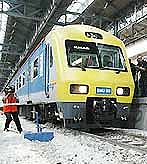
The fourth choice is to operate diesel trains that are independent of an electrical power system, as done when extending the Komuter service from Rawang to Rasa with a shuttle train .
This gives Komuter operations great flexibility. While diesel-powered trains cannot operate as fast or as efficiently as electric trains, they are a good way to introduce rail service without the cost of investment in electrification.
Additional lines
Potential expansion of the Komuter service is another valuable advantage to consider. KTMB has indicated an interest in expanding the rail service in the Klang Valley by upgrading existing lines and even creating new ones.
The best known of these plans is the double-tracking and electrification of track between Sentul and Batu Caves, for which construction will soon begin. This 7.5 km extension to the north of Kuala Lumpur will add four stations.
Extensions are also planned from Seremban to Senawang, Sg Gadut and Port Dickson. It is also possible that the YTL-financed KL-Singapore High Speed Rail line will follow an alignment along the west coast, which will likely take it close to Port Dickson.
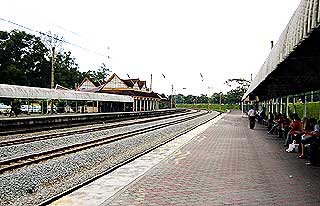 A short line branching off from Subang Jaya and Batu Tiga now connects with the Sultan Abdul Aziz Shah airport. If KTMB double tracks and electrifies this line, it would bring Komuter service to the airport, to back scheduled turboprop flights for Berjaya Air and Firefly, as well as private planes, charters, and a flying school. The line could lengthened past the airport to bring rail service to communities around the airport, as well as north of Shah Alam and Klang.
Consider the outer ring line recently mooted by the Selangor Menteri Besar. The proposal included a LRT line from KL to Klang, as well as an outer ring LRT line. These would have greater potential for success if built using the same technology as the Komuter service (overhead wires and electric trains), as well as incorporated into the Komuter service.
The extension of Komuter service to the airport and beyond could substitute for the proposed KL-Klang line. The ring line could also be built using the meter gauge to allow integration with the Komuter and make for a more complete network.
Different types of trains could be used in different areas. There is potential for Komuter-type service, trains to the airport, express trains into KL and others. Tram service could even be offered, by building spur lines off the main line. This would bring rail service directly into the communities, instead of being operated on the fringes.
Regional service
Along with the double tracking projects, the government is in the process of developing the FIRST plan, which aims to connect all major cities using high speed rail links.
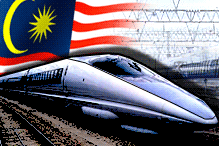 The first will be between KL and Ipoh, likely followed by one from Ipoh to Butterworth. The opportunity for a link between KL and Butterworth is obvious. Of course, high-speed service using meter-gauge rail lines may not be as fast as the service offered on standard gauge (like the KLIA Express/Transit) or wide gauge rail lines (like the Shinkansen 'bullet' trains). However, it will be fast enough to make a difference and encourage more people to use trains.
Other proposed links are between Kuala Lumpur and Kuantan; and along the East Coast, between Kuantan and Kuala Terrenganu, and Kuantan and Kota Baru; between Alor Gajah and Melaka town, Seremban and Port Dickson, and possibly between Ipoh and Teluk Intan.
Another potential regional expansion is the introduction of Komuter services in the north and south of the peninsula. There are already calls for Komuter service to move people in and out of Johor Bahru and in and around the Iskandar Development Region. KTMB's JB Sentral station is almost ready for operations.
Similarly, there are plans for a Komuter service in the north, which would build a network in Seberang Prai that would also service the Northern Development Corridor, connecting to Kedah, Perlis, and northern Perak.
Direct rail links between Singapore and JB will be necessary, as well as a (hopefully double tracked and electrified) connection between Butterworth and Hadyaai, with potential extension up to Bangkok.
Of course, this is partly speculation, but it is quite wonderful to finally be able to speculate about the potential for rail transit in Malaysia.
Read Part 1 here and Part 3 here
MOAZ YUSUF AHMAD, a regular user of public transport, is deeply concerned that government plans to encourage the use of public transport will ultimately fail because of poor planning and lack of support from the public.


