




On parenting, homosexuality and the church
My wife and I are parents to a one-year-old. When he tries to plunge head first from the bed, we stop him. When he is attracted to fragile items on display in the shops, we restrain him.
When it's late in the evening, we tuck him in bed. We don't explain our actions - although we sometimes might.
This won't be the case for long.
My wife and I are parents to a one-year-old. When he tries to plunge head first from the bed, we stop him. When he is attracted to fragile items on display in the shops, we restrain him.
When it's late in the evening, we tuck him in bed. We don't explain our actions - although we sometimes might.
This won't be the case for long.
If he progresses normally, he'll soon be talking and conversing. He'll start asking 'why'. Things that we could get away with before, would take on another level of complexity:
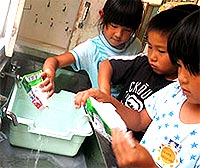
"Recycle, Daniel."
"Why recycle?"
"It's good, son."
"Oh, really? Why?"
How should I answer? I could say it's good because we are preserving the earth for future generations. But are things really so clear cut?
It's questionable whether recycling is good in all circumstances. For instance, rather than getting paper from pulpwood, recycling requires paper to be collected, cleaned, shredded, and treated chemically. Think about the miles of trips by the paper lama guy, the pollution, and the hard recycled toilet paper.
Would I really want to get into a dialogue about the pros and cons of recycling?
Digging deeper, things don't seem as simple as they first seem. Rather than just churning out a platitude, I may actually need to think things through myself. It would be so much easier to just leave things at: "It's good means it's good lah. Trust me, ok?"
Reasoning it out
Unsurprisingly, we often take this tempting route in other matters. Take Ouyang Wen Feng's efforts to start a church in Malaysia. A pastor at Metropolitan Community Church in New York, which accepts and condones homosexuality, Ouyang came out of the closet last year. He hopes to start a similar church in Malaysia by 2010.
Over the past couple of weeks, Ouyang's mission has stirred some Christians into a throwing a fit. Protest e-mails and SMSes have been sent as part of a co-ordinated effort to rally the troops against this 'disgusting' gay. There is fear of the consequence - 'more people getting HIV, and souls won by them would head for hell'!
More diplomatically, National Evangelical Christian Fellowship (NECF)'s Wong Kim Kong said, "Christians don't want others to assume they condone such a thing."
 Christians need not worry for now. Tourism Minister Tengku Adnan Tengku Mansor told
AFP
that the government would
block
the plan because the country seeks to portray itself as a "family-oriented" holiday destination.
Christians need not worry for now. Tourism Minister Tengku Adnan Tengku Mansor told
AFP
that the government would
block
the plan because the country seeks to portray itself as a "family-oriented" holiday destination.
Presumably, he hopes families on holiday don't read the local papers with their tales of stabbing, gang rape, and dumped babies (based on a glance at today's news alone).
But isn't there always something to worry about? In Ouyang's case, Christianity found a bedfellow in the tourism ministry. In other cases, maybe not.
A news article last week reported that a church has been accused of false teaching. Quizzed about what action they would take, NECF and the Council of Churches Malaysia (CCM) admitted their hands were tied "unless it violated the laws of the country". Hands are tied from doing what exactly?
Let's revisit the parenting scenario. I can tell my son to recycle, not to waste gratuitously. If he refuses while he's a toddler, I could still force him. In some countries, I could smack him if he refuses to obey. In others, smacking might be frowned upon - my hands are tied.
 Wherever we are and whatever our method of parenting toddlers, our aim would be to go beyond merely guiding and directing their actions. It should include reasoning with the child.
Likewise with the Ouyang story, our aim should be to explain our reasons, and reason with our fellow human.
Reason, however, is risky. Unless we're dead certain, there's always the chance we might be wrong. Is recycling always good? The classic example: Is lying wrong? If you were hiding Jews in your attic, and the Nazis asked if you were hiding any, what would be the right moral action?
Besides moral facts, we may think of others: Did humans evolve from apes? Who was to blame for May 13? Is Malaysia better off now than it was at the declaration of Merdeka? Which religion is true?
Nothing to lose
If truth is the goal, and reason the tool, we move towards this goal sifting through the arguments. We discuss and reason with each other. I doubt the SMSes to Ouyang sought to engage him in dialogue.
Rather than shut down Ouyang, why not let the arguments from both sides be heard. Who says homosexuality is wrong anyway? OK, the Bible. But why? What reasons does it give? And does Ouyang give good counter arguments? Moving further back, why should we believe in the Bible to begin with? The objective is truth - not a shouting match forcing our beliefs down others' throats.
I am a practising Christian. Thus, it's disconcerting to see the church, historically mission-minded, act in this way. The complaint of the leaders is that their hands are tied in acting against false teachers. When their hands are not tied, Ouyang is bombarded by the mob. Can't they see that the same accusation can be leveled against Christian teachers in non-Christian lands?
 If we are labeling things 'true' and 'false' remote from content, who is to say what's true and false other than those whose hands are untied. Isn't this how Christianity started anyway, kicked out from Judaism?
Focus on the arguments. If you disagree, argue your point. It's a tad simplistic to say we're the good guys, they are of the devil and damned, or the masses are easily deceived, so let's destroy the baddies to protect the foolish sheep.
And once the point has been discussed and arguments made, doesn't that leave us all better off? Of course there's the risk we might be convinced by the other party, but they too would have exposed themselves to the same risk.
If we are swayed and if we put our egos aside, perhaps we could even admit we were wrong. And what risk is there if the risk is truth?
This applies not just for Christians of course. Regardless of your current religion or situation, think - or, if you can't just yet, learn to think.
And leaders - whether of religious groups or non-religious groups - treat your followers as they deserve: as your fellows, your equals. Not as children who need to be shouted at and smacked.
Like children who are driven to run away from home, maybe that's why people flock to non-orthodox teachers in the first place.
ANDREW TAN works in IT, is pursuing a doctorate in philosophy, and a freshman in parenting. Originally from Petaling Jaya, he now resides in Manchester.


Report this comment
Are you sure you want to delete this comment?
This action cannot be undone.