




KTM Komuter - the way to go (Pt 3)
The first two articles discussed the high value of the KTM Komuter service in improving public transportation in Malaysia. It was emphasized that it was time to focus on improving the existing KTM Komuter service with better frequencies, to make the service more competitive.
The value of an expanded KTM train service (including Rapid Train service and additional Komuter networks) was also examined. This article discusses the value of an expanded network of KTM public transportation services (including bus and rail).
The purpose of this writing was to remind Malaysians to open our eyes to the potential of KTM Komuter services. We should not overlook KTM Berhad (KTMB) and the rail services that are offered in Malaysia.
The first two articles discussed the high value of the KTM Komuter service in improving public transportation in Malaysia. It was emphasized that it was time to focus on improving the existing KTM Komuter service with better frequencies, to make the service more competitive.
The value of an expanded KTM train service (including Rapid Train service and additional Komuter networks) was also examined. This article discusses the value of an expanded network of KTM public transportation services (including bus and rail).
The purpose of this writing was to remind Malaysians to open our eyes to the potential of KTM Komuter services. We should not overlook KTM Berhad (KTMB) and the rail services that are offered in Malaysia.
Double tracking and future rail expansion will improve reliability and allow a huge increase in the number of trains that can be run. The FIRST plans will bring regional rail service into the lives of more and more Malaysians, and I am looking forward to the day when KTM Komuter service is found all around Peninsular Malaysia.
Direct access
Expanded rail services will give people far more transportation choices than they ever had before. KTMB needs to become a public transportation provider. I hope that one day the KTM Railway lines and KTM networks will be the backbone of a complete national public transportation network.
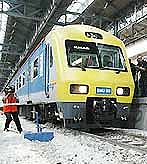 Rail services work best by giving people direct access to rapid transportation. Train stations are usually located in the central business areas of cities. Trains are immune from traffic congestion (unless there is a major structural problem). Connecting railway stations with other public transit services means that people can move and move easily without relying on a car.
Compare, for example, a trip between KL and Singapore. A person flying from KL to Singapore would have to drive to the airport (or take the KLIA Express), check in, pass through immigration and security, wait, board the aircraft, taxi, take off, fly, land in Singapore, wait in line to leave the plane, pass through security and immigration, leave the airport, and travel to the city (by transit or taxi).
If there was a high speed rail connection between KL and Singapore, a lot of the pointless waiting and travel time could be eliminated. Similarly, a high speed railway link between KL and Ipoh, or KL and Butterworth, would eliminate a lot of pointless travel time, waiting time, and time wasted in traffic jams.
But, what is the point of investing in high speed rail service if passengers are left to fend for themselves once they leave the station?
Feeding the stations
One of the things that RapidKL was created to do was to integrate the bus and rail networks of the Klang Valley. It is unfortunate that KTMB has not seen fit to integrate bus and rail service yet. It is fine to say that KTMB is "in the rail business" not the "bus business," but the point here is that KTMB should be offering complete public transportation service.
This means that KTMB should be offering contracted feeder bus service to all KTM Komuter stations, and even KTM stations in towns and cities throughout Malaysia. In fact, why stop there? KTM should create its own brand to offer feeder bus service from KTM stations to other place.
In Hong Kong, for example, the Kowloon-Canton Railway Corporation (KCRC) operates three rapid-transit lines (East Rail, West Rail, and Ma On Shan Rail), as well as an LRT (Tramway) network and a feeder bus service to connect people from their housing estates to the railway stations. KCRC offers customers a complete and effective service.
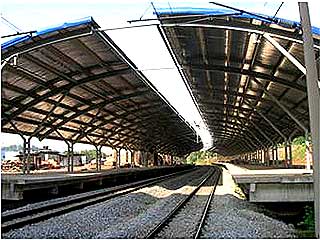 KTMB should consider offering expanded feeder services to KTM Komuter stations. For example, consider Subang Jaya. When the KTM Komuter service began operations to Subang Jaya, an expanded station was built. However, no plans came forward to actually extend public transport service into Subang Jaya.
KTMB could have contracted a feeder bus service to the station. Or, a larger tramway network could have been created to service the different areas of Subang Jay and USJ.
Today, the government is planning a RM2 billion extension of the Kelana Jaya LRT to Subang Jaya and USJ. I have gone on record as saying that this LRT extension was not what Subang Jaya and USJ and the Klang Valley needed.
If KTMB has started operating a proper KTM Komuter feeder bus or tramway network around Subang Jaya and USJ between 1994 and today, and improved their services to offer higher frequency on the Komuter lines, then no one would be calling for an LRT. Also, more people would be serviced by better public transportation. The future LRT line will be a single LRT line and it will not serve the needs of many people in Subang Jaya and USJ.
That is why KTM must start thinking of rapid transit options for the KTM Komuter lines, as well as providing complete public transportation services. By just focusing on core-rail services, KTMB misses the opportunity to really move people.
Public transport connections
KTMB is currently developing a Rapid Train Service between KL and Ipoh. There will be stops at Rawang, Tapah, Slim River, and Ipoh. Passenger rail services need excellent public transportation connections. If the goal of the RTS (and in future, the FIRST plan) is to get people out of their cars, then each station must have excellent public transportation services.
KTMB cannot just provide the train service and then abandon their customers when they leave the station.
With the example of the RTS, a public transportation service will be needed to provide connections between Ipoh railway station and Ipoh city. Sure, there may be a "RapidIpoh" bus service soon, but why should KTMB just sit back and wait for Rapid to come in and do that job?
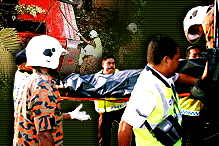 In the aftermath of the Bukit Gantang bus tragedy, many people will ask what changes can be made to improve public safety on express buses.
One clear solution would be to reduce the distance that long-haul express buses are traveling. Numerous studies have shown that most traffic collisions on highways happen approximately 200-300 kilometers distance from major cities. This is because driver fatigue sets in after two hours of driving.
By introducing better, more reliable long-haul rail services, the number of long-haul express bus trips can be reduced. Long haul buses can be shifted to short-haul and feeder routes. With fewer and shorter bus trips, many of the collisions on the highways caused by driver fatigue could be avoided. In addition, with these additional short haul and feeder bus trips, people can get closer to their destinations.
Safety and security
This means that people who are sending or receiving travelers will also not have to travel so far, which means fewer tired drivers and less collisions on the road.
With Hari Raya and the balik kampung season coming soon, we must take stock in the way that we as Malaysians choose to get around.
For our safety and security, we must realize that we can no longer rely on road transport alone. A healthy combination of public transportation services that use both road and rail modes will make land transport much safer for Malaysians.
KTMB, as a major provider of rail services in Malaysia, is currently expanding passenger rail services. To make this successful, KTMB must expand its scope of operations to offer rapid transit and feeder bus services.
Effectively, this means that to improve public transportation in Malaysia, KTMB needs to get itself out of the "rail business" and into the "public transportation business."
Read Part 1 here
Read Part 2 here
MOAZ YUSUF AHMAD, a regular user of public transport, is deeply concerned that government plans to encourage the use of public transport will ultimately fail because of poor planning and lack of support from the public.


