




Bukit Gantang - time for change
The recent bus crash at Bukit Gantang has been described by some as the worst bus accident in Malaysian history. I disagree with this description.
The recent bus crash at Bukit Gantang has been described by some as the worst bus accident in Malaysian history. I disagree with this description.
Certainly this bus crash, which resulted in 22 deaths and many more injured, is a terrible tragedy in a long line of tragedies on Malaysian roads and expressways.
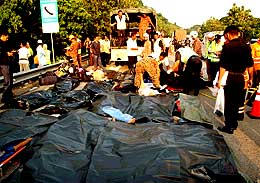 However, calling it an "accident" shows that we fail to understand the situation.
This was no accident. It was a huge tragedy caused by serious errors made by the public, the bus driver, the bus operator, the civil service and ultimately, the government of Malaysia.
In the aftermath of the crash, the public directed a lot of heat at the bus drivers, bus operators, and at the government. The media is taking part, closely examining the action of the bus operators and government agencies.
One hopes that, with the anticipated general election, as well as the ongoing holiday and balik kampung season coming, that this heat will continue until well into 2008.
The public
At the same time, there is a huge fear that the attention of the Malaysian public will soon be diverted to other issues. This tragedy has given us a chance to face and deal with many problems. If we squander this chance, we as a society have failed the people who died or were injured in this crash, as well as each and every person who will be injured in the future.
When it comes to safety on the roads and highways, Malaysians are quite willing to take risks. They will buckle their safety belts but allow their children to go unbelted. They will complain about aggressive driving and then push in front of other cars. They will criticise those who drive dangerously, but will drive long distances (after drinking coffee, of course).
And most recently, we realise that Malaysians will allow bus drivers to drive with little sleep, use nicotine, coffee and methamphetamines to stay awake, and yet complain when the bus arrives a few minutes late
It is the responsibility of the public to speak up for what is right. No amount of "safety first" campaigns and road safety campaigns from the Road Safety Department will make a difference if the Malaysian people do not stand up.
Images are flashing into my mind, of 1989, of a lone protestor at Tiananmen Square in Beijing standing in front of a column of tanks. Except it isn't 1989, it is 2007. And it is not at Tiananmen Square, this is the Tapah rest stop on the North-South Expressway. And it is not a column of tanks, but rather, a line of express buses.
What will it take to get safe buses onto our expressways?
The bus driver
Imagine that you are a bus driver on a long haul express bus route. Through some bureaucratic quirk, you do not get a salary. The company that owns the buses only pays you for each trip you complete. Each trip might earn you RM200-300. You get an allowance of about RM50 for meals, expenses and accommodations.
Whenever you have the opportunity to make another trip you take it. Even if you are tired. Even it means that you are risking your safety. Even if it means that you may be responsible for the injury or death of others. It is a risk you are willing to take.
You drive, and drive, and drive, hours and hours on end. You smoke cigarettes and use drugs to stay awake. You express to some passengers that you have only had two hours of sleep. Some of them suggest that you not make this journey. But you have to make the journey or you will not be paid.
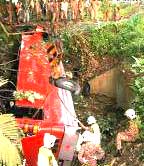 As you drive, you do not realise how your reaction time has slowed down, or how your reflexes have been dulled. You are not aware that you are zoning out, not actually seeing the road in front of you. Your eyelids get heavyand in that time, less than one second of inattention, you lose control of the bus.
There is a crash. People die, and youyou run away.
At 1 am on Tuesday Aug 21, another bus crash occurred at KM30.3 of the Gua Musang-Kuala Krai highway in Kelantan, killing one person. The driver ran away from the scene of the crash. Passengers would later report that he had told them he had only had two hours of sleep.
The driver chose to be careless, and risked the lives and safety of others. He could have decided to sleep but he had no choice. That choice was taken away from him by the bus operator, with approval of the government.
The bus operator
You are the operator of one of the many express bus companies that run along the roads and expressways of Malaysia. The government has decided that you and every other company should be competing with each other. Privatisation works and competition leads to lower prices and that benefits the customers.
Never mind that the market of the day demands point to point, long haul, non-stop express bus service, which is not actually good for the sustainability in the long term.
This is Malaysia, and there are a lot of ways that you can beat the system.
The first thing to do is buy cheaper buses. Sure, they are less safe, but what is safety anyway? You are operating a business and safety eats into profits. Besides, how likely are those bus "accidents" anyways?
While you're at it, don't actually hire the drivers. According to the government, they are not salaried employees anyway. They are licensed subcontractors. This means that you do not have to pay them for their hours, and you do not have to cover EPF, health care, Socso, government income taxes, or any of that other nonsense.
Since you do not have to give the employers a salary, just pay them on a per trip basis. They will do the smart thing and make more trips, which is good because more trips means more passengers, which means more money for you.
Let's be fair, you have to pay for the bus, don't you? You have to pay for licenses, permits, "coffee," etc. That's life. Let the drivers sacrifice. Why give them enough money to pay for a hotel room or space in a guest house? They can sleep in the bus. Why pay them a salary? They are only good to you when they are driving anyway.
Your bus, your driver kena saman? No worries. This is Malaysia, which means that a summons is just a mild inconvenience in your business operationsassuming those in the government actually even care. Even with a summons, your drivers can drive and your buses can travel on the expressways. No need to worry.
And if the people of Malaysia call for better driving, and demand that drivers get paid a proper salary, and that unsafe drivers are blacklisted, then fall back into the defensive mode. Whine about the cost of doing business, and ask them to consider the costs that you would have to face. Blame the drivers for poor driving. Blame the government for poor enforcement. If that fails, then start making threats. Introduce the idea of higher fares.
Eventually the people will back down, and everything will be alright.
The civil service
You are a member of one of the "uniformed service" groups of the Malaysian civil service. You are only concerned about your job and doing the tasks that have been clearly stated in your job description and offer letter. Tragedies do not rush you. You are an employee of the civil service. You work for the people but you don't really have to care about their needs or provide them the service.
Sometimes you do care. Sometimes you have interesting ideas. Sometimes you wonder if the department that you work for is actually part of the wrong ministry. But it is not your job to worry about such things. You have troubles every day too. You have to deal with bureaucracy. You have to work with different government agencies and sometimes you do not know where the responsibility of others end and yours begin.
The reality
The tragedy at Bukit Gantang occurred because the different agencies that were responsible for the safety of Malaysians could not bother to do their jobs properly. The police, the Road Transport Department (RTD) and the Commercial Vehicle Licensing Board (CVLB) all have failed in their responsibility.
And once the failure is known, the excuses come out. "Sorry," says one director. "Our departments don't talk to each other." "Don't blame us," chimes in another director. "We have no power to enforce regulations." "We want to do our jobs," says the third, "but we are seriously understaffed."
As I write this article, five agencies have been mobilised into a flurry of inspections of express buses. It is called Ops Bersih, and I suppose that the goal of Ops Bersih is to clean out the rot that is plaguing the express bus system.
Why don't government agencies look at themselves, and ask how and why they failed. If it is so tough for them to communicate in the past, how is it that they could mobilize themselves so fast today?
Look at the CVLB. Why is the government agency responsible for the renewal of commercial vehicle licenses a part of the Ministry of Entrepreneur and Cooperatives Development?
As far as I can tell, a ministry called "Entrepreneur and Cooperatives Development" would (and should) have very little to do with bus operations or public transportation.
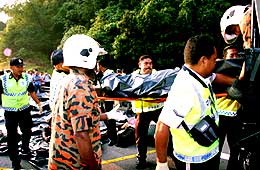 So why should the CVLB be given the power to enforce laws? We already have the police and the RTD. And let's be honest, if they are already failing to enforce traffic laws, what more could the CVLB possibly do?
Would it not be more logical for the CVLB to become part of the Ministry of Transportation? After all, these commercial vehicles are used for transportation.
Yes, it actually does make sense. And, if the CVLB becomes part of the Ministry of Transportation, then maybe, just maybe, it could be included with the RTD? And maybe, just maybe, if the jobs of all of these government agencies are streamlined, maybe the employees could actually spend more time enforcing laws and less time trying to figure out where their responsibilities begin and end.
The RTD should be the only agency responsible for the licensing of drivers and vehicles. The RTD should also be the only agency responsible for enforcing licenses and vehicle permits. Of course, we still need the police to stop drivers and enforce traffic laws and traffic safety.
Ultimately, what Malaysia needs is an Alexander (Eskander), who can just cut through the Gordian knot that is the Malaysian bureaucracy. Because this is Malaysia, we can only find such a person in the Cabinet.
So I ask the members of the Cabinet, to please heed the call from the people. Bring about change. Do it now. Thank you.


