




Prelude to a great military game?
Early last month, Exercise Malabar 2007 took place in the Bay of Bengal. A concerted effort of Australia, Japan, India, Singapore and the United States, it was the largest ever naval exercise in the Indian Ocean.
The fact that two American and one Indian aircraft carriers - USS Nimitz, USS Kitty Hawk and INS Viraat - were present is telling, and the scale and complexity of this highly sophisticated joint naval manoeuvre is beyond doubt.
Although the participating countries made it clear that the objectives of the exercise were to gain operational and doctrinal expertise, and heighten maritime domain awareness through sharing of information - thereby increasing interoperability among the partner navies with a view to enhancing maritime security in the Indian Ocean region - the underlying message could not have gone unnoticed in the rest of the world, particularly China and Russia.
Early last month, Exercise Malabar 2007 took place in the Bay of Bengal. A concerted effort of Australia, Japan, India, Singapore and the United States, it was the largest ever naval exercise in the Indian Ocean.
The fact that two American and one Indian aircraft carriers - USS Nimitz, USS Kitty Hawk and INS Viraat - were present is telling, and the scale and complexity of this highly sophisticated joint naval manoeuvre is beyond doubt.
Although the participating countries made it clear that the objectives of the exercise were to gain operational and doctrinal expertise, and heighten maritime domain awareness through sharing of information - thereby increasing interoperability among the partner navies with a view to enhancing maritime security in the Indian Ocean region - the underlying message could not have gone unnoticed in the rest of the world, particularly China and Russia.
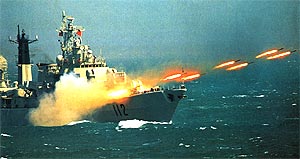 Both Beijing and Moscow were indeed watching with keen interest. Just the previous month, the Shanghai Co-operation Organisation, of which China and Russia are the driving force, conducted a nine-day military exercise in Xinjiang Uyghur Autonomous Region and Russia's Chelyabinsk Oblast that involved some 6,500 troops from all the member-states.
Ironically codenamed Peace Mission 2007, the sheer size of the manoeuvre no doubt raised the eyebrow of defence experts in the West, especially the US, with many being convinced that a new Great Game is now gathering pace.
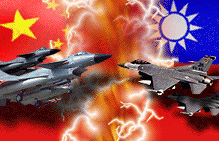 Stephen J Blank, a specialist in post-Soviet strategic studies and a Central Asia expert at the Strategic Studies Institute of the US Army War College, has suggested that Peace Mission 2007 had Taiwan and Korea in mind in addition to any potential Central Asian contingency.
After all, given its military constraints, China can ill afford to head off any attempt by the US and Japan to interfere in the Taiwan Strait should war break out, and a partnership with Russia will go a long way in keeping the US-Japan ambitions in East Asia at bay.
Jostling for advantage
So, was Exercise Malabar a repayment in kind?
It is an open secret that the US has been rather active behind the scenes to orchestrate series of military exercises with regional countries to encircle China, and Washington is indeed wary of a potential alliance between Beijing and Moscow that could limit and reduce its influence in East Asia, where its geostrategic stakes are high.
As far as India is concerned, the exercise has come to symbolise the country's clean break with its leftist past, as New Delhi rapidly forges robust military ties with Washington. The move was prompted by the rise of China as a regional power that has aroused strong suspicions among the Indian ruling elite in regard to Beijing's long-term intentions, especially when the border disputes between the two countries are no where near a peaceful solution.
Meanwhile, India's position as a naval power in the Indian Ocean is buttressed by the visits of navies from around the globe, including Britain, France, Russia, Thailand, Singapore and the US. One can also interpret that these countries are seeking to jostle for advantage to maintain the balance of power in this part of Asia by forging closer naval ties with India.
As for Australia and Singapore, multifaceted and multilateral military strategies have long been a core principle of the two governments given the countries' relatively smaller populations and the uncertain surroundings, although both countries are trying to keep the implications of the exercise to a minimum in order not to jeopardise their strong diplomatic and business ties with China.
 This leaves Japan an interesting case to observe. In his visit to New Delhi recently, Shinzo Abe proposed an "Arch of Freedom and Prosperity" to consist of Japan, India, the US and Australia, as these countries shared the "common values of freedom, democracy and respect for human rights". The proposal was noteworthy by its exclusion of China. Before he could elaborate on this "noble" idea further, Abe resigned in an abrupt manner as prime minister and became the latest victim of "Japanese freedom and democracy" for the sake of the country's "prosperity".
 Last week, Yasuo Fukuda, standing for presidency of Japan's ruling Liberal Democratic Party, pledged to make hope and security top of his agenda if elected. Now that he has assumed the leadership, Fukuda will do well to avoid all the mistakes of his predecessor.
As an aging society, Japan has been experiencing negative demographic growth over the last decade. A decreasing population means fewer contributions to the national coffer, while the dependence of the retired persons on pension increases.
When France and Germany opposed to the War on Iraq in 2003, a major reason was that any further commitment to unnecessary military expenditure would have severe effects on national budgets on pension. The very same problem has now plagued Japan. Should Fukuda continue with Abe's dangerous policy and make anti-terrorism and overseas troop deployment the twin pillars of his foreign policy, chances are, he may stay in the job no longer than his former boss now that the calls for a general election are getting louder.
In any case, the competition for influence over the Indian Ocean region is on, and the world can expect more exercises in the years to come.


