




The Burma conundrum
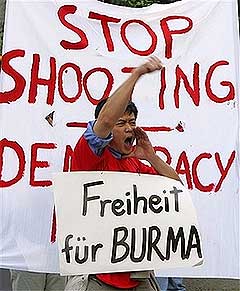
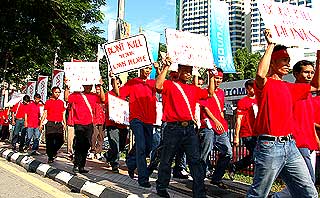
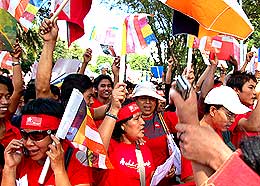
The recent protests in Burma have indeed put Asean in a very difficult position. On one hand, the regional grouping is making the utmost endeavour to realise a greater, freer economic entity, while each and every of its member state is jealously guarding their national sovereignty and territorial integrity.
One must bear in mind the fact that the whole region of Southeast Asia, with the exception of Thailand, has been through centuries of colonisation. From the seafaring Portugese to the brutal rule of the Japanese, the painful memories of being oppressed and having their dignity trampled remain imprinted in the national psyches of the Southeast Asian nations.
This explains why Asean countries have been pathetically slow in applying pressure on the military junta that has subject the various ethnic groups in Burma to decades of tutelage. To my mind, should there be an accomplice to be named for the blatant and notorious human rights violations that are now going on in the country, it can, first and foremost, only be Asean.
In 1997, it was Asean that fought hard to lobby for Burma to become a full-fledged member of the regional grouping, with the national leaders from President Suharto to Prime Minister Dr Mahathir Mohammad pretending that all was fine and dandy in Burma as far as human rights were concerned.
The recent protests in Burma have indeed put Asean in a very difficult position. On one hand, the regional grouping is making the utmost endeavour to realise a greater, freer economic entity, while each and every of its member state is jealously guarding their national sovereignty and territorial integrity.
One must bear in mind the fact that the whole region of Southeast Asia, with the exception of Thailand, has been through centuries of colonisation. From the seafaring Portugese to the brutal rule of the Japanese, the painful memories of being oppressed and having their dignity trampled remain imprinted in the national psyches of the Southeast Asian nations.
This explains why Asean countries have been pathetically slow in applying pressure on the military junta that has subject the various ethnic groups in Burma to decades of tutelage. To my mind, should there be an accomplice to be named for the blatant and notorious human rights violations that are now going on in the country, it can, first and foremost, only be Asean.
In 1997, it was Asean that fought hard to lobby for Burma to become a full-fledged member of the regional grouping, with the national leaders from President Suharto to Prime Minister Dr Mahathir Mohammad pretending that all was fine and dandy in Burma as far as human rights were concerned.
It does not take a genius to know that they were happy to overlook the horrendous crimes of the Burmese junta as they themselves were not entirely unblemished on their respective home turfs.
 According to Professor
Shee Poon Kim
, an expert on East and Southeast Asia, Asean's defiance of international opinion by admitting Burma was partly informed by a serious concern over China's strategic inroads into Southeast Asia that could see Rangoon slowly tilt towards Beijing in strategic, military and economic terms.
According to Professor
Shee Poon Kim
, an expert on East and Southeast Asia, Asean's defiance of international opinion by admitting Burma was partly informed by a serious concern over China's strategic inroads into Southeast Asia that could see Rangoon slowly tilt towards Beijing in strategic, military and economic terms.
Meanwhile, Mahathir himself once defended that, had Burma been locked outside of Asean, the regional grouping would not be in any position to effect real changes there.
With the benefit of hindsight, Mahathir had clearly overestimated the influence of Asean and underestimated the leverage of China as well as the staying power of the junta.
When Burma joined Asean in July 1997, the region was still besieged by the financial crisis that had caught much of the world off-guard. The following years practically put paid to the much hyped-up "Asian Miracle" while China emerged as an unexpected leader in the region, and Beijing began to reap diplomatic windfalls beyond its wildest dreams. The geopolitics in this part of the world has changed forever.
China factor
There are now speculations that Burma could be on top of the agenda when Asean leaders meet in Singapore for a summit in November this year.
But other important issues are still very much on the horizons, and a potential pact between Asean, China and Russia is one of them.
 In August this year, Sergei Lavrov, Russia's foreign minister, proposed that Asean and the Shanghai Cooperation Organization (SCO) should, through well-spelt out principles and regulations, initiate closer partnership on the issue of counter-terrorism.
In China, Lavrov's bold suggestion has fallen on sympathetic ears among some analysts. Zhang Jing Wei, a prolific political commentator, wrote in an article that Beijing should embrace Asean under the auspice of the SCO now that the global anti-terror measures led by the United States have met with considerable hurdles.
Zhang believes an alliance between the two regional groupings will enhance, not destroy, the anti-terror mechanism in Asia, and be conducive to the economic and social development as a whole.
Zhang's view is echoed by Ali Cordoba, who opined that "the stage that is now set for a possible cooperation between the SCO and the Asean since it will give the Asean the opportunity to influence and elaborate a plan regarding policies implemented for regional security".
This latest development goes to show that the Asean member states are still anxious to maintain the coherence of the regional grouping while exploring other opportunities of pacts and alliances with the rest of the world.
Asean's recent stern warning against Rangoon over the killings of monks and civilians is more than welcome, but to expect the national leaders to expel Burma as a member will be rather premature.
Asean has never taken such drastic a step in dealing with a member state over the past so many decades. Confronted with economic challenges and the vastly changed military-strategic realities in the region, there is no guarantee expulsion would be one of the measures to be contemplated come November.
Bleak future
The single most important factor that could influence the junta is still China.
 Contrary to the received wisdom, Beijing is not the largest trade partner of Rangoon, while Bangkok is, thanks to the massive natural gas deals between the two capitals.
Still, China's trade with Burma comprises of substantial quantities of arms and weapons that are crucial to the junta's long-term survival. Ironically, much of the China-made weaponry is also used against the ethnic Chinese living in northern Shan and Kachin states of Burma!
Hence, Asean can only carry this much weight so long as China looms large behind the military regime, not to mention other major powers, from the US to Japan, that are waiting to fill up the vacuum.
One thing is sure: even if the junta collapses, it will not be the end to Burma's misery, but the beginning of yet another long journey of national reconciliation and rebuilding.
If history is any guide, the future does not auger too well for a country and the various ethnic groups that have suffered immeasurably since the end of World War II.


