


/file/publisher-c1a3f893382d2b2f8a9aa22a654d9c97/2022/09/b98852fbd029a3753d5ad6b320133a2a.jpg)

COMMENT | How can we resurrect our national health services?
In the past 15 to 20 years, when we discussed our national health service and people asked my opinion, I said our national health service was dying.
Many of us have spoken to senior management in the ministry to tell them about the crisis we are facing on the ground. Sadly, listening has been poor, and no meaningful, concerted action has been taken to rectify the situation.
Hence, we have now come to this situation today where our national health services are in crisis. Those of us who have served for decades in the ministry feel heartbroken about the current state of our health services and the lack of adequate care for the public.
What is most distressing is that the...
COMMENT | I held back about the state of our national health services because so many individuals have articulated opinions about it. However, the limited solutions currently offered by the government require that we speak up.
In the past 15 to 20 years, when we discussed our national health service and people asked my opinion, I said our national health service was dying.
Many of us have spoken to senior management in the ministry to tell them about the crisis we are facing on the ground. Sadly, listening has been poor, and no meaningful, concerted action has been taken to rectify the situation.
Hence, we have now come to this situation today where our national health services are in crisis. Those of us who have served for decades in the ministry feel heartbroken about the current state of our health services and the lack of adequate care for the public.
What is most distressing is that the solution(s) presented by the government are moving to a fee-for-service model, which is not good for the poor and middle class.
I do not agree with private practice being a model for healthcare. It is expensive, and no longer controlled by doctors but by large corporations, which have profit as their primary goal.
Private healthcare only serves those who have the money to pay. I have friends and colleagues in the private sector. Many of them do good work, but they are not able to control the fee structure, which is set by private hospitals and large corporations.
Hence, my comments here will be about how we can resurrect our national health services. The recent Rakan KKM Express Lane Service announced by the health minister is another attempt at a fee-for-service model.
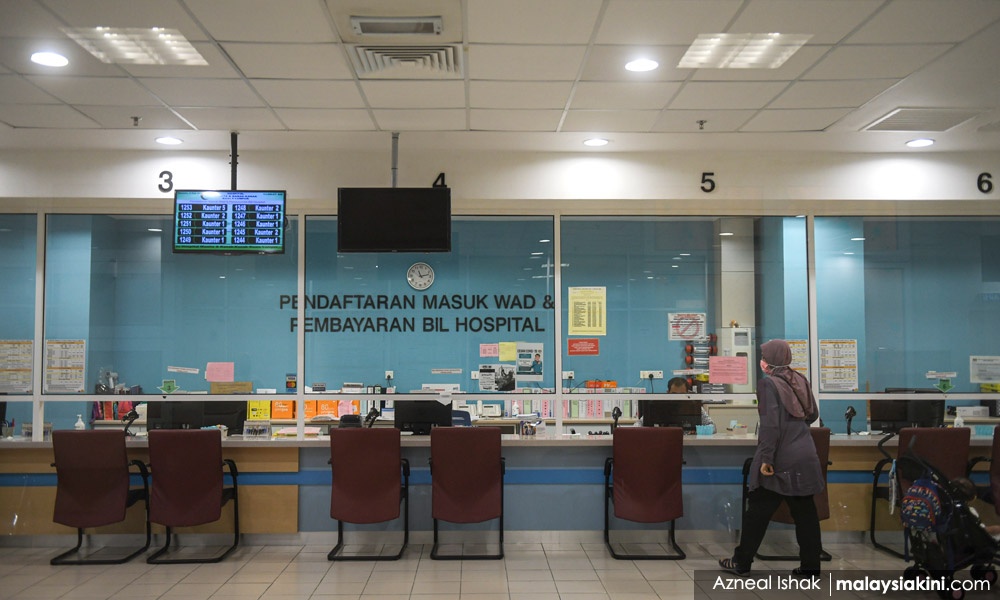
Past fee-for-service models include enabling Health Ministry specialists to work in practice (part-time private practice), full-paying patients, private wing, etc. All these take away experience and expertise from patients who need them.
They worsen the inequality of care within the national health services. It is suggested that specialists have extra time to go and work in the Rakan KKM scheme, but most of us who serve in the ministry have 10 to 12-hour working days, and this does not include calls.
‘Demoralised, exhausted’
The Health Ministry seems to be unaware of the fact that public healthcare professionals are demoralised and exhausted. Healthcare professionals in our national health services currently see no future.
I am unsure who is advising our good health minister, but the advice is poor. We do not pay taxes so that our national health services can be transitioned into a fee-for-service model, or corporatised, or whatever term we want to use.
And Private Health Insurance (PHI) and Social Health Insurance (SHI) are not good solutions.
There are no easy solutions to resurrect our national health services that have been ailing for decades. But perhaps it is important to crystallise what plagues our national health services.
Why have we come to this low place where many specialists want to leave the service? Why do new graduates and young doctors prefer working in other countries or in the private sector rather than in the public service?
Why do we have such a poor complement of nursing personnel and allied health care professionals? Why is our hospital and health infrastructure so poor?
Years of neglect
One key has been the neglect of our national health service by our governments, those in power for decades. We have spent too little on health services. However, governments of the day have spent lavishly on mega projects.
Preterm babies, ill children, and adults have died due to the lack of intensive care services. The failure to rectify the overcrowded emergency, outpatient, and primary care services for decades is a testament to the government’s long-standing failure.

The Pakatan Harapan government promised to “rebuild Malaysia from the rubble of devastation brought about by overlapping crises across multiple sectors such as healthcare…”. However, they have not lived up to the health promises in their manifesto.
Other key issues are the “elephants in the room” that we seldom want to face. We have institutionalised corruption in our country. Corrupt practices impact our healthcare system in terms of spending and development.
Meritocracy is lacking in the civil service, and this damages the development of health services with a haemorrhage of many good health professionals into the private sector and overseas.
In addition, we have failed to address the quality of training of medical undergraduates, with medical errors and incompetence having risen over the years.
Finally, and by no means a complete list of problems, the Health Ministry has encouraged, for decades, a disease focus with specialisation and sub-specialisation, which take up 60 to 70 percent of health resources.
This has resulted in a huge lack of generalists, with primary care services having been relatively neglected. This “disease-focused” model that the ministry has promoted has resulted in a public addicted to curative services.
The cry of the public is for more hospitals nearer their homes, more specialists at their doorstep, and more quick fixes for their medical problems. We have failed to promote health and wellness with a focus on community care as the primary model for our health services.
We have not addressed the worsening social determinants of health, where the poor, disadvantaged, and marginalised have the worst access to and quality of healthcare - they are the ones whose children have the highest mortality and morbidity.
Data suggest that the under-five years of age mortality for the B20 community is at least 10 times that of the T20 community.
How do we “rebuild Malaysia from the rubble of devastation”? How do we move forward?
Let’s face reality
Firstly, we must admit that we are in a very bad state and have failed. It is not possible to move forward without an honest assessment and public admission of our dire health services crisis.
Secondly, let’s take some ideas from the October 2022 Harapan manifesto, their promises to us at the last elections. Many suggestions are meaningful:
“Healthcare reform must be done immediately before it is too late.”
“Increasing the public healthcare expenditure to five percent of gross domestic product (GDP) in five years in order to keep up with the national population growth, increase in lifespan, and current needs.”
“Shifting from sick care to healthcare and wellness, including addressing social determinants for health, such as poverty and preparing health education and equal access to healthcare for all.”
Giving special attention to overcoming the rise of non-communicable diseases (NCD) by focusing on primary care,”
“tabulate and monitor the execution of the National Health Reform Plan“
“The national health service delivery reform will cover reduction of waiting periods for procuring health services, modernising health facilities.”.
“To solve the contract doctors’ conundrum, set up a National Health Services Commission to reinforce the management of human resources, staffing, training, and career growth of healthcare staff.”
While the Harapan government has failed to live up to most of these promises over the past two years, nonetheless, these ideas are good and we should use them.
We need increased spending on our public health services with an increased focus on preventive health efforts, and we will need to develop workable solutions to fund this.
I ask the current government to return to their healthcare promises and look back at what they were fighting for just five years ago. Any meaningful National Health Reform Plan must be fully accessible to the public and involve all Malaysians in its development.
For far too long, we have allowed our national health service to decay. There are no easy fixes, no easy solutions.

However, I do believe that we can resurrect our health services and keep our healthcare professionals to serve in the public sector.
Basic health is a human right and not one that citizens should have to pay to receive. It is time we work concertedly to end the inequality in healthcare and not exacerbate it.
I leave you with a quote from Martin Luther King Jr: “Of all the forms of inequality, injustice in health is the most shocking and inhumane.”
DR AMAR-SINGH HSS is a consultant paediatrician and child-disability activist.
The views expressed here are those of the author/contributor and do not necessarily represent the views of Malaysiakini.
/file/publisher-c1a3f893382d2b2f8a9aa22a654d9c97/2024/08/d8de7624a305e30a3dd9fdc19c6f6141.jpg)
/file/publisher-c1a3f893382d2b2f8a9aa22a654d9c97/2023/02/faa9dc243b4d3687b5c33ccd630d113b.png)
/file/publisher-c1a3f893382d2b2f8a9aa22a654d9c97/2024/07/c4ddaa74c8286af6571965ce2d2f92c5.jpg)
/file/publisher-c1a3f893382d2b2f8a9aa22a654d9c97/2024/08/2e30fb8e81dc996926b50a0c94fcf276.jpg)
/file/publisher-c1a3f893382d2b2f8a9aa22a654d9c97/2022/07/526ff019eaa9ebe0a032d022a09d6625.jpg)


Are you sure you want to delete this comment?
This action cannot be undone.