




See the truth, hear the truth
In the season of peace and goodwill, the government may want to ponder if being more compassionate would help it achieve better outcomes for the long term.
The jailing of Malaysians under the Internal Security Act (ISA) only achieves it notoriety and hardens resolve. All Malaysians want for Christmas is just governance where reason and justice prevail.
The clampdown on healthy demonstrations will only make things worse and create more problems. The government should show maturity and understanding and release all ISA detainees and drop all charges against innocent Malaysians. It is absurd that, in a modern and civilised society, Malaysians can be jailed for protesting peacefully.
In the season of peace and goodwill, the government may want to ponder if being more compassionate would help it achieve better outcomes for the long term.
The jailing of Malaysians under the Internal Security Act (ISA) only achieves it notoriety and hardens resolve. All Malaysians want for Christmas is just governance where reason and justice prevail.
The clampdown on healthy demonstrations will only make things worse and create more problems. The government should show maturity and understanding and release all ISA detainees and drop all charges against innocent Malaysians. It is absurd that, in a modern and civilised society, Malaysians can be jailed for protesting peacefully.
 Prime Minister Abdullah Ahmad Badawi has broken his promise and used the ISA on civilians who are even less a threat to internal security than some Umno politicians who make incendiary speeches and cause consternation among Malaysians without being taken to task.
For as long as the Hindraf 5 are in detention, it will serve as living proof of the government's strong-arm tactics and its abuse of the ISA for political purposes. While we may not support all of Hindraf's agenda, we support the use of the ISA even less. During Operasi Lalang in 1987 the ISA was also used unjustly but 20 years later the government will face more criticism.
Malaysians have seen 22 years of the Dr Mahathir Mohamad tenure during which unfair tough measures achieved nothing constructive for the nation. Instead Mahathir himself now derides the legacy he left behind as "rotten" and "a police state" which is unravelling itself as the police vigorously quash all public dissent. Images on Youtube of police rough tactics do nothing for country’s image.
The quick fix is dialogue and reform that attack the root of the problems, not knee-jerk reactions, spin in its controlled media, and more use of the ISA and police curbs. The judicial scandals and other allegations of corruption require credible independent inquiries that expose the real felons, not the charging of mums, dads, students and ordinary folk whose only crime is that they joined others on a Sunday stroll.
Concerned Malaysians only want their government to do the right thing. The government's approach to the judicial scandal and failure to form the recommended Independent Police Complaints and Misconduct Commission fall short of public expectations and raise doubts about its efficacy.
Poor reflection
After 50 years of independence and Umno hegemony, it reflects badly on the nation that the government has to stifle public debate on rice-bowl problems faced by impoverished Malaysians.
The Indian plight - crystallised by Hindraf - could have been better handled. It is a symptom of the root disease of corruption despite billions of ringgit spent on development programmes. All reports of corruption have not been properly investigated which leaves the government open to criticism and suspicion. The Bersih and Bar Council lobby agitations can be traced to the same cause. It makes no sense for the government to window-dress the malaise when this should be purged.
Under Mahathir, activists or bystanders were browbeaten, gagged, prosecuted or simply jailed without trial. It enshrined the culture of unreasonable force in the government's modus operandus . It also used psychological weapons of harassment, victimisation and ostracism to destroy dissenters within and without the government, as we saw in the Anwar Ibrahim drama. It was a failed approach that is repeatedly being deployed.
Malaysians therefore don't dare to be openly critical. It only makes the government's job easier. And Mahathir once remarked that Malaysians are "easy to govern". But marching Indians and lawyers have shown grit. Their mettle will be severely tried as their leaders face the wrath of their persecutors in framed charges and prison.
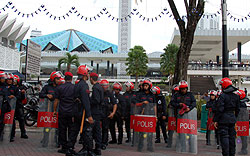 Our concern is not so much who is involved but that the country should be fair to all and give every citizen the right and freedom to air their grievances and articulate their case in accordance with constitutional law. After all Malaysians are intelligent and can make up their minds for themselves once the facts are known. There is no need to resort to the melodrama of breaking up peaceful marches and for the government to think for them.
Those who openly dissent for the public good and get into trouble like the lawyers and Bersih organisers are heroes, and their place in history is reserved. A more enlightened government may in future even honour them, as we honour our past freedom fighters. No one is a traitor who loves his or her country and labours for its good. The traitors are those who are corrupt and bend the laws and the will of the people to their selfish interests.
The government has branded as traitors those Malaysians who go overseas to run down the country. It should be commended for its incredible imagination. The truth is those 'traitors' are not slandering the country but merely stating the truth about the situation. It is duplicitous in equating the government with the country itself when in reality the two are separate entitites. People talk to foreigners only because the government has constantly failed to listen to their pleas.
If governments are concerned about citizens going abroad to report badly on them, then they should be careful not to give their citizens and foreign journalists any cause to do so. No citizen likes to wash dirty linen before a foreign country, but sometimes have no choice. The government has the choice to expeditiously tackle corruption with the same determination it uses the police to crush dissent. It has to be more pro-active and not reactive. If there is no will there will be no result. So far it is only responding to exposes from others.
Even Nobel laureate Al Gore had to point his finger at his government for its failure to tackle the problem of climate change in front of a world audience in Bali recently. Americans who speak their mind have the least to fear from their government branding them 'traitor'. The McCarthy days are long gone. For a country that fought a war of independence and a civil war, and practised racial segregation, it has come a long way.
Siege mentality
But after 50 years of independence and self-rule, with virtually no enemies, Malaysia still has not left the blocks and functions under a siege mentality. Every vital subject is taboo. The public political arena is still barb-wired and out of bounds to all except those in Umno. Even government coalition partners who dare dissent are silenced. Anyone who innocently speaks the truth on a foreign television station can be harassed, as blogger Jeff Ooi found out from being on Al Jazeera. All media, bar Malaysiakini , are licensed to say only the things the government's itching ears want to hear.
While the country has made impressive progress on the economic front and other areas, it is still floundering in the intellectual and political backwaters. By 2020 the country hopes to be an advanced and developed nation. It will be another pipe dream while the country is hamstrung by censorship and repression and a mentality that Abdullah himself derides as "third world".
 The nanny-state mentality prevents the nurture of Malaysians to be bold and progressive thinkers and only produces a nation of selfish people preoccupied with material success. In a climate of censorship and discriminatory policies, generations of Malaysians are passing on their fears and insecurities and bitterness to their children's children.
The rising discontent among urban Malays is symptomatic of the discriminatory policies of the government that they see only looks after their cronies and not all their countrymen. Many of them no longer see race as the danger but like other concerned Malaysians realise the real threat of administrative heresy that makes those in power think they have the right to abuse their power and enrich themselves in corrupt wheeling and dealing.
Still race is the bogeyman in politics and the government likes to cry wolf and indulge in fear-mongering as we saw at the Umno general assembly, where keris waving - the veiled threat - is explained away as a gesture to protect all Malaysians. But from whom?
Talk more
All disputes end at the negotiating table. Even the hardcore stakeholders in the Middle East dispute are prepared to sit down and talk. The government should be sitting down and talking with those who have valid grouses and open up the public space. A good parent will not smack a child when she cries but responds caringly and tends to her needs, how much more a government when so many of its citizens have cried out for its attention?
If the government did not have a jaundiced eye it would have seen the marches not as acts of defiance but pleas for help. They were orderly and peaceful and PAS itself showed great responsibility with its traffic marshals at the Bersih march. But the police had to flex its muscles and spoil the party and prove to the world that it is indeed a police state by hampering the events from the onset. Shooting the peaceful marchers with chemical-laced water cannons isn't exactly a good tourist advertisement for the government or the country.
The government further shoots itself in the foot by letting firebrand spokespersons embarrass it with gaffes and lies. It is Malaysia's version of the Keystone Cops, those bungling American cops, from the silent movie era, except the politicians make more noise. The back-pedaling ways of the government as in the dropping of the murder charges against the Hindraf 31 betray initial responses which are ill-conceived and impetuous, not to mention unjust and will not survive the judicial test, even if we suspect some judges are flawed.
 Going on its own signature campaign is counter-productive and betrays the government's own lack of confidence. It will only split the nation, and pit Malaysians against one another, when that was not the aim of the marches. Such ploys are rather puerile and detract from the focus on corruption in the judicial and electoral systems. After all the marches were not about popular support but calls for reform and justice. Malaysians still love their government, but can't stand the corrupt bit, and want to see justice done like the murderers of the Mongolian woman, Altantuya Shaaribuu, getting their just desserts.
It is such international scandals that tarnish the country abroad not people marches which occur on a daily basis in some countries. Foreigners are put off not by the people's clamour for justice but the denial of justice they further suffer for their expressions.
Malaysians desperately want to support their government because they are not political creatures, they are mostly concerned with their rice bowls and don't care who rules as long as he or she is a good ruler, and rightly so because too much talk which politics engenders, is not good for any nation. Mere talk leads only to poverty but hard work brings a profit.
But the government makes it hard. It has itself to blame because it has squandered the opportunities by allowing corruption to fester. It is common knowledge that the politically connected have done well for dubious reasons. Even then most Malaysians appear indifferent. It is left to the lawyers, NGOs, the opposition, concerned individuals, and even government backbenchers whose consciences are pricked to stem the nation's constitutional and moral regress and the endemic corruption. And for serving their nation they pay a price and get clobbered.
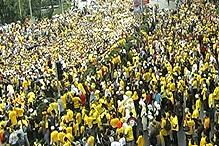 The Bersih, Bar and Hindraf grouses can all be resolved if the government would sit down and reason with their leaders. The leaders of these groups are Malaysians who love their country as much as those in government, perhaps more because they have stuck their necks out and got more to lose. Many of us don't even know them but we do know that what they ask for are not unreasonable demands that a good government can't easily accommodate. The Bersih and Hindraf agendas are worlds apart. But they are trampled by the same heavy boots.
So far Malaysians are sensible and it behooves the government to be more conciliatory, instead of hostile, and listen to the people and give them a proper forum to redress their plights. The season of reason is still with us and if we all love the country, we should be saying, ‘Come let us reason together’. The ISA is a failed weapon of political destruction and should have been repealed ages ago when the threat that gave rise to its creation was no longer there.
Insidious evil
There is another insidious evil that makes certain Malaysians develop a high tolerance of wrongdoings, and who will shy away from those who appear to challenge the status quo. For them it seems speaking out against the government is the cardinal sin, almost like blasphemy. They have been brainwashed or are naive and myopic. They are so cowed to the ways of the establishment that they have been desensitised and their instincts for self-preservation have made them reluctant to be seen as openly defiant of the government in challenging any of the wrongdoings themselves.
They will complain but are resigned to the convoluted system which sees corruption's tentacles reach into almost every nook and cranny of the administration as the Auditor-General's 2006 Report illustrates. The altered states of their minds renders them incapable of seeing the truth and behaving like members of a cult they can't see the heresy of corruption that destroys their country's vital institutions. Unless they change their mindset, which is hard to achieve in a nation of censored thoughts and media, the corruption will continue to fester. Without mass critical opinion and support no substantial change will occur.
The obstacle then for all would-be reformers is to bridge the gap between mindsets. Erudite intellectuals and moral campaigners need to realise that what seems obvious to them may not be so among those who have been brainwashed and conditioned by years of propaganda and lies. The trouble with lies is that if they are repeated often enough people think they are true. And simple people believe simple lies.
The problem is not a war of races or religions or even political parties but a war between good and evil. The government must rise above the temptations to do wrong and do right. It must save itself from itself for the government has become its own worst enemy because it has been unable to tame the serpent of corruption that has wrapped itself so tightly around it.
Anyone with a grain of intelligence will know that the pussyfooting of the government in not biting the bullet and forming the necessary royal commissions to investigate corrupt behaviour is because of its possible own casualties. Yet it is the only way for the government to regain public confidence in their leader who has so far promised much and delivered nothing to be excited about. Prosecuting the corrupt without fear or favour is justice restored.
Foreign perception
Many foreign journalists are writing what many Malaysians feel. A typical example is the editor of the Jakarta Post who wrote (Dec 11, 2007): “The threat to jail protesters for an indefinite period of time seems to have worked, at least for the time being, because the number of street demonstrations has sharply declined. But the prime minister needs to remember that demands for justice, more freedom and more political and economic equality cannot be silenced just by throwing more people into prisons.
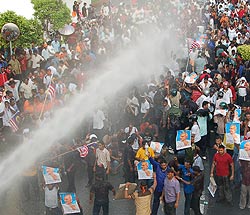 “PM Badawi and the ruling Umno need to remember that as long as the roots of discontent exist anti-government movements will not subside. The experience of Soeharto before his fall in May 1998 showed there was a point where people lost their fear of the iron-fist man and did not care anymore about his brutal responses to their protests.
“It is clear the current situation in Malaysia today is very different from what Indonesians faced nine years ago, especially in terms of economic conditions. In 1998, Indonesia's economy was on the brink of disaster, while Malaysia's economy today is relatively healthy. But as its economy shows declining growth amid soaring oil prices, many people have begun to feel the heat.
“The attitude of many Malaysian officials in responding to the street demonstrations is similar to the attitude of Indonesian officials in 1998. They point their finger at "third parties", "western countries" or "irresponsible press" creating the political unrest. They are reluctant to accept the street facts, because they have been too long in power, enjoying all privileges.
“The Malaysian government needs to be more sensitive in listening to the aspirations of its people. Defensive attitudes - such as blaming others, probably including this newspaper - will not be helpful at all.
It is time now to honestly listen to criticism from citizens. Putting anti-government activists in jail is only a very short-term solution. PM Badawi needs to show he is the prime minister of all Malaysian citizens no matter their ethnic or religious background."
If the editor of a foreign newspaper with no vested interests is able to see the truth so clearly, and offer sound wisdom, it is time the government takes notice.
The future of Malaysians and the country's image abroad lie in free and fair elections and a corrupt-free government and until that is guaranteed they should do all they can to ensure it. The government must have the heart to make it happen and not clamp down on the people and in so doing prove it is afraid of fair elections.
I honestly urge the government to do some serious soul-searching in the quieter moments of the festive season and sincerely think of the nation's interest and avoid further repressive measures. The tens of thousands who took part in the Bersih and Hindraf marches can't all be wrong. Even if the means are questionable, the raison d'etre of their marches can't be ignored, especially the Bersih concern for clean and fair elections.
In a democracy it is not the party in power that decides the rules of democracy. The rules are long established by the constitution which allows the freedom of speech and assembly. If the government says no one is above the law it must itself submit to the same laws of the land. Its double-standards are not acceptable. The police need to be reined in for they have become a law unto themselves not unlike the Rela vigilantes.
Moral obligation
Life itself is but a brief sojourn and we are all crossing sojourners on our earthly pilgrimage. Our time on earth is but a wink in the eyes of eternity. I have seen the rich and powerful when they reach the twilight of their years painfully sigh, ‘All is vanity’. Some realise that all their earthly pursuits and desires have been in vain, especially when they have wronged others and hurt them.There is no virtue in making life for others harder than what life itself renders. Humans are such slow learners.
Those in government have a moral obligation to care for their citizens and not do them harm. They who have been given a trust must prove faithful. No one begrudges their rise to fame and fortune. No one complains that they dine at the ruler's table of choice foods and drinks, fly here and there and enjoy all the trappings and pleasures of power on the taxpayers' account.
But it would be an affront to the country they serve and to God who relies on them to do their job of governance honestly, efficiently and caringly, and in making the sojourn of their fellow citizens peaceful and safe from harm.
 When I read reports of rape, robbery and assault, acts of bullying and the victimisation of Malaysians, refugees and foreign workers, and the police and Rela members are implicated, and the government does not seem to act, I am compelled to ask, ‘Does the government have a heart?’
Our ardent desire is for Malaysia to prosper in every respect. Ultimately there is only one God to whom we give an accounting and it is in our interest not to be inordinately preoccupied with temporal problems of power and success. We should not measure life purely in economic and political terms and be so obsessed with power that we fail to honour one another's humanity and neglect their deeper needs and so doing deny our own humanity. Success at any costs, by any means, is not success at all, when the innocent suffer injustice.
None of us is perfect. We must accept our faults, the government most of all because of its leading role and responsibility, and be open to the criticism so that ultimately we are the ones to benefit. There is more to be gained from connecting with God and loving one another than hurting one another. Even those who don't believe in God still believe in love and human decency. Life is too short to waste in vanities.
Peace and goodwill to all Malaysians.
STEVE OH believes that speaking the truth in love is not always easy but sometimes necessary.


Are you sure you want to delete this comment?
This action cannot be undone.