


/file/publisher-c1a3f893382d2b2f8a9aa22a654d9c97/2021/01/3a0b812279e2bb82b5ef35f930f64c40.jpg)

COMMENT | Jelutong landfill project: Four EIA rejections should mean the end
This is despite the Environment Department (DOE) rejecting the project’s Environmental Impact Assessment (EIA) for the fourth consecutive time.
We commend the DOE for upholding environmental integrity. As Jelutong MP RSN Rayer has rightfully pointed out, four rejections constitute a severe red flag that cannot be ignored.
In light of the Penang state government’s indication that it may attempt to salvage the project...
COMMENT | We take serious note of the Penang chief minister’s recent remarks indicating that the Jelutong landfill project could still move forward in a “scaled-down” form or under “another concept”.
This is despite the Environment Department (DOE) rejecting the project’s Environmental Impact Assessment (EIA) for the fourth consecutive time.
We commend the DOE for upholding environmental integrity. As Jelutong MP RSN Rayer has rightfully pointed out, four rejections constitute a severe red flag that cannot be ignored.
In light of the Penang state government’s indication that it may attempt to salvage the project, ProtectKarpal states our position unequivocally:
1. Rejected plan can’t be revived through rebranding
A fundamentally flawed reclamation plan cannot be cured by a new label, a smaller footprint, or a repackaged concept.
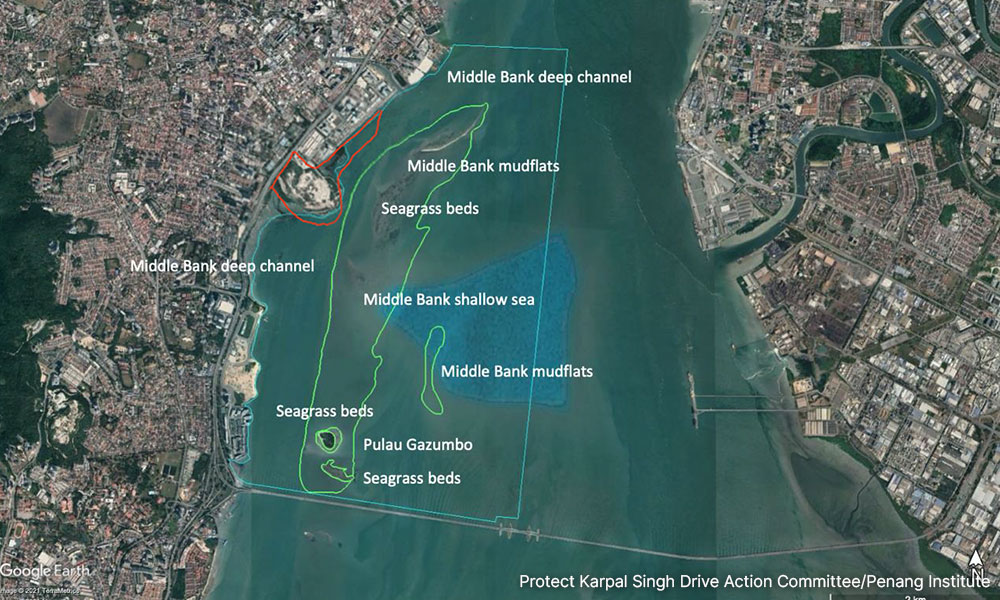
The core issue has never been about the project's branding; it is about the irreversible ecological devastation to the Middle Bank marine ecosystem and the severe public health risks of unearthing decades-old toxic waste to reclaim the sea area.
Reducing the size of the reclamation does not remove the hazard; it merely scales the devastation. Rebranding does not change the reality. We firmly reject any “incremental” approach to coastal reclamation.
2. Publish DOE rejection letter in full
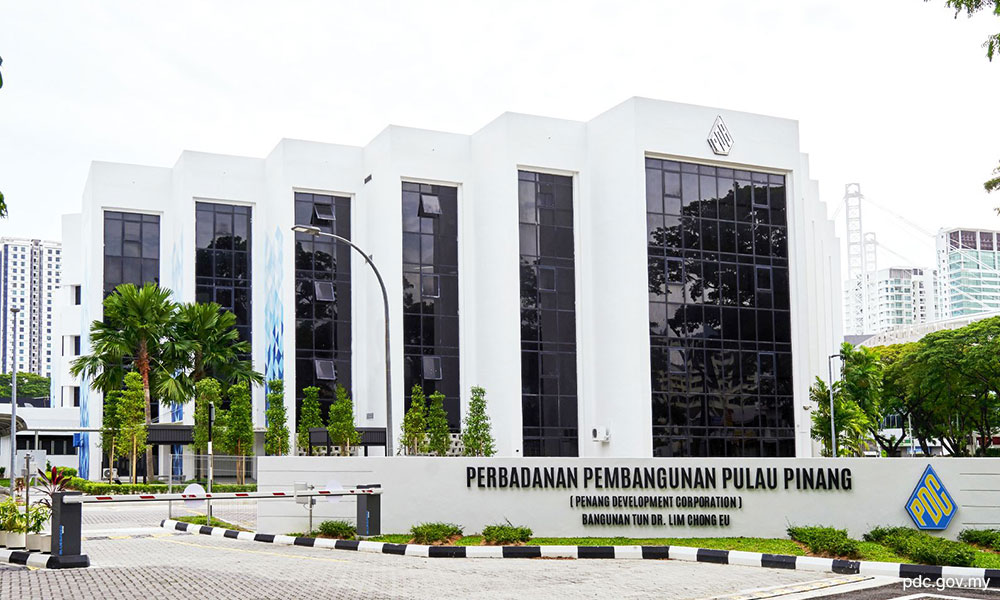
The chief minister reportedly stated that the Penang Development Corporation (PDC) must study the DOE’s letter in full before making recommendations to the state.
ProtectKarpal further questions why PDC has been tasked with studying the DOE’s rejection letter and recommending the next course of action, when PDC is itself the project manager and an institutional stakeholder in the project.
A party that is directly tied to the project’s implementation cannot be treated as a neutral interpreter of the rejection. Any review of the DOE’s findings must not be confined to PDC alone, but must include full public disclosure, independent expert scrutiny, and the formal participation of affected residents.
Therefore, if public resources are being used to review this failure, then the public must be granted immediate and unredacted access to understand the scientific basis of the rejection. ProtectKarpal demands the immediate publication of the DOE’s rejection letter based on three unassailable principles:
• Public accountability: Residents and civil society have a democratic right to know why a project of this magnitude failed four times. Environmental governance cannot operate on hints, fragmented disclosures, or selective executive summaries.
• Policy integrity: If the state is actively considering a “scaled-down” version, the public must know exactly what structural deficiencies and environmental hazards the DOE identified. Without this baseline data, there is no way to verify if the state is genuinely mitigating risks or merely looking for administrative loopholes to bypass the regulator.
• Restoration of trust: After years of controversy and repeated public assurances that the project would not proceed without EIA approval, transparency is the absolute minimum condition for credibility. The public cannot be coerced into accepting a reformulated proposal while the empirical grounds for the original rejection remain concealed.
3. Mandating democratic participatory governance
Aligned with the Madani government’s commitment to a democratic, inclusive, and transparent approach, the traditional model of top-down policymaking is no longer acceptable.
Therefore, ProtectKarpal demands that any plans regarding the Jelutong landfill must transition from mere “public consultation” to active participatory decision-making.
We demand that a formally constituted joint task force comprising state government and Penang City Council representatives, independent environmental and public health experts from local academic institutions, civil societies, and community representatives, including Persatuan Penduduk Bandar Sri Pinang Pulau Pinang, must be formed to determine the next steps.
The community bearing the primary risk must have a seat at the table where the solutions are drafted, not just a chance to view them after they are finalised.
Our uncompromising demands are as follows:
• No coastal reclamation by another name, size, or concept.
• Immediate, unredacted publication of the DOE’s rejection letter.
• The formal inclusion of ProtectKarpal and independent experts in all future decision-making processes regarding the site.
• A strict focus on resolving the landfill crisis through science-based, in-situ safe closure methodologies, completely decoupled from commercial reclamation development.
• Gazette Middle Bank as a marine sanctuary.
The people of Bandar Sri Pinang and Jelutong are entitled to clarity, empirical transparency, and a direct voice in their environmental future. They are entitled to the absolute assurance that a rejected, hazardous reclamation plan will not quietly return in altered packaging.
PROTECTKARPAL stands for the Protect Karpal Singh Drive Action Committee representing the communities of Bandar Sri Pinang and Jelutong, Penang. It advocates for transparent governance, evidence-based environmental policy, and the protection of community health and ecological integrity in Penang.
The views expressed here are those of the author/contributor and do not necessarily represent the views of Malaysiakini.
/file/publisher-c1a3f893382d2b2f8a9aa22a654d9c97/2025/03/2410a3f030acc8954b6beb2e2764a3bd.jpg)
/file/publisher-c1a3f893382d2b2f8a9aa22a654d9c97/2021/01/3a0b812279e2bb82b5ef35f930f64c40.jpg)
/file/publisher-c1a3f893382d2b2f8a9aa22a654d9c97/2024/07/57758aeba0e89efed59d725eb247982f.jpg)
/file/publisher-c1a3f893382d2b2f8a9aa22a654d9c97/2024/08/8d50d9d87a6f9fb7f903d3ad75ed2be7.jpg)


Report this comment
Are you sure you want to delete this comment?
This action cannot be undone.