




From FTA to Asean
When Commodore Matthew Perry anchored in Edo Bay in July 1853, he only had two things to offer the Shogunate: trade with Washington, or risk military action.
When Commodore Matthew Perry anchored in Edo Bay in July 1853, he only had two things to offer the Shogunate: trade with Washington, or risk military action.
A year later, Japan succumbed to the Commodore’s demands and opened several ports to the United States, granting it even the most favoured nation privileges. Why the Japanese did it is easy to understand: in 1842, Qing China signed the unequal Treaty of Nanking following its ignominious defeat in the First Opium War. Unable to match the US’ military might and naval technology, Japan had no option but to give in to the demands that many ultra-nationalistic Japanese still regard as preposterous today.
What happened subsequently is all history, but using trade for political and geostrategic purposes has long been a modus operandi by global and regional powers who can afford it. For some, gunboat diplomacy and even outright military attack are used just “to get things done”, such as Iraq in 2003.
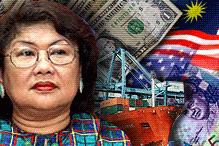 Last week, US chief negotiator Barbara Weisel cautioned that difficulties could arise if there was no conclusion on the proposed US-Malaysia free trade agreement (FTA) by the middle of the year given that the new administration would be formed after the November presidential election.
That Weisel was seeking to accelerate the rather sluggish progress is clear for all to see, prompting Rafidah Aziz, Malaysia’s Minister of International Trade and Industry, to respond by saying that there would be no deadline as it was vital to secure an outcome that both sides would be “happy with”.
The talks have hit a snag mostly because Washington hopes to include government procurement on the table, which could have grave implications for a country that sees its race-based affirmative as a sacred cow. Should the US have its way, one can assume many suppliers to be “unhappy”, while even more Umno cronies would be grumpy.
No doubt the Americans are desperate. The US dollar has lost much of its value, while interest rates do not rise sufficiently enough to choke off inflation. In the 1850s, the US forced Japan to open its door for trade because it was already producing more goods than the domestic market could consume. Now, Washington needs more overseas markets to help it cushion any potential crash and to tie smaller nations into its geostrategic arrangements. In a time and age when the world looks askance at wanton use of military force, a bit of soft power can sometimes goes a long way. Same objective, different approach.
Major strategic partner
And the US’ eye does not just rest on Malaysia, which is too small in the grand scheme of things anyway. Rather, it is Asean as a whole that Washington is most concerned about. Since the end of the Cold War, the region has transformed itself from a “beacon of stability” for the West to become a major strategic partner for various powers, with the US, China, Russia, India and Japan all vying for influence.
However, US pursuit of an Asean-US FTA is currently a non-starter due to the crisis in Burma. In the aftermath of the bloody crackdown on the public protests last September, the White House has been pressuring Asean countries to “do more” about the military junta sitting comfortably in Naypyidaw, Burma’s new capital. If not handled carefully, it could in the long run threaten the unity and cohesiveness of the organisation that is at pains to identify a new role in the vastly and fast changing geopolitical realities.
President George W Bush once extended an invitation for Asean leaders to his Crawford ranch in Texas to discuss US-Asean issues, an attempt clearly aimed at elevating US-Asean ties in the face of China’s growing influence in the region. For those desirous of vanity and glamour, such gesture by a US president is beyond their wildest dream. Only the most important and closest friends get to go to Crawford, and it would put US-Asean relations in the same category.
Asean leaders were somewhat cold to the proposal. After all, what kind of a message would they send the world if they were being toured around the Texan ranch by Bush without the presence of a Burmese leader? Hands Off My Bastard is bad and crude, but it is still better than showing the international community a disparate Asean.
With the Burma issue unsolved, Bush now seems to have dropped the ranch invitation.
By the way, it is incongruous for the Bush administration to insist on excluding the junta, for Jiang Zemin, the former Chinese president famed for human rights violations and keeping journalists in jail, was invited to the Texan ranch and served smoked beef brisket and pork ribs in October 2002.
Be so as it may, open trade is increasingly seen as the best response to the challenge of globalisation and cut-throat competition. In this regard, whether Asean, and Malaysia in particular, can withstand the pressure remains to be seen. One thing is certain: rushing ahead can only cause the regional grouping to fall into pieces, and all the effort to build a prosperous and strong Asean over the years will simply go down the drain.


