




Suharto's dubious legacy
Perhaps the only confusion that emerged in the aftermath of the death of former Indonesian president Suharto yesterday, were due to conflicting reports about how many names he had - one, like most Javanese, or two, prefixed by ‘Muhammad’.
The remaining details about his life have been plain and clear.
Suharto’s death merely ended his physical presence. His obituary is the kind which can be prepared in advance; the author only needs to fill in the blanks for the date and place.
Perhaps the only confusion that emerged in the aftermath of the death of former Indonesian president Suharto yesterday, were due to conflicting reports about how many names he had - one, like most Javanese, or two, prefixed by ‘Muhammad’.
The remaining details about his life have been plain and clear.
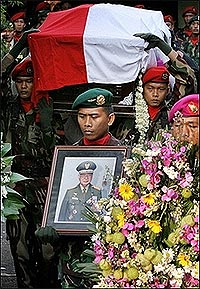 Suharto’s death merely ended his physical presence. His obituary is the kind which can be prepared in advance; the author only needs to fill in the blanks for the date and place.
He was effectively dead years ago after his fall in 1997 following pressures from both domestic protestors and his foreign protectors who turned into adversaries as soon as they realised that their blue-eyed boy was being cornered. While he was no more in action in the last decade since stepping down, the domino effect that occurs every time a tyrant leaves the scene has been felt throughout the Indonesian archipelago up to today.
The social and economic mess left by him will eclipse whatever ‘development’ was brought about during his era. Yet, whether or not Suharto lives on is irrelevant, even amidst all the noise to bring him to justice, a process which ultimately will end with him being pardoned by the current president.
Mainstream Western media will insert this information when reporting about his death: Suharto’s time saw some of the worst atrocities committed on the peoples of Indonesia. And what they will skip is this: that he was backed by the same Western powers which were celebrating his resignation during the peak of the East Asian economic crisis.
While the West pays attention almost entirely to his killings of his opponents, the invasion of East Timor, his desperate bid to hold on to West Papua as part of Indonesia - an inevitable duty being president - the fact is that the brunt of Suharto’s tyranny was targeted at Muslims both in Jawa and Sumatra during the longer part of his tenure.
In Sumatra (read Aceh), the West’s hand-in-glove campaign is well documented, especially in helping the Suharto dynasty suck out oil and reap billions of dollars of profit for Western multinational oil companies and Suharto juniors. Alongside enriching themselves, it also greased Suharto’s long and brutal campaign against Aceh fighters, whose aim had been to break free from the hotchpotch pancasila order imposed by Javanese leaders.
In Jawa, Suharto and his Christian military advisors had embarked on - only to fail to achieve the desired results - a grand Christianisation programme, building thousands of churches with funding from Western Christian missionaries, and de-Islamising the identity of Indonesian Muslims.
Rise to power
Suharto’s rise to power is the same old story; as with many other tyrants in the 20th century, the CIA’s footprints were all over it. As an ambitious military general, Suharto's rise became unstoppable after a failed coup in 1965 to take control of the army by communist party elements within the army who were aligned to Sukarno, then president whose overthrow was being planned by Americans for a long time.
Soon after being appointed minister and commander of the army, Suharto, backed by the CIA, began his first job to cleanse the army of communist members in a naked attempt to undermine Sukarno.
He was to literally conduct the cleansing process: with the help of militias armed by the West and his army, more than a million people were killed, and subsequently Sukarno found himself isolated, forcing him to formally hand over power to Suharto two years later.
Ties with Washington immediately improved, with millions of dollars of military aid being poured by the Americans to help Suharto's fledgling dictatorship. He handpicked judges and bosses of state-owned companies, held dubious elections and selected a third of the parliamentarians himself.
The communist-cleansing style killings which accompanied Sukarno’s fall became a cornerstone of Suharto’s rule throughout the next three decades. Although his fellow-generals lost political power after his political demise, they had briefly continued such crimes through the Indonesian National Army for a few more years even after his fall.
De-Islamising society
Parallel to the anti-communist campaign was the campaign to obliterate Islam from the political scene. This was hoped to be achieved by de-Islamising the Indonesian society altogether. Key to this effort was what came to be coined as Kristenisasi or Christianisation. The aim was far from converting people into Christianity, which was nothing new in the history of this region.
Rather, the hope was to undermine the Islamic identity through think-tanks and NGOs, as well as the establishment of hundreds of Christian institutions calling for ‘pluralism’ in a country which is overwhelmingly Muslim. In the 1970s amd 1980s, Sukarno extended the same brutal tactics to Muslim activists and intellectuals opposed to the pancasila , which is in fact another code name for the de-Islamisation campaign.
One common trait among Sukarno and Suharto, and about which the West has no problem, is their animosity towards Muslim activists eager to reestablish the Islamic identity of Muslims in the archipelago after centuries of plunder by Europeans, most notably the Dutch. Although both openly declared war on such Islamic inclination, added to Suharto’s tactics was subverting Islam through the use of ‘Muslim’ intellectuals and eventually, the de-politicising of Islam.
This naturally involved some sort of Machiavellianism to bring into his fold Muslim intellectuals and organisations, who had earlier been opposed to Sukarno, and whose leaders were jailed. With the coming of Suharto, some of these activists were released, including those of the Masyumi party, the core Islamic organisation that later broke up into several other Islamic groups, most notably Nahdatul Ulama, the largest Muslim body in Indonesia.
 Suharto was of course grateful to Masyumi leaders for supporting his coup against Sukarno. However, his conciliatory gesture came with a price: they were not allowed to involve themselves politically but were given all the help for
dakwah
purposes, effectively banishing Islam from the public life. Suharto also used such Muslim intellectuals as the late Nurcholish Madjid, promoting “modernisation, tolerance and pluralism”: the same three virtues that the current Bush administration of the US has been looking for in many “Islamic democrats” today.
Suharto was of course grateful to Masyumi leaders for supporting his coup against Sukarno. However, his conciliatory gesture came with a price: they were not allowed to involve themselves politically but were given all the help for
dakwah
purposes, effectively banishing Islam from the public life. Suharto also used such Muslim intellectuals as the late Nurcholish Madjid, promoting “modernisation, tolerance and pluralism”: the same three virtues that the current Bush administration of the US has been looking for in many “Islamic democrats” today.
Nurcholish’s most well-known remark which he made in 1972, “Islam, yes; Islamic parties, no”, is just the tip of the iceberg about how Suharto had engaged these “Muslim democrats” to pacify Islamic groups. At least during his rule, such a campaign met with some success, with Islamic groups being relegated to dakwah . They were tolerated, indeed encouraged, by Western governments, and funded by the Saudi lobby, most notably the Rabita al-Alam al-Islami (World Islamic League).
Re-energised groups
While these conservative ulama were slowly being converted to Saudi-Wahhabism and being de-politicised, ‘moderate’ spokespersons of Islam such as Nurcholish were busy promoting liberal Islam. In 1986, he established the Paramadina foundation. Its activities among others were running training centres and educational institutions, teaching ‘Islamic’ subjects such as law, philosophy and mysticism.
In its spare time, it organised forums and seminars in luxury hotels inviting neo-liberal Islamic scholars to speak. Its female students in the classes it conducted were free to wear short skirts, just one aspect of the kind of de-Islamisation sought by Suharto.
Today, many such institutions are being maintained, one of which is run by the daughter of none other than Abdurrahman Wahid, the leader of Nahdatul Ulama. In addition, many think tanks and ‘Islamic NGOs are aided by USAid and German-based Friedrich Naumann Foundation, which sponsor trips for budding ‘human rights activists’ and politicians in Southeast Asia.
A few years after Suharto, Nurcholish’s battle-cry was proven to be his own unfulfilled dream, when election results in 2004 showed an increase of votes that went to ‘radical’ Islamic parties - almost one-fifth of total votes. Islamic groups which had been pressed down for centuries by succeeding rulers in Java, re-energised like a rubber ball.
This has been perhaps the clearest change in Indonesian politics since the political demise of Suharto. The West, however, would not like to share the ‘democratic’ pie with Muslims. As such, it is no surprise that it is still pouring all its resources into making sure that only those Muslim ‘leaders’ whom they tolerate remain in the mainstream.
Indonesia is a region that gave birth to renowned Muslim scholars in Southeast Asia, and whose contribution and life-long dedication ensured that Islam became strongly entrenched politically and geographically. The Dutch, Sukarno and Suharto successively failed to alter this reality in the region, including in neighbouring Malaysia, Cambodia and Thailand.
Islam came a bit late to this part of the world, but when it came, it refused to leave and even became synonymous to the Muslims’ ethnicity. Little wonder that no colonial power or their colonial droppings have been able to subvert the Islamic character of the Muslims, whether in Indonesia or elsewhere.
Suharto’s failure is part of the same story. Now that he is not present, even physically, Muslims in Indonesia face the greater challenge of exorcising his ghosts that are littered among the many Islamic ‘mainstream’ organisations.
Learning from recent history such as in Iran and Turkey, this will happen within the not-so-distant future.
ABDAR RAHMAN KOYA is in his early 30s and works at an Islamic publication firm in Petaling Jaya.


Report this comment
Are you sure you want to delete this comment?
This action cannot be undone.