




When you believe your own spin
To hear Prime Minister Abdullah tell it, his government is ahead that of Japan, Germany and United Kingdom in terms of efficiency. He based this apparently on his reading of the 2007 World Competitiveness Yearbook compiled by the Swiss Business School, IMD.
To hear Prime Minister Abdullah tell it, his government is ahead that of Japan, Germany and United Kingdom in terms of efficiency. He based this apparently on his reading of the 2007 World Competitiveness Yearbook compiled by the Swiss Business School, IMD.
The man can hardly stay awake long enough to flip through the thick volume much less read or comprehend it. When he made that assertion to the assembly of civil servants last Monday, Jan 28, he was merely uttering what his ‘bright boys’ on the infamous Fourth Floor fed him.
That is scary. Those boys are now beginning to believe their own self-created legends and swallowing their own spin. If they truly believe that the Malaysian government is ahead of Germany, they must be hallucinating, a deranged state of mind brought on through their prolonged isolation from the real world.
A hallucinatory state by itself is not dangerous as long as you are fully aware of it. The danger comes when you believe it to be the reality. Indeed the criterion for psychosis (or in layman’s term, madness) is your inability to differentiate reality from delusion. When individuals begin acting on their hallucination, then all hell breaks loose.
They would then pose an immediate danger not only to themselves but also to society, and they would have to be committed to ‘protective medical custody’, an euphemism for the nut house.
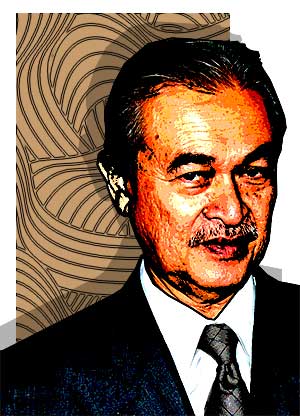 The absurdity of Abdullah’s claim is readily exposed by the manner in which he made his assertion. He chose his regular assembly of civil servants as the forum. This is his favorite mode of communication, a mass sermon. According to press reports, about 9,000 civil servants were ‘privileged’ to hear that special sermon from their leader. That represents the top one percent; presumably only the secretary-generals (KSUs), director-generals, and important department heads.
Assume that those top civil servants each make an average RM$15,000 per month (a conservative estimate) and with the normal working day of seven hours and 22 working days in a month, their time would be worth (or more accurately, cost the public) about RM100 per hour, at the minimum.
Abdullah took about an hour to deliver his speech. Of course, those civil servants would have to arrive early and then linger behind to socialise with their colleagues, including taking the obligatory group pictures. They would have spent at a minimum of two hours that morning just to listen to the prime minister’s homilies.
By my calculation, that morning cost the government (the public, really) in excess of RM1.8 million (RM100 per hour times 2 hours times 9,000 civil servants). In addition there would be the cost of using that massive auditorium and the video transmitting facilities so the speech could be beamed to the various state capitals.
The biggest cost however, is hidden. The whole government machinery was paralysed that entire morning. No important decisions could be made that morning as senior officers were out of their offices for the hour before and after the assembly and of course, during it. Where do you begin to quantify in monetary terms such a huge loss in productivity?
Chance to 'ponteng'
Unfortunately, these giant assemblies are a favorite with Abdullah. He loves the captured, doting and uncritical audience. That gathering reminded me of my weekly school assemblies, with the pupils dutifully lining up in straight lines under the strict eye of our prefects before we would march obediently into the school hall. Then after we were all seated, the teachers would stroll in, with the junior ones leading and the senior ones plodding behind, desperately trying to put some gravitas to their steps.
Likewise with this assembly of civil servants; first to enter the auditorium would presumably be the Superscale G officers (the lowest on the rung), followed by the F, E, and so on till A, meaning the KSUs and DGs. Then when they were all settled down, Abdullah would make his imperious entry.
 Everybody would, of course, rise and the applause would be long, loud, and sustained. The little fellow would slowly make his way up the stage, nodding, grinning and shaking a few hands along the way, albeit not so regally. Up on the stage he would continue his wide grin, lapping every moment of this effusive display of manufactured affection.
In scale and grandeur, such shows would dwarf what the North Koreans regularly put on for their ‘Beloved Leader’ ( pix ). The mindset, however, both among leaders and followers, is the same in both Pyongyang and Putrajaya.
In this day and age, a more effective way of communicating, and considerably much cheaper at that, would have been for Abdullah to videotape his speech and webcast it. Then civil servants or members of the public could hear it on their own free time. Of course, those civil servants would not like it. Part of the reason they relish those assemblies is that they get to ponteng (escape) from their offices.
Webcasting is how CEOs of large multinational corporations communicate with their far-flung employees as it is very effective.
Abdullah and his senior advisors are still stuck at the school assembly mode of communication. That is also reflective of the ‘school boy’ mentality of his advisors. It is ‘efficiency’ according to the wisdom of Abdullah Ahmad Badawi and his advisers. Unfortunately this is the kind of operational details that are frequently missed by foreign surveyors.
The IMD Yearbook report on Malaysia looks too good to be true. No matter how meticulous their research, those academics would have a tough time convincing Malaysians, especially those who have had any dealings with their government.
Yes, the Yearbook does say that based on certain specific criteria and prescribed framework, the Malaysian government is ahead that of Britain, Germany, and Japan. The big question is the relevance of those criteria and frameworks to everyday reality.
Dooming the country
When something is too good to be true, chances are it is not true. Regardless how impressive the credentials of those who made the assertions, if their reports or findings have - in Lord Bauer’s memorable phrase - ‘widespread disregard of evident reality’, we must not believe them. This applies not only to economics but also to everything else in life.
Abdullah and his advisors are banking that the average Malaysian would not have access to th Yearbook. They are right. At nearly RM3,000 for the cheapest print edition, few, if any, libraries would acquire the volume. Consequently, few Malaysians would have the opportunity to read the full report and scrutinise the criteria and framework. That is an important caveat.
 I can credibly make the claim of being the best surgeon if I choose my framework carefully, like for example, being the best surgeon this side of Coyote Creek, US. I may be factually correct but the issue is the relevance of that claim.
Malaysia has been favourably cited lately by two well-known international bodies. One was the earlier World Bank Report on our higher education, and now this IMD Yearbook on competitiveness. It is instructive that Malaysia had engaged both institutions to do significant consulting work - the World Bank on our higher education, and IMD on development in Sabah.
May I suggest to all, especially to foreign pundits and scholars, that the current circus that is the royal commission on the Lingam tape scandal gives a more realistic picture of the government machinery than the expensive IMD Yearbook. As for the World Bank Report, the government would have gotten the same ideas and recommendations by buying and reading my earlier book, An Education System Worthy of Malaysia . It would have been considerably cheaper too!
I fear that Abdullah, his advisors, ministers and senior civil servants would treat the findings of this IMD’s World Competitiveness Yearbook as an endorsement of their maintaining the present course. That would a guarantee for dooming the country to perpetual mediocrity.


Are you sure you want to delete this comment?
This action cannot be undone.