




Venturing into the great Unknown
My generation of Malaysians has indeed never experienced more exciting and fascinating political changes in the country until very recently.
No one would have imagined the decades-long Barisan Nasional rule in Kedah, Penang, Perak and Selangor could simply be brought to an abrupt end. For those who had lived through the tragedy of 1969, this was too nightmarish a scenario. When news of the opposition parties bagged victory in Selangor broke, there were voices of concern as to whether Khir Toyo, then the care-taker Menteri Besar, would relinquish power willingly.
After all, Khir Toyo had vowed to see "zero opposition" in the state assembly, and used all the administrative authority that he could get hold of to keep his cronies in power.
Thankfully, rational prevailed.
My generation of Malaysians has indeed never experienced more exciting and fascinating political changes in the country until very recently.
No one would have imagined the decades-long Barisan Nasional rule in Kedah, Penang, Perak and Selangor could simply be brought to an abrupt end. For those who had lived through the tragedy of 1969, this was too nightmarish a scenario. When news of the opposition parties bagged victory in Selangor broke, there were voices of concern as to whether Khir Toyo, then the care-taker Menteri Besar, would relinquish power willingly.
After all, Khir Toyo had vowed to see "zero opposition" in the state assembly, and used all the administrative authority that he could get hold of to keep his cronies in power.
 Thankfully, rational prevailed.
Malaysia is clearly going through the teething period, with leaders of the opposition parties struggling to rule states in what are perceived to be inchoate coalitions. Naturally, the unexpected scale of success has caught them off guard, with some realizing that they had most probably promised more than they could deliver.
Such ill-preparedness can be seen from Lim Guan Eng's first week as the newly elected chief minister of Penang. He first toyed with abolishing the deputy chief minister's post - something that I was personally against - only to execute a volte face by appointing two deputies, one Malay and one Indian. How on earth could Lim had failed to foresee the sure outrage of the Malay community is still perplexing to me.
Malay concerns
Then Lim, in a clearly populist move, waived all the summonses issued by the local councils in the state. But how would that solve the traffic congestion in Penang is everyone's guess.
So long as the DAP is unable to reach out to the Malay constituency, Umno-instigated demonstrations will continue, at least sporadically. The best way to discourage them is not to resort to the much discredited BN rhetoric that police permit should have been sought, but to come up with concrete policies to address Malay concerns.
DAP clumsiness is understandable given that the Chinese-based party had sort of given up on the Malay vote. Now, the Penang chief minister should learn to visit some mosques, religious/Malay schools etc. to fight back Umno propaganda through the unholy alliance of Utusan Malaysia, RTM and TV3 . Call it window-dressing, but it is a necessary step to take.
Why Gerakan did not face such dilemma? Because Dr Koh Tsu Koon was happy to play second fiddle to Umno. The DAP now has 19 members in the new state assembly, and none of them Malay. The party will need all the help that it can get from PAS and the PKR, not to kowtow to their Malay/Muslim leaders as Gerakan has done, but to build up a closer and mutually beneficial relationship.
Again, how Lim Kit Siang could have overlooked the important role that these two coalition partners can play in stabilizing the Malay/Muslim sentiments is beyond me. If the DAP top leadership is still haunted by their near meltdown in 1999, it does not deserve our support. PAS and the PKR, too, suffered merciless defeat in 2004, but they made a formidable comeback four years later, having learned their lessons and moved on.
The DAP made Jom Ubah! their loudest election slogan, and should now boldly shoulder the responsibility and change its mindset truly and deeply, even madly if necessary.
The DAP aside, another area of concern following the recent general election is the not-too-quiescent attempt by several royal households to influence political outcome. This is a serious issue that deserves much greater attention by the public.
In Perlis, Tuanku Syed Sirajuddin has acted against the advice of Prime Minister Abdullah Ahmad Badawi and appointed Md Isa Sabu as the new menteri besar. No doubt, not many would shed tears over the departure of Shahidan Kassim from the official residence in Kangar, but such blatant defiance of an executive advice only shows that the prime minister is losing his grip.
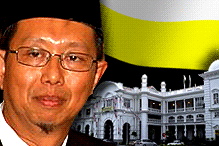 In Perak, the Regent Nazrin Shah had to step in and had all the 31 members of the state assembly of the ruling coalition to declare that they would abide by their collective choice of the new menteri besar, the multi-lingual Mohd. Nizar Jamaluddin. Since the new government only has a slim majority, this royal intervention may be able to prevent crossovers, but a bad precedent has been set and the people in Perak may have to bear some serious consequences in the future.
And it seems that the royal household of Terangganu wants its presence to be strongly felt too. Last week, the 23 BN state representatives were summoned for a meeting with the state's Regency Advisory Council, signaling some tussle between them. Why should the much-awaited swearing-in ceremony be postponed over and over again? I am no wiser than anyone on this but perhaps some old writing of Raja Petra Kamaruddin could be of some help.
And finally, the Selangor royal household made its voices heard again as it indicated that it would want the numbers between Muslim and non-Muslim state representatives to be equal, a blow not only to the DAP but the PKR also and another setback for Malaysian democracy should the new Menteri Besar Khalid Ibrahim give in.
Constitutional crisis
Last November, the Malaysian people openly called for the King to help put right the distorted electoral process. Some boycotted the idea for fear of creating a more powerful monarchy. Now some royal heads of the federal states appear to be demanding their pound of flesh.
Onn Yeoh calls this, amusingly, royal activism , but it is not entirely exaggerating to say that Malaysia is now on the verge of a constitutional crisis.
Democracy aka Thailand, in which popularly elected governments have been overthrown with royal connivance, is the last thing that Malaysians deserve after halting the nation's democratic erosion.
What lies ahead is the great unknown, but all the signs are that the prime minister is losing control faster than thought. His new cabinet lineup reveals more power struggle and opens more wounds within Umno, and some are ready to throw down the gauntlet.
Anwar Ibrahim, initially hoping to concentrate on consolidating the new governments in the non-BN-ruled states, now seems hard pressed to contemplate forming federal government in a matter of months.
We first saw denying the BN two-thirds majority as an insurmountable task, but have been pleasantly shocked and surprised. Are we ready to see the back of Umno soon? And are the opposition parities ready for a national takeover? Can the DAP set aside its anxieties over Pas and forge a common ground based on justice, tolerance and transparency?
Most importantly, would the nation send the racist alliance of Umno, the MCA and the MIC packing, only to see the royal households lurking in the shadows?


