




PAS needs power without politics
That there are now two ruling coalitions in Malaysia - respectively led by Umno and PKR de facto leader Anwar Ibrahim - aptly describes Malaysia’s post-election reality. For the first time, the opposition’s credibility is being put to test at the governing level.
The aftermath of the elections has become an open season for everyone, including Umno stalwarts, to turn on Abdullah Ahmad Badawi, with some even demanding his resignation.
That there are now two ruling coalitions in Malaysia - respectively led by Umno and PKR de facto leader Anwar Ibrahim - aptly describes Malaysia’s post-election reality. For the first time, the opposition’s credibility is being put to test at the governing level.
The aftermath of the elections has become an open season for everyone, including Umno stalwarts, to turn on Abdullah Ahmad Badawi, with some even demanding his resignation.
Several states retained by Umno have been embroiled in delays and crisis in forming their governments: even the sultans, who have traditionally listened to the prime minister’s recommendations, are for the first time using their constitutional powers to refuse Abdullah’s choice of state leaders.
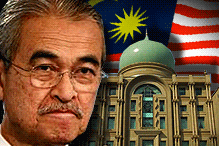 The opposition’s success has cost Abdullah many prominent ministers and party leaders, forcing him to trim the cabinet and for the first time admit mistakes, with even Umno stalwarts calling for reforms within the government.
Many attribute the success to Anwar and rightly so, especially after his intense campaigning, criss-crossing the country, which is typical of his modus operandi . His almost-one-man battle against relentless eleventh-hour personal attacks by the government media ensured a last-minute swing of sympathy votes from Malays.
Anwar was not abashed to admit this either: “Newspapers were full of vicious personal attacks against me, so I knew things had to be going well,” he told Newsweek .
The most painful reality for Umno, however, is the fact that Anwar has been able to return to mainstream politics, and that too on a multi-racial platform, a feat rarely achieved by opposition leaders because of racial prejudices that are exacerbated and exploited by the Barisan Nasional (BN).
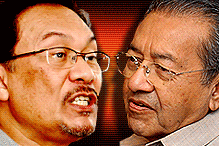 Anwar’s lifelong prime ministerial ambition, for which he was seen as a threat and punished by Dr Mahathir Mohamad, can now be regarded as an achievable possibility after years of uncertainty.
As if that were not enough to frighten Umno leaders who have tried hard to forget or ignore him, Anwar has been playing on the idea that he needs only 30 defecting MPs from the BN to form a federal government, a move many warn will backfire if what he claims is true. And even if this does not happen, there will be constant tension, as one observer puts it, from the fact that it might.
In tandem with Umno’s loss of five states, calls for ‘Malay unity’ have resurfaced. The move may be a veiled effort to woo Malay opposition members, especially from PAS, which is part of opposition-controlled states, to abandon their present coalitions and join Umno to form coalition state governments.
Owing to the victories of non-Malay candidates, the new coalitions have increased the non-Malay composition in the new state governments, spelling an end to Umno’s dominance via business contracts given to cronies who hitherto greased the party machinery.
Irony of gains
The possibility of PAS switching is remote, although not non-existent. It gobbled up almost all the seats in Kelantan, won control of Kedah, and its candidate became menteri besar of Perak although the party won fewer seats than its coalition partners.
Yet one of the ironies of PAS’s gains is that the party has become more defensive than ever about its Islamic commitments. Even before the elections, it had not taken such pains as now to explain that an Islamic state (which effectively means implementing Islamic policies, and not necessarily the implementation of Syariah or hudud laws) is not its aim.
 It was forced to lodge police reports against leaflets claiming that PAS will begin curtailing sales of alcohol and close gambling outlets, as it did in Kelantan. In Kedah, PAS controls a state which includes the popular tourist destination of Langkawi island, but leaders have been almost silent about any possible action to control the influx of tax-free alcoholic drinks for the tourism industry.
In Selangor, PAS’ participation is required to give the coalition a majority to rule a state which has in its economy the presence of one of the region’s largest breweries. Odd as it seems, the party appears stronger in exerting pressure over Islamic matters when it is in opposition; but it seems to be on the fringe when it is part of the government.
The fact that Anwar has sprung back to challenge the BN makes the question of PAS’ dependence on him ever more relevant.
 Not long ago, when pressed to answer this claim, PAS deputy president Nasharuddin Mat Isa explained that its strategy was drawn from the Prophetic example, in which the Prophet (saw) “used different strategies when addressing the Makkan and Madinan communities”.
In July 2005, Nasharuddin told this writer: “Our relationship with Anwar and the others ... is because we know it is quite impossible for PAS as an 800,000-member organisation to govern at the federal level.”
PAS is being forced to display ‘openness’ to maintain its fragile majority in several of the coalition state governments. While such openness is an attitude required from a Muslim party, it is not being displayed from a position of strength, nor from an Islamic moral high ground, but rather for political expediency, to deny Umno and its allies an opportunity to get back to power.
Its present share of power has been mostly due to the art of electoral politics. In order to be more effective and not only popular, PAS will ultimately have to generate power without politics: an exercise which requires far more commitment and solutions whose terms are longer than five years.
As such, the question posed in the conclusion to an earlier article is still valid, albeit with a new twist, that this time it is to be answered from a position of victory rather than defeat: what is PAS’s future role in a quasi-democratic, multi-racial, multicultural Muslim country such as Malaysia, now that it has met with some electoral success?
PAS’ answers will be seen in how it handles non-Muslim support in the new states, at the same time keeping its raison d’etre intact.
 The opposition may claim it has won the trust of the electorate; pro-government observers keep arguing that the results of the election were mostly a protest vote. While both interpretations may have some truth, the burden of victory on the opposition is heavier than the burden of defeat faced by the wounded BN.
The initial promises to pay more attention to people’s welfare, make large cuts on unnecessary luxuries and pledge zero tolerance on corruption, are positive steps. Any failure to improve things will mean not having such a chance again for a very long time.
After all, it’s not for every general election than an Anwar Ibrahim will be there as an alternative prime minister to show the opposition’s seriousness about forming a new government.
For now, it remains to be seen whether Malaysia’s small but uniquely crowded political landscape will be permanently altered.
ABDAR RAHMAN KOYA is former news editor of PAS organ Harakah . This is an edited version of an article written for London-based Islamic political newsmagazine, Crescent International .


Report this comment
Are you sure you want to delete this comment?
This action cannot be undone.