




Public transportation - an evaluation (Pt 1)
On March 4, I received a phone call from the Finance Ministry, asking me to create a report for the 2009 Budget. The topic of the report was ‘User's perspective on the state of public transportation - suggestions on how to improve it’. This report was presented to the Finance Ministry on April 7 and short-listed for discussion.
On March 4, I received a phone call from the Finance Ministry, asking me to create a report for the 2009 Budget. The topic of the report was ‘User's perspective on the state of public transportation - suggestions on how to improve it’. This report was presented to the Finance Ministry on April 7 and short-listed for discussion.
On April 21, I attended the Budget Consultation Meeting 2009, chaired by Prime Minister and Finance Minister Abdullah Ahmad Badawi, at the Finance Ministry in Putrajaya. While my report was not included in the topics for discussion, I did raise public transport issues during the open discussion session. I also managed to spend some time discussing the contents of my report with officers from the Finance Ministry, Rapid KL, and the Economic Planning Unit.
 What follows is part of the report which I submitted to the Finance Ministry. It has been edited for content and to make it more concise.
Introduction
In 2003, the government took steps to integrate ‘network thinking’ into public transportation by creating two government-linked companies wholly owned by the Finance Ministry. Syarikat Prasarana Negara Berhad was created to take over the assets of four public transport operators while Rangkaian Pengangkutan Integrasi Deras Berhad (Rapid) was created to operate and integrate these assets now owned by SPNB (now known under the trade name of Prasanara).
In other words, Prasarana would build or buy public transportation assets and Rapid would be responsible for the operation of these assets. Together, these companies would be responsible for the creation of a successful, integrated public transit network.
Issue – Inconsistent national standards and poor planning and regulation
The government’s plan for network integration has been a good idea in theory, but things have not worked out so well in practice. Rapid and Prasarana have improved network integration and operations but there are many ‘wild cards’ within the system.
One problem is the oversight and regulation of public transportation in Malaysia. Many different federal ministries, departments, and government-linked companies, as well as state and local governments are playing different roles.
The Commercial Vehicle Licensing Board (part of the Entrepreneur and Cooperative Development Ministry) licenses buses and regulates bus fares throughout Malaysia. The Transportation Ministry is responsible for maintaining the overall transportation network (which includes public transportation), but is generally not involved in the network planning.
The Economic Planning Unit (part of the Prime Minister’s Department) is responsible for the planning of infrastructure and development (including public transportation) but not operations.
The Finance Ministry controls the two government-linked companies, Rapid and Prasarana, which build and operate transit services. However, neither organisation has the authority or power to regulate service at a local level.
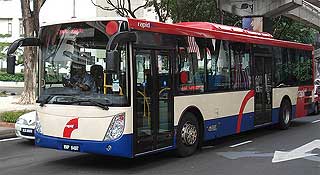 Finally, at the local level, there are different local councils, city xouncils and the Kuala Lumpur City Hall, all of which have a role in introducing public transit into their communities. Finally, there are the Road Transport Department and Royal Malaysian Police which (presumably) have the authority to enforce laws and ensure the safe operation of buses on the roads and expressways.
The point is that despite all the efforts that the federal government is making, there is still a huge tangle of bureaucratic confusion. In the long term, this will limit the success of any efforts to improve public transportation in Malaysian cities.
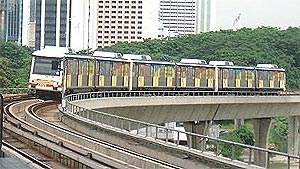
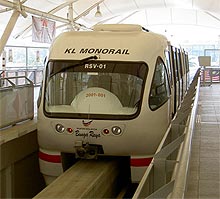
Because no single organisation has the power or authority to control operations, regulate fares, maintain service quality and promote network integration and future planning, the goal of integration has not yet been achieved. In the Klang Valley, the other bus and rail operators, (over one dozen bus operators, the KL Monorail, and the KTM Komuter rail service) are still operating independently.
Laws are still not being enforced and service quality is deteriorating. The government-linked service in Penang is being placed in competition with existing bus companies, but it is possible that service quality and enforcement will become lax after the attention of the public and the government is directed elsewhere.
It is easy to create new companies, buy new buses, introduce new routing systems, and announce grand plans, but until changes take place at the political level, these efforts will be largely wasted.
Step 1 – Reorganise and simplify
The Federal Government has stated a wish to encourage more Malaysian to use public transit. They have stated a goal of having 40% of the population using public transportation. If they wish to accomplish this goal, it is vital that the Federal Government reorganise and simplify the political organisation of public transportation in Malaysia immediately.
Fortunately the first step has already been taken with the creation of the Public Transportation Committee in the Cabinet chaired by Deputy Prime Minister Najib Razak.
Creating Local Public Transport Authorities would be the next step to carry out the vision of the government. However, it must be understood that improving public transportation will not be successful if it is only done in isolation or in response to local issues like traffic congestion.
This can be seen from the unsuccessful attempt by the Majlis Perbandaran Pulau Pinang to revamp public transportation in 2006, or the unsuccessful attempt to create a Klang Valley Transport Authority which has been talked about for many years.
 Attempts to create Local Public Transport Authorities have gone nowhere because there is no national vision or national standard for public transportation in Malaysia. Without a national vision and national standard, public transport will not improve. Without improvements to public transportation, there will be reduced mobility and this will in turn have negative effects on the economy and on communities throughout Malaysia.
What is needed now is to create a new National Public Transportation Authority (NPTA), answering directly to a Parliamentary Committee on Public Transportation. The National Public Transportation Authority would be modeled after other successful transportation planning and regulation bodies, such as ‘Translink’ in Vancouver, Canada, or the Land Transport Authority of Singapore.
The National Public Transport Authority would bring together representatives from within the Transportation Ministry, the Economic Planning Unit and the Finance Ministry. It would cut through the bureaucratic tangle and centralise the planning and regulation of public transportation throughout the country.
The ultimate goal of the NPTA would be to create a National Strategy for Public Transportation which would create national quality standard and integrate these standards with the National Physical Plan. The NPTA would promote and enhance public transportation by creating a complete National Public Transport Network with complete service in two zones - Peninsular Malaysia and East Malaysia.
Once the NPTA has established a national vision, the next step would be to restructure public transportation to focus on providing service to the people and improving their communities.
Step 2 – Build communities not businesses
The importance of public transportation within a community cannot be underestimated. Encouraging people to use public transportation is an excellent way to improve the cohesion of a community. However, for the majority of people in Malaysia, public transportation does not provide the convenience or reliability that they are looking for.
 There are many reasons why this is occurring, but a major factor has to be the way that public transportation is planned and regulated in Malaysia. The Commercial Vehicle Licensing Board, within the Entrepreneur and Cooperatives Development Ministry approves bus routes (and occasionally plans them) in Malaysia.
The reason why the CVLB is responsible for handling bus routes reflects the existing problem in Malaysia, which is that public transportation is viewed as a commercial activity, not a public service or a development tool. Because of this view, buses are viewed as commercial vehicles, and bus drivers as independent contractors or subcontractors.
This is good in theory, because it should generate competition which would keep prices (in this case, fares) low. Unfortunately, the government has acted to create a competitive system in the public transportation industry that is actually quite unfair and creates many problems with the quality of service.
MOAZ YUSUF AHMAD, a regular user of public transport, is deeply concerned that government plans to encourage the use of public transport will ultimately fail because of poor planning and lack of support from the public.


Are you sure you want to delete this comment?
This action cannot be undone.